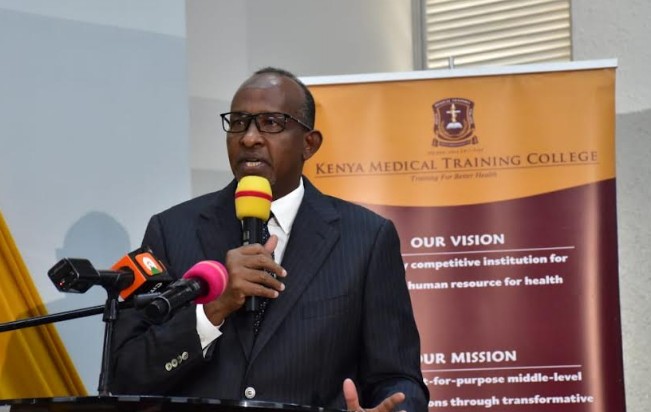
The Cabinet Secretary (CS) for Health, Aden Duale, has pledged the government’s unwavering commitment to improving medical education and healthcare delivery through research-driven policy, strategic partnerships, and equitable student support.
Speaking at the official opening of the 8th Biennial Kenya Medical Training College (KMTC) Scientific Conference, Duale emphasised the institution’s central role in the ongoing health sector reforms under the Kenya Kwanza administration.
“KMTC is not just for the ride. It is steering the way. From training over 107,000 community health promoters to anchoring primary healthcare services in all 47 counties, KMTC remains central to the delivery of affordable, accessible, and dignified care to every Kenyan,” stressed Duale.
Duale responded affirmatively on medical student training, stating that public teaching and referral hospitals under the Ministry of Health would immediately stop charging KMTC students for clinical rotations.
“That will never happen again. Kenyatta Hospital, KU Teaching and Referral, MTRH, and Mathari will not charge our students. We are also consulting the Council of Governors to standardise this across counties,” he assured.
Addressing student financing, Duale revealed ongoing efforts with the National Treasury to unlock Sh500 million allocated to support KMTC students.
“We are actively engaging to ensure this money is released,” he said, vowing that no KMTC student will be left behind.
Further, the CS emphasised that student support would be equitable and not determined by geographic or socio-economic factors.
On the other hand, Duale warned against the proliferation of substandard health training programmes in the country, insisting that transformative research cannot happen in isolation.
“Partnerships ensure our work is globally relevant and impactful,” he reiterated.
The CS at the same time cautioned some institutions whom he claimed are training graduates with little regard for quality or relevance.
“KMTC will not be part of this problem. Every course must meet a real public health need,” directed Duale.
He urged the college to maintain rigorous curriculum standards, strict admission criteria, and outcome-driven teaching in order to remain the national benchmark.
Duale further called on KMTC to explore sustainable funding through endowments, philanthropic partnerships, and alternative financing models.
“Let this not be a conference of good speeches and PowerPoints, but a turning point where science drives action,” he urged.
The CS assured participants that policy in the Ministry would be backed by data as he pledged to act on the outcomes of the conference.
“We must bring hope, trust, and order to the health sector. That is my mission,” asserted Duale.
KMTC Chief Executive Officer (CEO) Dr. Kelly Oluoch opened the event by expressing deep appreciation for the government’s support, adding that KMTC is strengthening partnerships with local and international organisations, including Africa CDC, the African Union, and universities in Canada and the U.S.
He highlighted the institution’s remarkable growth since its inception in 1927 with only four students to over 70,000 students across 90 campuses and six satellite centres.
“We do not see research as a thesis requirement but as a public health obligation,” stated Dr. Oluoch, disclosing that KMTC currently has 36 research presentations, including 11 posters.
Despite the progress, the CEO noted pressing challenges, including a staff shortage of 3,350 professionals, estimated to require Sh6.8 billion, and limited access to clinical training areas.
While noting that clinical areas have become competitive and expensive, citing increased charges by private institutions and public hospitals, Dr. Oluoch expressed gratitude towards the Government’s commitment to finding a solution.
In his remarks, KMTC Board Chairperson Joseph Cheruiyot reaffirmed the institution’s support for the Ministry’s leadership and the President’s health agenda.
“From the management to our gate officers, we are one team. We have psychologists and nutritionists ready to support you, Waziri, whenever you need to relax,” he expressed.
Meanwhile, speakers at the conference reiterated that research is embedded at the heart of KMTC’s strategic goals, emphasising that the institution has developed a comprehensive research and innovation policy and is investing in infrastructure to support commercialisation and intellectual property protection.
By Victor Kiplagat and Amina Bakari