The government is working towards addressing issues that are hindering the floriculture sector from playing its full potential in national economic and social development.
Agriculture and Livestock Cabinet Secretary Mutahi Kagwe said that he is in receipt of a memorandum from the sector players on the challenges, noting that together with the National Horticulture Standing Committee (NHSC), they will fully seize on matters and address them.
“As the issues are multiple and cross-cutting, we are taking a whole-of-government approach in consultation with the Investment, Trade, and Industry ministry, the National Treasury; the Kenya Revenue Authority (KRA); the Ministry of Transport; the Cabinet Office; Kenya Airways (KQ); and others to get lasting and holistic solutions, he said.
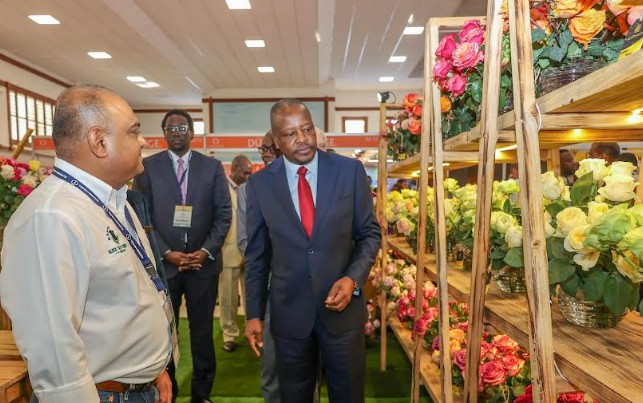
Kagwe, who was speaking on Tuesday during the opening of the International Floriculture Trade Expo (IFTEX) 2025 in Nairobi, noted that one of the key issues raised in the memorandum is the EU Regulation (2024/2004) compliance requirement for the export of fresh-cut roses to prevent the introduction of the False Coddling Moth (FCM) in EU territories.

“This requirement came into force on April 26, 2025. I am happy to note that the relevant authorities have developed, tested, validated, and employed the FCM Systems Approach (FCMSA) to comply with this requirement,” he said.
He added that the FCMSA has also received the approval of the EC Directorate General Food and Food Safety (DG-Sante), as the implementation of the FCMSA protocol went live on 25th April, 2025.
The CS further said that Kenya, being a member of the EU-Economic Partnership Agreement (EU EPA), a government delegation to the EU will be happening soon to discuss support for Kenya in the implementation of this protocol, especially for small growers, and other tariff and non-tariff barriers (NTBs) like the very stringent minimum residue levels (MRLs) and sampling levels.
“Our trading and development partners have an obligation to work with us in meeting these requirements. It cannot be one way.
It is a shared responsibility. This applies too for the climate change mitigation commitments and EU Deforestation Regulations (EU DR),” Kagwe said.
He added that his ministry is also in discussions with the Ministry of Transport, Kenya Airways (KQ), Kenya Civil Aviation Authority (KCAA), KenTrade, and Kenya Revenue Authority (KRA) on the high air-freight charges.
To expand the global market share, Kagwe said that they are collaborating with other specialist government agencies like the Kenya Investment Authority (KenInvest) and KEPROBA in exploring new markets for Kenyan products beyond the traditional destination markets.
“The demand for good-quality, traceable agricultural products is burgeoning, and this expo is more than a trade show—it’s a global marketplace of ideas, innovation, and investment. Here we will connect with 500+ international buyers, forge new partnerships, and explore novel markets, from the EU to the Middle East to Asia, as well as benchmark against giants like Colombia and Ecuador, thus elevating the Kenyan brand, which is synonymous with quality, reliability, and responsibility,” Kagwe said.
The CS said the government is committed to streamlining policies to slash the cost of doing business, investing in cutting-edge research to keep Kenya ahead, upgrading infrastructure from logistics to cold chain systems, expanding market access to new frontiers, and deepening public-private collaboration to ensure Kenyan floriculture remains globally dominant and locally transformative.
Managing Director of the Kenya Plant Health Inspectorate Service (KEPHIS), Prof. Theophilus Mutui, said that last year alone they inspected and facilitated exports of over 573,773 fresh produce consignments consisting of 240,000 tonnes of fresh cut flowers, 98,000 tonnes of fresh fruits and 130,000 tonnes of fresh vegetables and herbs with a total value of about Ksh 136 billion.
This contributed to over 200,000 direct jobs, touching the lives of over 4 million Kenyans and significantly contributing to the country’s foreign exchange earnings, he added.
To ensure sustained compliance, the MD said that KEPHIS has enhanced pest monitoring systems after the recent updated phytosanitary regulations in Kenya’s leading destination markets (European Union, UK, and South Korea), particularly in relation to FCM EU regulations, which came into force in April this year.
“Working closely with growers, industry associations, plant protection service providers, other government departments, and international experts, we developed and implemented the systems approach in compliance with the EU and UK phytosanitary requirements.
I am pleased to note that the systems approach is proving to be effective courtesy of our growers, who have deployed their energies to offer the best produce in the market.
Dick van Raamsdonk, president of HPP Exhibitions, organisers of IFTEX, said Kenya’s flowers tell a different story, one of beauty, excellence, and potential.
“They are not just a commodity; they are Kenya’s living brand ambassadors, spreading a positive, compelling narrative across the globe,” he said, adding that this year’s IFTEX has seen 12.5 % more growers compared to last year’s exhibition.
“There’s a total of 82 new growers in this year’s edition, and this makes a total of 189 exhibitors participating with stands from 18 different countries worldwide,” Raamsdonk noted.
The CS was accompanied by United Arab Emirates (UAE) Ambassador to Kenya H.E. Dr. Salim Ibrahim Binahmed Mohammed AlNaqbi and also Lee Kinyanjui, Cabinet Secretary for Investment, Trade, and Industry.
Kenya is the third-largest exporter of cut flowers globally, exporting to over 60 countries. The industry injects a staggering Sh100 billion annually into the economy. The industry creates over 200,000 direct jobs and sustains more than a million livelihoods through backward and forward linkages.
By Wangari Ndirangu