The national government will expend Sh500 million to accelerate rural electrification schemes in Tana River County, which will see 4,000 households connected to the national power grid.
The move is part of the Ministry of Energy efforts towards attaining universal electricity connectivity across the country by launching multiple high-impact rural electrification projects with a strong focus on renewable energy and off-grid solutions.
Remote communities in Tana River have lived without electricity for decades and have long awaited connection to the national grid.
Development experts have long viewed energy as a catalyst for economic growth and social progress, with stakeholders noting that Tana River has the largest number of people without access to electricity nationally.
Cabinet Secretary (CS) for Energy and Petroleum Opiyo Wandayi says the country looks to expand electricity access in some of the most underserved communities.
CS Wandayi emphasised that expanding access to energy remains a top priority of the government particularly for rural and hard-to-reach areas.
He reaffirmed the government’s commitment to rural electrification initiatives aiming to close the country’s electricity access gap.
Wandayi says the government will be lighting up villages in far-flung areas of the country by scaling up renewable energy programmes through the Rural Electrification and Renewable Energy Corporation (REREC).
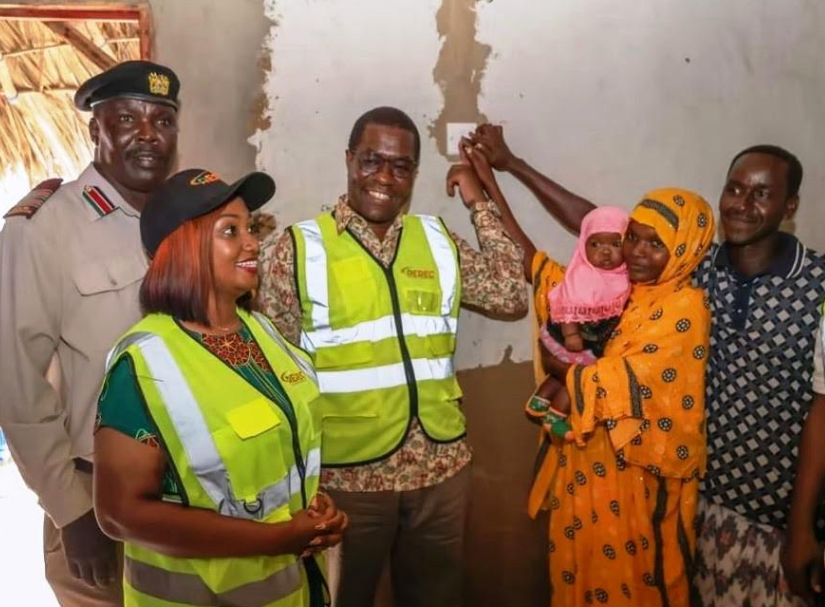
The CS who was accompanied by Garsen MP Ali Wario and REREC General Manager for Information, Education and Communication Beatrice Njuguna, was speaking when he launched rural electrification schemes in Gubani and Dibe settlements in the Garsen sub-county of Tana River.
In Gubani village REREC commissioned a Sh9.8 million electrification project which includes a 2.25km low-voltage line and a transformer which has seen 164 new customers connected to the power grid.
REREC also launched a Sh25 million electrification project in Dibe village, where 141 new customers were connected to power.
“These Garsen projects reflect the government’s vision of leaving no community behind in national development,” said Wandayi.
“It is the first time this rural electrification project is reaching remote areas of the country and in Tana River for instance, many communities have stayed in darkness for many decades,” he said.
He said the schemes mark a significant milestone in efforts to expand electricity access and improve the lives of rural communities who have long been in darkness.
Wandayi stated that the rural electrification schemes by REREC across the country align with the government’s aspirations for inclusive development and universal access to electricity.
“As a ministry we are lighting up villages, empowering communities and bridging the rural-urban energy divide,” he said.
The minister underscored the government’s determination to ensure that no community is left behind in the country’s energy transformation agenda.
“The rural electrification projects will enhance service delivery and stimulate economies in remote and historically underserved areas,” he said.
He said the new electricity connections will transform rural lives and benefit households, business centers, schools, and health centers thereby fostering inclusive development.
“The rural electrification schemes will provide a platform for improved education, healthcare and local enterprises,” he said, adding that household connections will open up economic opportunities and enable small businesses to thrive.
Wandayi said electricity is not just about lighting households but it is also about driving enterprises and transforming lives.
The CS said under the Kenya Off grid Solar Access Project (KOSAP), the government has also constructed five mini-grids in Tana River to enhance power access.
MP Ali Wario expressed confidence that the completion of the power projects will transform service delivery and boost economic activity in the area.
Ms Njuguna said REREC is launching major rural electrification schemes to power underserved communities through solar mini-grids and renewable energy solutions.
She called on residents in the Garsen constituency to protect the electrical equipment from vandalism and ensure its effective use for the benefit of all.
The REREC official said installation of electricity equipment was not just about power supply but also about investing in commerce and education by improving learning outcomes, healthcare, supporting agriculture and the overall wellbeing of the people.
She said REREC will collaborate with the Tana River devolved government to equip schools already connected to power with learning materials.
“REREC is undertaking high-impact rural electrification projects to broaden electricity access for communities in far-flung areas and enhance clean-energy provisions,” she said.
By Hussein Abdullahi