The government has unveiled an ambitious plan to establish a one-billion-shilling date palm industry across Kenya’s arid and semi-arid lands (ASALs).
This marks a strategic shift toward dryland agriculture as the country moves to unlock the vast, untapped potential of the regions that make up 83 per cent of its total landmass.
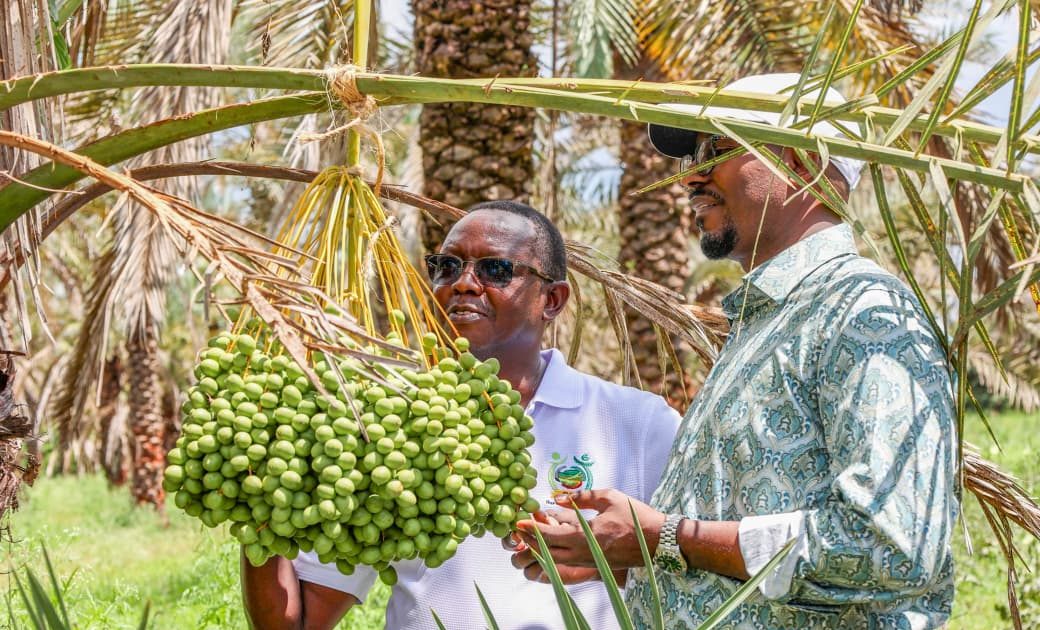
The initiative gained momentum during a high-level tour of Kutch Farm in Kibwezi, Makueni County, led by Agricultural and Food Authority (AFA) Director General Dr. Bruno Linyiru and Council of Governors Chair and Wajir Governor Ahmed Abdullahi, alongside technical teams from KEPHIS and KALRO.
The delegation inspected thriving Indian and Israeli date palm varieties as part of a broader government-led effort to fast-track Kenya’s entry into the global date value chain.
At the farm, officials observed date palms producing up to 200 kilograms per tree and reviewed the entire production cycle from selection of male and female palms and controlled pollination to irrigation, harvesting and value addition, underscoring the crop’s immense commercial promise for Kenya’s drylands.
The move comes at a critical time as climate change continues to disrupt rain-fed agriculture, reinforcing the need for resilient production systems tailored to ASAL conditions.
Globally, dates are a multi-billion-dollar commodity dominated by countries such as Egypt, Saudi Arabia, Iran, Iraq, Algeria and the UAE regions whose hot, low-humidity climates closely mirror northern and eastern Kenya.
Despite this natural advantage, Kenya produced just 1,100 kilograms of dates in 2023 and spent over Sh359 million importing dates in 2024, highlighting a significant gap between its potential to produce dates.
Government officials say this imbalance represents one of the country’s most promising opportunities to reposition ASALs as engines of agricultural growth.
The delegation also reviewed an innovative intercropping model where date palms are grown alongside mangoes, pixies, oranges, okra and other horticultural crops, boosting land productivity while providing diversified income streams for farmers.
For ASAL counties including Wajir, Mandera, Marsabit, Turkana, Garissa, Kitui, Tana River and Makueni, the government says commercial date farming could stabilise household incomes, reduce drought vulnerability and open new export markets. Dr. Linyiru emphasised that embracing dryland agriculture is now central to national planning.
“Eighty-three per cent of Kenya’s land is arid and semi-arid. If we are to fully tap our agricultural potential, we must invest in climate-smart agriculture and high-value crops suited to these regions. Date palms offer a clear opportunity to transform ASALs economies,” he said.
The initiative aligns with the Bottom-Up Economic Transformation Agenda (BETA) and the Frontier Counties Development Council (FCDC) framework, which prioritize high-value, climate-resilient crops. Premium varieties such as Medjool, fetching up to Sh 1,200 per kilogram on export markets, can generate Sh 3.4 to 4.4 million per hectare annually once mature.
With plans underway to expand certified nurseries, irrigation infrastructure, farmer training and value addition, the government is positioning date palm farming as a flagship dryland enterprise, one capable of transforming vast underutilised ASAL landscapes into hubs of sustainable growth and export-led prosperity.
By Charles Matacho and Gladys Nyambura, PCO