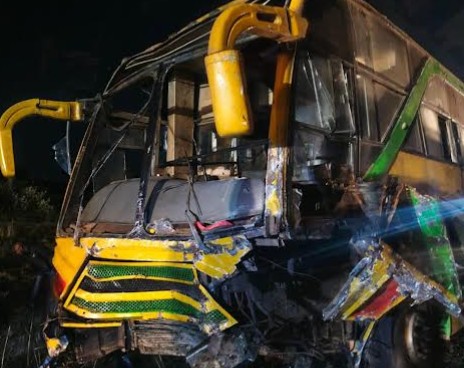
Nine people, including two minors, died in a tragic road accident involving a long-distance bus and a Nissan matatu along the Nairobi–Nakuru highway.
The crash occurred at about 2a.m. in the Kayole area, around 10 kilometres from Naivasha town, leaving several other passengers seriously injured as the country continues to grapple with a rise in fatal road accidents.
Initial reports indicate that a Greenline bus travelling from Western Kenya towards Nairobi collided head-on with a Nissan matatu heading to Nakuru. Six occupants of the matatu lost their lives on the spot.
Three more victims, including two children, were pronounced dead on arrival at Naivasha Sub-County Hospital, where the injured were rushed for emergency medical care.
Eyewitnesses recounted dramatic moments leading up to the crash, with Duncan Kirui, a passenger, noting that the bus driver attempted to overtake several vehicles at high speed before the collision.
He alleged that the driver appeared fatigued, having driven for long hours before commencing another journey, and attributed the crash to exhaustion and dangerous overtaking.
Emergency response teams comprising police officers, Kenya Red Cross personnel and county disaster units worked through the wee hours to rescue survivors trapped in the wreckage and clear the highway.
Naivasha OCPD Wilson Sigei confirmed the incident, stating that the bodies had been taken to a local mortuary while the wrecked vehicles were towed to a police station to aid investigations.
“We have lost nine people in this unfortunate accident. The increasing number of road fatalities is alarming, and we are appealing to motorists to exercise caution, particularly during night travel,” Sigei said.
The incident occurred barely two days after six people were killed in the Kikopey area of Gilgil following a separate collision involving a trailer and a Nissan matatu, further underscoring the Nairobi–Nakuru highway’s reputation as one of the country’s most dangerous road corridors.
The highway is a critical transport route linking western Kenya to Nairobi and carries heavy passenger, commercial and transit traffic around the clock.
Night-time crashes along this stretch have frequently been associated with driver fatigue, speeding, unsafe overtaking and poor visibility, contributing to hundreds of fatalities over the years.
Data from the National Transport and Safety Authority (NTSA) shows that by December 2025, Kenya had recorded an estimated 4,458 road accident deaths, up from 4,311 in 2024, representing a 3.4 per cent increase.
Pedestrians remain the most affected group, accounting for about 1,685 deaths in 2025, while fatalities involving motorcyclists rose sharply to approximately 1,148. Pillion passenger deaths also increased to around 432.
In response, the government has embarked on the expansion of the high-risk corridor, including plans to dual the multi-billion-shilling Rironi–Mau Summit Road, a move aimed at easing congestion and improving safety.
By Erastus Gichohi