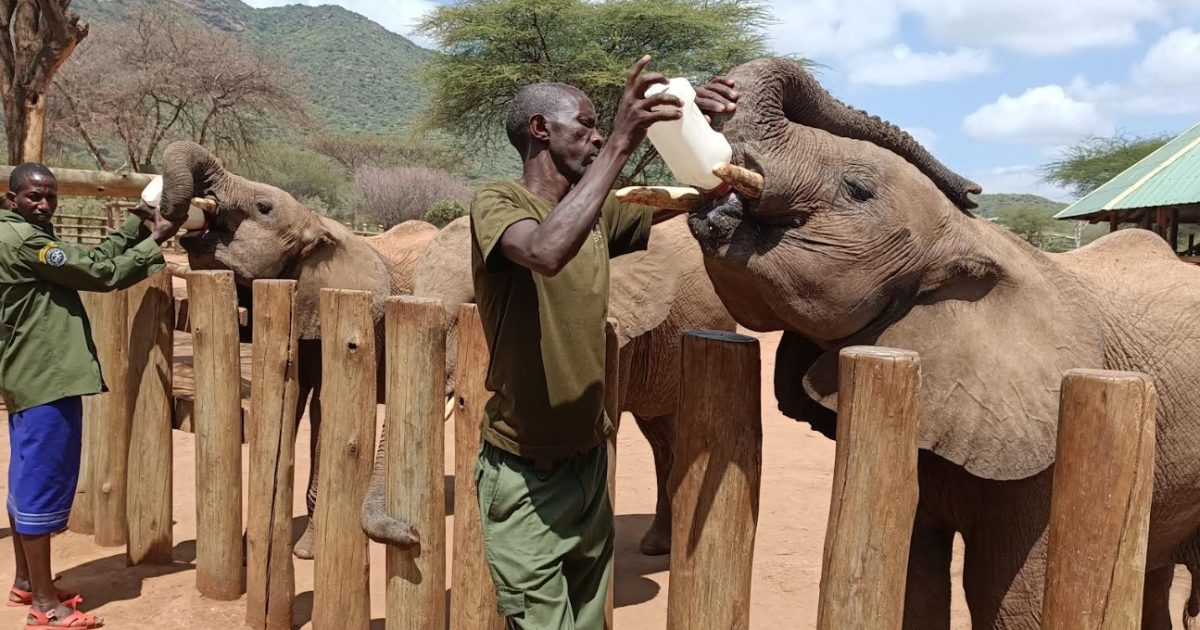
eep in the heart of Samburu county, within the lush Namunyak conservancy, lies a sanctuary dedicated to giving a second chance to some of Africa’s most vulnerable giants – orphaned elephant calves.
Established in 2016, Reteti Elephant Sanctuary is the world’s first indigenous community-owned African elephant sanctuary where orphaned and abandoned baby elephants are rescued, rehabilitated and later released into the wild.
With the support of the Kenya Wildlife Service, Samburu County and the Samburu community in Namunyak conservancy, Reteti elephant sanctuary is an excellent example of what locally led conservation efforts can achieve.
Russia Lenanyokie, a keeper at the sanctuary, explains that elephant calves become orphaned in several ways, including when their mothers die of natural causes or when they are separated from their herd, adding that most of the babies at Reteti are rescued after they fall into man-made wells when their mothers are looking for water.
He explained that during the dry season, elephants dig puddles on dry riverbeds from which they drink.
Guided by the elephants’ scrapings, Samburu families make the wells deeper to trap water overnight for their livestock and domestic use.
“At nightfall, wild animals stalk the wells, which get deeper as the dry season progresses and baby elephants desperate to drink sometimes lose their footing and fall inside the wells.
Once stuck in, it becomes difficult for the herd to pull them out and eventually they have to make the heartbreaking decision to move on,” Lenanyokie says.
“In the past, Samburu warriors tried to rescue the calves and after futile attempts, the babies were left for dead.
Today, thanks to the grassroots community movements in this region, they have the option to alert Reteti and ensure the calves are brought to safety,” he points out.
Lenanyokie narrates that once they get a call alerting them of an elephant calf in distress, they rush to the scene and hoist the calf to safety on the sandy riverbed and wait for the herd to return.
“Elephants are creatures of habit and more often than not, the herd will return to drink in familiar places and once they return, the calf is reunited with its herd.
We keep vigil for 72 hours and if the herd has not returned, we take the calf to the sanctuary, where it is examined and treated for any injuries, fed and a human mother is assigned to it,” he explains.
The keeper added that currently the sanctuary is home to 45 baby elephants of different ages that are fed goat milk at three-hour intervals throughout the day and during the night.
“After sharing the same habitat with elephants for many years, we realised that goats and elephants browse the same trees for food and that is why we feed them goat milk with additional supplements such as ground moringa tree leaves, honey, vitamins, algae and coconut oil,” he said.
Lenanyokie noted that the Samburu community has benefited directly from the sanctuary through the employment of 120 keepers and 60 per cent of revenue acquired through tourism is given back to society to build schools, bursaries and other development projects.
One of the main challenges the community faces is how to sustain the operations at the Reteti sanctuary and the entire Namunyak conservancy.
As a result, World Animal Protection has partnered with Reteti in a move geared towards giving rescued elephants a better life as they undergo the process of rehabilitation and rewilding by supporting veterinary care, the goat milk programme and a smooth rewilding process.
Research and Planning Manager at the World Animal Protection Dr. Patrick Muinde said that apart from funding the rehabilitation and rewilding process, their partnership is ensuring that 1,250 Samburu women supply the sanctuary with 1,000 litres of goat milk every day at Sh 180 per litre to keep the calves nourished.
After collection, the milk is boiled at 70 degrees to kill germs and then it is refrigerated overnight before supplements are added to it to increase its nutritional value.
“As an organisation we believe animals belong to the wild and we are glad to partner with Reteti because their main mandate is to rescue, rehabilitate and rewild animals,” he explained.
Muinde noted that the partnership comes as the dry season sets in, when more cases of calves being rescued are recorded and there is a need to support the sanctuary with more feed, water and veterinary services to enable them to continue with the rescue efforts.
Over the years, 26 elephants have been released into the wild, Reteti’s mission has grown, and the sanctuary is also home to rescued giraffes, ostriches, kudus, oryx and at one time a rhino and a buffalo, which were released into the wild.
By Robert Githu