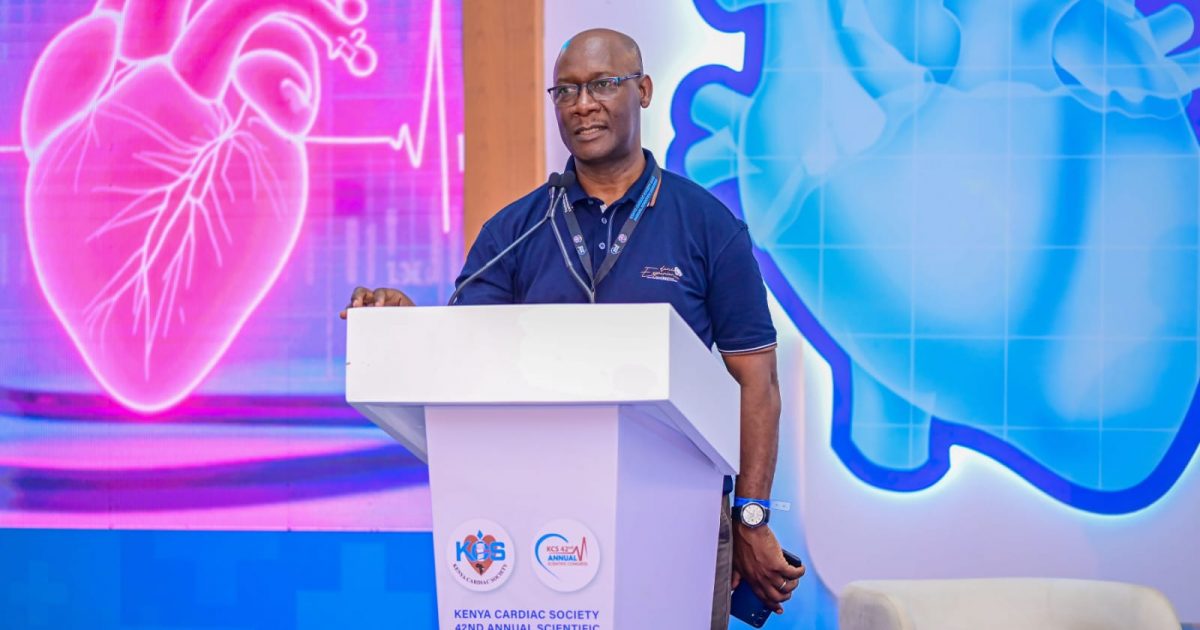
Cardiologists are being encouraged to adopt emerging technologies to enhance efficiency and extend healthcare services to remote and underserved areas, as it emerges that cardiovascular disease accounts for 10 per cent of deaths in the country.
Dr Bernard Samia, President of the Kenya Cardiac Society (KCS), highlighted that the medical profession has struggled with adopting digital solutions, partly because many healthcare workers are accustomed to traditional approaches.
“They need to inculcate these new technologies. The incorporation of these technologies into the existing healthcare system can now be quite robust, where certain hospitals already have a mechanism of how to care for patients,” Dr Samia said, on the sidelines of the KCS 42nd Annual Scientific Congress in Mombasa.
“When you add on these new systems that are not necessarily integrated, it’s like double work for the healthcare provider,” he added.
The society has conducted multiple community surveys to track cardiovascular disease trends and identify optimal management strategies.
The data help pinpoint gaps in diagnostic facilities, medication access, surgeries, and cardiac rehabilitation. The findings are then presented to policymakers.
“It helps in designing treatment algorithms and treatment guidelines that would then detect what kind of diagnostic facilities, clinical staff and support services should be available at every level of our healthcare, depending on the complexity of the disease,” Dr Samia explained.
Dr Gladwell Gathecha, Acting Head of Cancer and Non-Communicable Diseases (NCDs), revealed that 10 per cent of the national mortality is attributed to cardiovascular diseases, the highest burden among NCDs.
“It’s for this reason that we have seen it is business as usual. Things have to be done differently,” she said, adding that the Ministry of Health has sustained management of the disease at the Primary Health Care level.
The Ministry has also intensified health promotion through the Community Health Promoters (CHPs) and the school curriculum, cessation of smoking and alcohol, maintaining a healthy weight, exercising and eating a healthy diet.
To enable early screening, CHPs have been provided with a sphygmomanometer to check on blood pressure before referring patients with higher readings to health facilities for management.
“We have been able to empower Health Care Workers at Primary Health Care level to be able to manage complicated cases; for example, with hypertension, they can diagnose and they are also able to give the much-needed treatment,” stated Dr Gathecha.
She further revealed that the Ministry is embracing task shifting by capacity building of Clinical Officers to manage cardiovascular.
Through the reforms in the health financing landscape, now cardiovascular patients’ medical expenses can be taken care of by the Social Health Authority at a higher reimbursement rate in comparison to NHIF.
“We are doing this so that the patient doesn’t have catastrophic expenditures. This is a lifelong disease, and they need to be on medication and constantly follow up. Quite a number of these cardiovascular diseases may end up in surgical care, and there is an improvement in surgical care under SHA.”
By Sadik Hassan