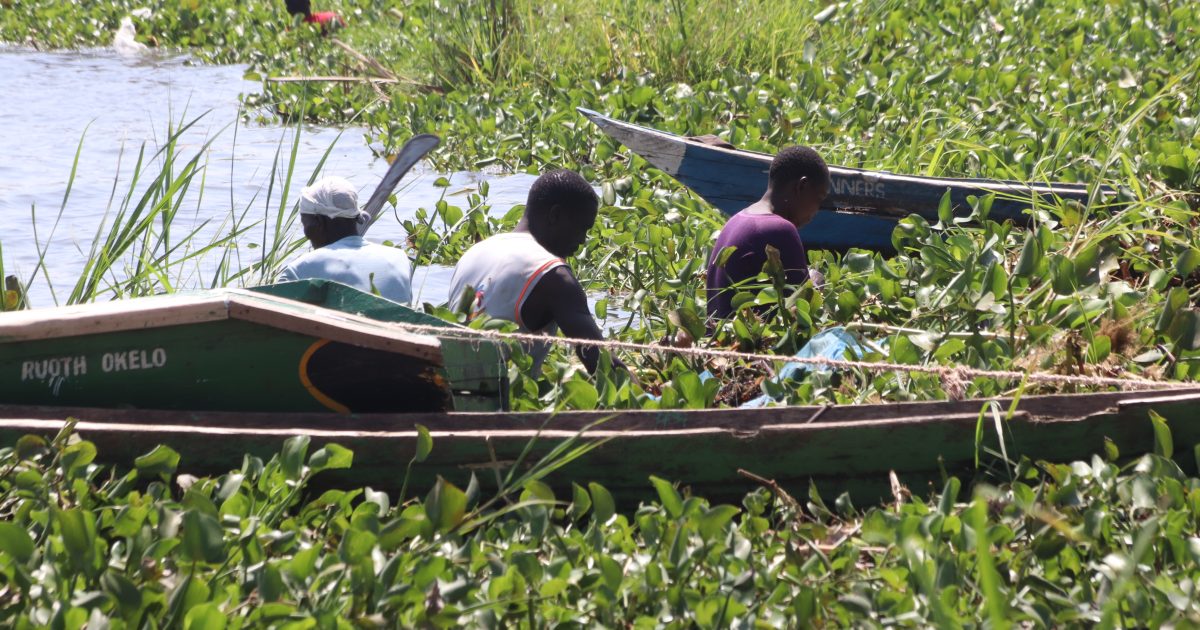
Along the shores of Lake Victoria on sunny morning, fishermen prepare to venture out to the lake, but they are confronted by a huge obstacle, the rapidly spreading water hyacinth.
At Koginga beach, the fishermen converse in low tones pondering their options as the weed builds up. They are deeply worried because the invasion is a threat to their livelihoods.
The stubborn weed has begun invading Kisaka, Ndhuru and Sikri beaches in Mbita Sub-county alongside Koginga, Angalo and Kananga beaches in Homa Bay Sub-county.
The parts of the lake invaded by water hyacinth look like a farmland with green vegetation. Some varieties of water hyacinth grow tall and appear like bushes.
For the past few years, the water hyacinth had moved away from the beaches of Homa Bay county, but they are moving back fast.
At Koginga Beach, we met Moses Mwai who was among the 70 fishermen, trapped in Lake Victoria for three days in 2012.
Mwai recounts how the government had to dispatch a helicopter from Nairobi to rescue them.
“Whenever I see water hyacinth, I get traumatized due to the ordeal we went through, being stuck in Lake Victoria for three days was a nightmare,” he said.
The fisherman says they endured rained, cold nights and scorching sun for the three days.
Mwai said the return of the weed has disrupted their fishing activities.
“We can longer fish normally because it has interfered with the movement of boats in the lake,” Mwai said.
Manoa, another fisherman lamented that the water hyacinth destroys their fishing nets causing them huge losses.
“Fishing nets are very expensive but the water hyacinth ends up destroying them,” Manoa said.
On the other hand, Richard Otieno, a seasoned fisherman complained that the weed leads to infestation of mosquitoes which cause skin irritation and eventually malaria.
“Malaria infection is very high along the shore of Lake Victoria during water hyacinth invasion. We have discovered that the water hyacinth is a fertile breeding ground for mosquitoes,” Otieno said.
The fishermen urged the government to come up with robust measures for eradicating the water hyacinth.
A fish merchant, George Oloo said fishermen should not continue suffering because of the weed.
“We call on the county government to collaborate with the national government to eradicate this weed from Lake Victoria. It is interfering with our economic well-being,” Oloo said.
However, for some the water hyacinth serves as a source of livelihood. They get young mud fish which are used for catching tilapia in the lake.
“The water hyacinth is full of young mud fish which we catch and sell at Sh5 each. This is a very lucrative economic activity,” said Sarah Achieng.
Ruth Onyango said the young mudfish had improved her livelihood.
“The young mudfish is a game changer in my life. I am assured that my children have food on the table daily from the sale of the mudfish,” Onyango says.
However, public health officials warn that the locals, mostly women, who wade into the water hyacinth to catch young mudfish risk contracting bilharzia and other infections associated with muddy waters.
By Davis Langat