Automotive industry players have commended the government for introducing enabling legislation that has revitalised the sector by promoting local assembly and the manufacturing of automobiles.
The review of legal and regulatory frameworks has led to a surge in locally assembled vehicles. The government has rolled out a raft of incentives to encourage local assembly, including tax exemptions on imported parts meant for assembly.
Government’s National Automotive Policy seeks to further support the growth of the industry. In addition, the State is considering the introduction of a Sh13 billion affordable credit financing kitty for automotive players.
To regulate the importation of parts such as batteries, it has also implemented incentives and tax measures, including the Duty Remission Scheme.
Isuzu East Africa Chairperson and Managing Director, Rita Kavashe, said over the last ten years, local assembly has witnessed tremendous growth, noting that seven years ago, 50 per cent of vehicles were imported and the other 50 per cent were produced locally.
“But because of good legislation, good regulation, and the introduction of assembly regulation in Kenya, more players have been enabled to come into the marketplace and start to do local assembly here in Kenya,” she stated.
“Government policy advocacy around Buy Kenya, Build Kenya has also enhanced and brought in additional production capacity in Kenya,” she added, also attributing the surge in local assembly to the leasing of motor vehicles from local companies by the state.
The leasing of motor vehicles by the government has bolstered local production and created thousands of employment opportunities. After the lease ends, the vehicles are sold locally as second-hand vehicles, reducing dependence on imported vehicles that are not produced for the country’s terrain.
“This has made it possible for the 50-50 split to transition. Now we are only producing about 85 per cent locally, and only about 15 per cent is being imported. The UD trucks, for instance, are being produced by Kenya Vehicle Manufacturers (KVM) in Thika.”
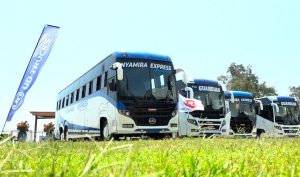
Kavashe spoke during a customer appreciation event in Mombasa, where Isuzu East Africa handed over nine premium locally assembled Quester UD buses worth Sh150 million to Nyamira Express Premium and Guardian Bus Company.
She noted that the integration of technology in the buses will give customers peace of mind, as the use of telematics will generate several reports that can be used for better management of the fleets.
The Isuzu MD further announced that from January 2026, 100 per cent of what Isuzu East Africa sells in the Kenyan market will be produced in their factory in Nairobi or associated facilities.
UD Trucks General Manager David Were explained that the buses are incorporated with an Anti-lock Braking System to enhance manoeuvrability for a driver and robust suspension systems for safety.
“On reliability, we have incorporated a lot of technology that helps the operation of the truck. The driver is able to get a lot of reports from the vehicle, which helps him to drive better. The management can see these reports and support data-driven decision-making,” said Were.
To enhance the comfort of long-distance drivers, the buses are fitted with air-suspended driver seats, and the driver is more comfortable and less fatigued.
“The rigidity of the chassis gives a more robust vehicle and a more comfortable ride for both the passengers and the driver.”
Nyamira Express and Guardian Coach Director Julius Mokaya said they want to leverage UD Trucks technology to enhance the operational efficiency of their logistics business.
“Fuel consumption, they have said, is good. Of course, we are going to confirm about it, the comfort and the rest. Of course, they have come timely during the peak season for us, so we are going to make sure that we support our customers to reach their destinations safely,” he said.
By Sadik Hassan