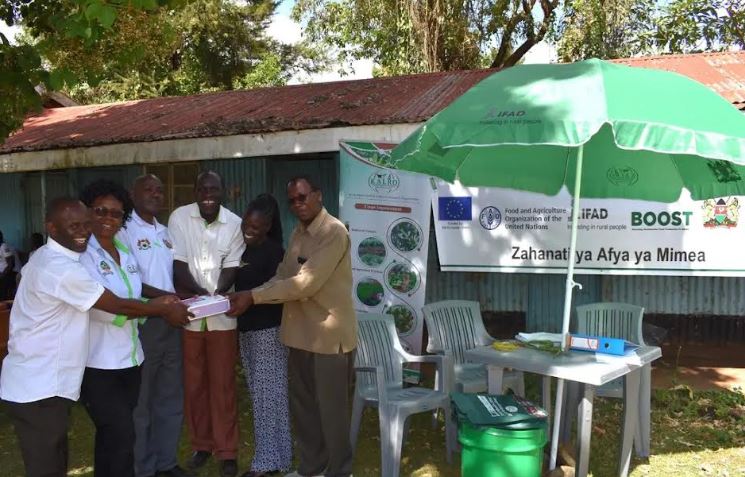
Homa Bay County has unveiled a new integrated plant health model designed to curb rising crop losses and strengthen food security through youth-led agroecology clinics.
The initiative, dubbed BOOST (Benefits of Optimal Sustainable Safe Technologies) project, combines pest and disease diagnosis, safe pesticide management, and sustainable farming practices to help farmers protect their crops while reducing production costs.
The project is supported by FAO (Food and Agriculture Organisation), implemented in partnership with the county government, KALRO (Kenya Agricultural and Livestock Research Organisation), and funded by the European Union.
Speaking during the launch of the project in Kendu Bay, Jimmy Mweri, an agronomist and FAO Lead Coordinator for the BOOST project said the new plant health clinics are expected to significantly cut the region’s persistent post-harvest losses, which currently stand at about 30 per cent, while offering farmers accurate, science-based solutions.
“We have today launched the plant health clinic but also hope for the farmers. The possibility of reducing post-harvest losses and increasing the income and food base for our farmers is essential. This integrated approach means farmers will no longer rely on guesswork to spray their crops,” he said.
Mweri added that the model is rooted in a youth-led agroecology service providers hub, transforming extension services into a sustainable, business-driven enterprise.
Youth experts will offer diagnosis, guidance and safe spraying services, ensuring long-term availability of extension support in rural areas.
“These youth are bridging the gap between demand and supply of extension services. For them it is business; for farmers it is access to solutions for pests and diseases,” he said.
He noted that the project promotes agroecology by minimising reliance on harmful external inputs and encouraging safe, appropriate interventions. Trained experts will also ensure banned chemicals stay out of farms.
Mweri said the project, which started in 2023, promotes a shift away from guesswork in spraying and excessive reliance on external inputs. With the new clinic, trained specialists will diagnose plant problems, recommend safe solutions, and ensure farmers abandon hazardous or banned products.
“This approach guarantees long-term food security, but the food safety attribute is very important,” he added, noting that service providers have been trained by the Pest Control Products Board on safe pesticide use, and by KALRO on Integrated Pest Management (IPM).
Margaret Makelo, Director in charge of Partnerships and Business Development at KALRO headquarters, said the clinics have been rolled out in four other counties, Nandi, Migori, Bungoma and Kakamega.
“150 experts have been trained across the five counties and will be deployed down to ward level. KALRO specialists will serve as consultants for more complex cases,” she said.
She informed that the clinics aim to reduce crop loss both in the field and in storage, while promoting environmentally friendly pest management.
“Some pests and diseases do not need chemicals and farmers need to know the right management practices. Pesticides must be the last resort. Good agricultural practices such as proper timing, spacing and seed selection can greatly reduce the need for chemicals,” she noted.
Makelo said the five counties will be assigned 30 experts each to work with farmers on plant health, who will diagnose diseases, give recommendations and even support farmers in management, including spraying, at a small fee.
Homa Bay Director of Agriculture Erick Adel hailed the initiative as a critical step in addressing the county’s high crop losses and limited extension workforce.
“We lose about 30 per cent of our crops to pests and diseases. If we can save this percentage, we will realise food security and improve livelihoods,” Adel said.
The agroecology hubs have been established in Rachuonyo North and Ndhiwa Sub-Counties, and will act as long-term service centres for farmers seeking plant health solutions.
He noted that with limited county resources, only one agricultural officer can be deployed per ward, and that the ratio of extension officers to farmers is one to 4000.
The new model, however, brings in 30 agroecology service providers in the two sub counties significantly expanding farmer support.
“The service provider hub is very critical. These trained experts will help us manage pests and diseases and support our food security mandate,” he added.
By Sitna Omar