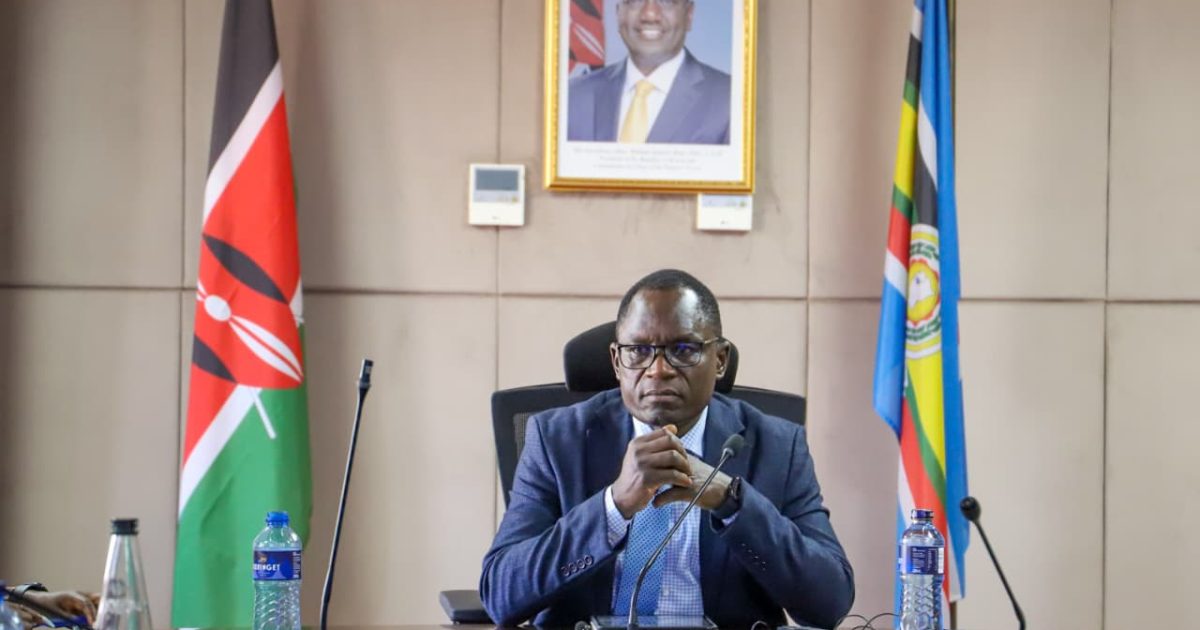
Principal Secretary for Broadcasting and Telecommunications Stephen Isaboke hosted a senior delegation from GSMA’s Global Spectrum team at his office, ahead of a high-level workshop on spectrum licensing and satellite technologies scheduled for tomorrow.
The courtesy visit focused on Kenya’s digital competitiveness, spectrum pricing reforms, satellite regulation, energy constraints in the telecom sector, and strategies to close the country’s 60 percent mobile internet usage gap, despite near-universal 4G coverage.
The delegation was led by Luciana Camargos, Head of Spectrum at GSMA Global, and included Ms Caroline Mbugua, Senior Director, Public Policy and Communications; Mr Luiz Felippe Zoghbi, Spectrum Engagement Director and Senior Policy Manager for Sub-Saharan Africa Mr Linus Melly.
Kenya currently boasts approximately 98 percent 4G population coverage, positioning it among Africa’s top digital performers and reinforcing its reputation as a regional innovation hub. However, stakeholders acknowledged that coverage alone does not guarantee usage.
“Kenya has built a strong digital foundation. Our next frontier is adoption and inclusion,” PS Isaboke said.
“Our responsibility as government is to ensure that every regulatory decision — whether on spectrum, licensing, or new technologies — directly addresses a national need. The question we must always ask is: what gap are we closing?” he added.
Despite widespread coverage, Kenya faces a 60 percent usage gap, meaning millions are within network reach but are not actively using mobile internet services. Without targeted interventions, studies suggest it could take decades to close this gap.
Camargos emphasized the scale of opportunity tied to predictable and affordable spectrum frameworks.
“If Kenya adopts international best practices in spectrum pricing, transparent roadmaps, and efficient licence renewals, the country could unlock up to Sh662 billion in additional GDP by 2028. The potential impact on jobs and tax revenue is significant,” she said.
The GSMA Digitalisation Report on Kenya indicates such reforms could also raise tax revenues by approximately Sh150 billion while accelerating digital adoption, innovation, and private sector investment.
Discussions also centred on emerging satellite connectivity and direct-to-device (D2D) services, which increasingly complement terrestrial networks globally. PS Isaboke welcomed innovation but cautioned against unintended market disruption.
“Innovation is welcome. Satellite technology can help us reach remote areas. But it must complement, not destabilize, the mobile infrastructure that already serves millions of Kenyans,” he said.
He stressed that new entrants positioning themselves as rural connectivity solutions must demonstrate clear rollout plans, measurable commitments, and alignment with Kenya’s universal service objectives.
Mbugua noted that Kenya has an opportunity to shape regulatory standards across Africa.
“Across Africa, satellite regulation remains uneven. Kenya can lead by developing a balanced framework that ensures coexistence between mobile and satellite operators while maintaining fair competition and long-term investment certainty,” she said.
The meeting also addressed sector cost pressures, including spectrum pricing and rising energy expenses linked to expanding digital services and data demand.
PS Isaboke signaled that any structured support measures would be performance-based and tied to measurable rollout commitments.
“If there is to be flexibility or structured support, it must be matched with clear timelines, coverage milestones, and accountability. Expansion must be measurable and aligned to national development goals,” he stated.
Senior Policy Manager Linus Melly welcomed the collaborative tone of discussions.
“What we are seeing in Kenya is constructive dialogue. The objective is not deregulation, but predictable and transparent frameworks that allow operators to invest sustainably while protecting consumer interests,” he said.
The meeting also explored the need for proactive communication of Kenya’s digital achievements, highlighting the country’s position as one of Africa’s leading digital economies.
Isaboke emphasized celebrating progress while candidly addressing reform areas such as spectrum policy and taxation saying, “We must celebrate what is working. At the same time, we must refine the areas that need strengthening. That balance builds credibility and investor confidence”.
The meeting sets the stage for tomorrow’s workshop themed, “Driving Digital Inclusion in Kenya: Effective Spectrum Licensing and the Role of Satellite Technologies.” The forum will bring together government officials, ICT leaders, and industry stakeholders to deliberate on transparent spectrum roadmaps, affordable and predictable pricing models, efficient licence renewals, regulatory integration of satellite services, and strategies to accelerate digital adoption.
With Kenya advancing its Digital Superhighway agenda, targeting 100,000 kilometres of fibre optic cable and digitisation of over 80 percent of government services, the discussions are expected to shape the next phase of the country’s connectivity policy.
“We must move deliberately to ensure no region, no community, and no citizen is left behind,” Isaboke concluded.
The PS was accompanied by Information and Broadcasting Secretary Temesi Mukani.
By Violet Otindo