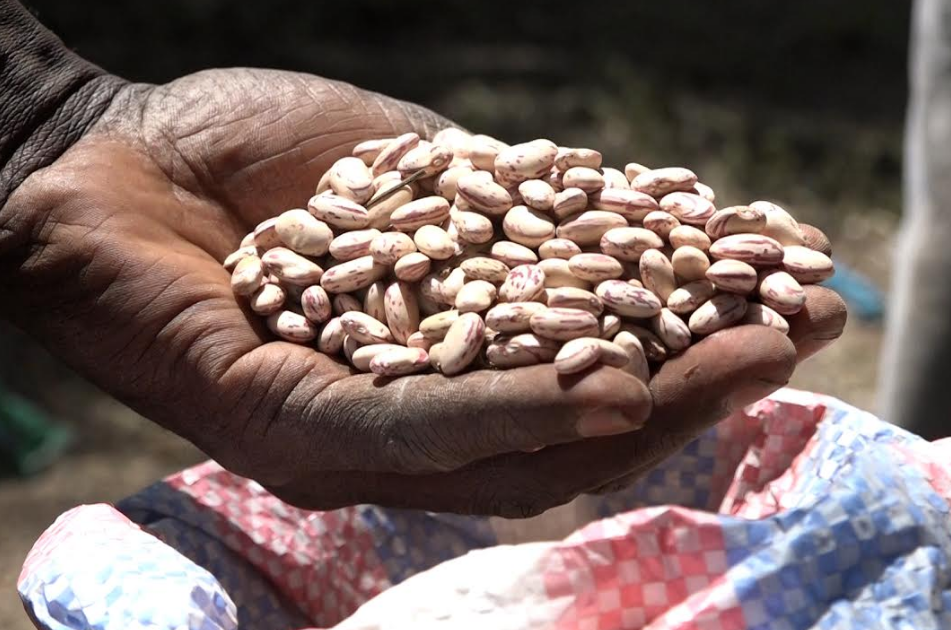
Kenya Agricultural and Livestock Research Organisation (KALRO) is partnering with the International Center for Tropical Agriculture (CIAT) to train over 15,000 farmers on proper agronomic practices for the ‘Nyota’ bean variety.
The initiative aims to boost productivity, promote climate-smart farming and help farmers cope with the impacts of climate change.
The programme, supported by the Pan-Africa Bean Research Alliance (PABRA), targets farmers from Njoro, Subukia, Rongai, Bahati and Gilgil Sub-Counties.
It focuses on training farmers on high-yield, disease-resistant Nyota beans, post-harvest management, market linkages, and export standards.
Alliance for Biodiversity-CIAT Senior Research Associate Mr Justin Mabeya Machini said climate change has increased the prevalence of pests and diseases that previously were rare, negatively affecting bean yields and farmers’ incomes.
“The initiative ensures farmers not only improve production but also access favourable markets. We are encouraging aggregation of produce through cooperatives to strengthen bargaining power and secure bulk sales to processors and buyers,” Machini said.
He explained that KALRO is exploring the creation of a bean value chain where farmers supply processors who convert beans into consumable products, including bean flour and noodles, thereby adding value and avoiding exploitation by middlemen.
The training also includes familiarisation with mandatory standards for local, regional, and European Union (EU) export markets. Machini noted this is crucial for tapping international markets.
He spoke at Kiambogo Centre in Gilgil Sub-County during an event that saw the official flagging off of nine tonnes of beans produced by the Ushirikiano Women Group, a cooperative of over 100 agribusiness women.

The group has been linked directly to buyers, ensuring value addition and fair pricing.
According to Machini, adoption of the Nyota bean variety is central to enhancing both yield and quality.
The red-mottled Nyota beans mature in 60–70 days, are drought-tolerant and disease-resistant, and produce 6–10 90 kg bags per acre.
They cook within 15–27 minutes, compared to up to three hours for traditional varieties, and are rich in nutrients.
“The fast-maturing and climate-adaptable Nyota bean improves household food security and nutrition while providing a marketable crop for farmers,” Machini added.
The variety, whose name means “star” in Swahili, was developed at KALRO Katumani and released for national trials and commercialisation in 2017.
It thrives in both hot, dry regions and cold highlands, making it versatile for small-scale and subsistence farmers. Unlike other varieties, it does not cause flatulence and can be easily pre-cooked for snacks.
County Chief Officer for Agriculture, Engineer Margaret Kinyanjui, said farmers are being trained on compliance with national and international regulations, post-harvest handling, and pre-harvest intervals to meet export requirements.
“Promoting this variety not only improves nutrition with high iron and zinc content but also enhances immunity and prevents stunted growth in children,” Engineer Kinyanjui said.
She noted that youth and women are primary beneficiaries, empowering them with technical skills and improving rural household incomes.
Kinyanjui cited alarming local nutrition statistics, noting that 27.9 per cent of Nakuru’s 275,921 children under five are stunted, 5 per cent are wasted, and 10.2 percent are underweight.
She said promoting the Nyota variety contributes to addressing these deficiencies while conserving energy and minimising deforestation, as the beans require less fuel to cook.
Despite being highly nutritious, Kinyanjui observed that per capita bean consumption in Kenya remains low, averaging 50–60 kilograms per year, partly due to the long cooking time of traditional beans.
The Nyota variety addresses this challenge.
Gender, Social Services and Inclusivity Chief Officer Ms Gladys Kamuren said the initiative prioritises women farmers, especially in rural areas, because they actively engage in agribusiness and can combine bean farming with other income-generating activities.
The Nyota variety was developed after extensive testing of 47 bean varieties across Kenya and Uganda, narrowing down to four varieties in Kenya and eight in Uganda, selected for their productivity, nutritional value, and adaptability.
KALRO aims to establish a national bean corridor, encouraging farmers with half an acre or more to adopt Nyota beans.
The organisation expects bean consumption in Kenya to double this year, meeting recommended micronutrient levels for zinc and iron, crucial for immunity and blood health.
A 2022 Kenya National Bureau of Statistics report highlights persistent nutritional challenges, with 18 per cent of children under five experiencing stunted growth and 42 percent of pregnant women suffering from anaemia.
Engineer Kinyanjui said the county government’s involvement is intended to increase rural household incomes, empower youth and women, and improve food security and nutrition while promoting climate-smart agriculture.
“Micronutrient deficiencies remain unacceptably high in Kenya. Adoption of high-nutrient, fast-growing, climate-resilient crops like Nyota beans will improve nutrition and incomes simultaneously,” she said.
By Esther Mwangi and Dennis Rasto