The Ministry of Agriculture, in collaboration with the private sector, has launched Kenya’s first fertiliser insurance programme, aimed at safeguarding smallholder farmers against climate-related risks and enhancing agricultural resilience.
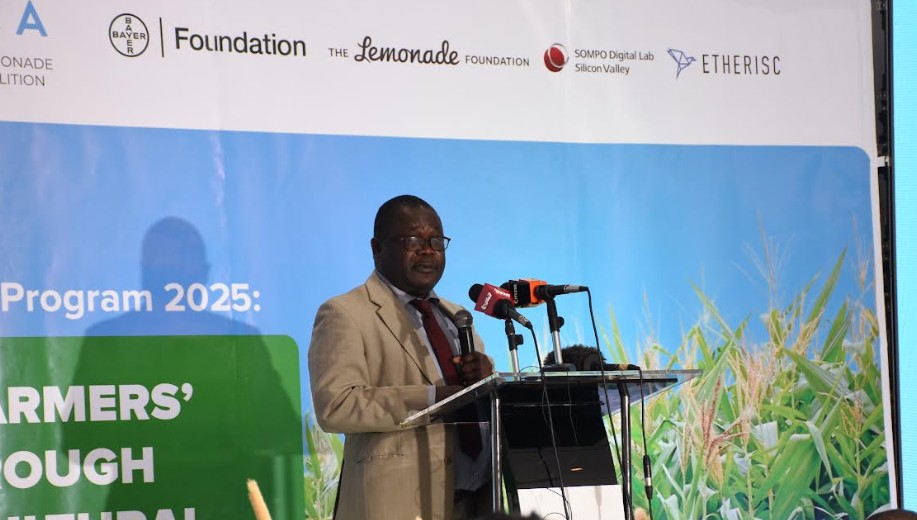
Speaking on behalf of Principal Secretary (PS) Dr Paul Kipronoh Ronoh, Tom Dienya, Director of Agricultural Data and Statistics, emphasised the role of data in transforming subsidy delivery and insurance efficiency.
“We now have a complete digital database of registered farmers. This enables transparency and ensures that services such as financing and insurance reach the right people,” he noted.
Dienya emphasised that this is not just a policy experiment but an important shift in agricultural support strategy.
“We are not only digitising input delivery but embedding resilience into every step of the process. This is the future of climate protection in agriculture,” he said.
This innovation is a collaborative effort between the Ministry and private partners, including Pula Advisors, Bayer Foundation, Lemonade Foundation, SOMPO Digital Lab, and Etheric.
According to the Ministry, the programme aims to support farmers affected by climate shocks such as drought and floods by bundling crop insurance directly into the purchase of subsidised fertiliser.
Each registered farmer under the Kenya Integrated Agriculture Management Information System (KIAMIS) in beneficiary counties will now receive automatic insurance coverage worth Sh 7,000, an equivalent value of two bags of fertiliser, during the current long-rain season.
The pilot counties include Makueni, Machakos, Kisii, Migori, Meru, Nyeri, Trans-Nzoia, Kakamega, Kericho, Nakuru, and Uasin Gishu.
The long-term objective is to de-risk farming at scale and integrate data-driven tools into input distribution systems.
Samuel Ndung’u, Managing Director of the National Cereals and Produce Board (NCPB), lauded the programme as a game changer.
“Embedding insurance into every bag of fertiliser is a masterstroke. The same product that helps farmers grow now protects them when things go wrong,” he said.
Ndung’u further outlined NCPB’s operational success, stating that the board had distributed 9.2 million bags of fertiliser during the current financial year, a record high.
“Our target is 12.9 million bags. This initiative takes us a step closer by not just delivering inputs but delivering hope and protection,” he added.
The insurance component is powered by Pula’s proprietary technology, including the Pula Insurance Engine (PIE) and Mavuno, an AI-based farmer registration platform.
In addition to that, these tools, combined with satellite, rainfall, and field data, allow accurate monitoring of crop performance and enable timely payouts in cases of loss.
“Together, we are transforming how agricultural subsidies work, this programme delivers dignity, resilience, and predictability to farmers who feed our nation,” said Pula CEO Thomas Njeru.
It is important to note that agriculture contributes 33 per cent to Kenya’s GDP and employs more than 70 per cent of the rural population; yet, fewer than 5 per cent of farmers have access to formal insurance.
Therefore, by integrating insurance into essential government services, the initiative is set to stabilise rural incomes and unlock investment opportunities.
“This partnership is about creating meaningful access to resilience; insurance shouldn’t be a privilege for a few but a tool that empowers underserved farmers, especially women and youth,” said Bayer’s Head of Public Affairs, Mildred Nadah Pita.
Additionally, the initiative will also benefit from mobile wallet integration, ensuring that farmers receive payouts quickly and transparently when losses occur.
“By leveraging digital infrastructure, we ensure timely compensation that truly matters,” noted Dimitri Fishler of the Lemonade Foundation.
As the government moves forward with the pilot, there is optimism that this model of embedded insurance can become a national framework for resilience.
With expanded rollout and public-private coordination, the Ministry aims to build a robust shield for smallholder farmers who remain at the frontline of climate impact.
By Kamau Daniel and Amina Bakari