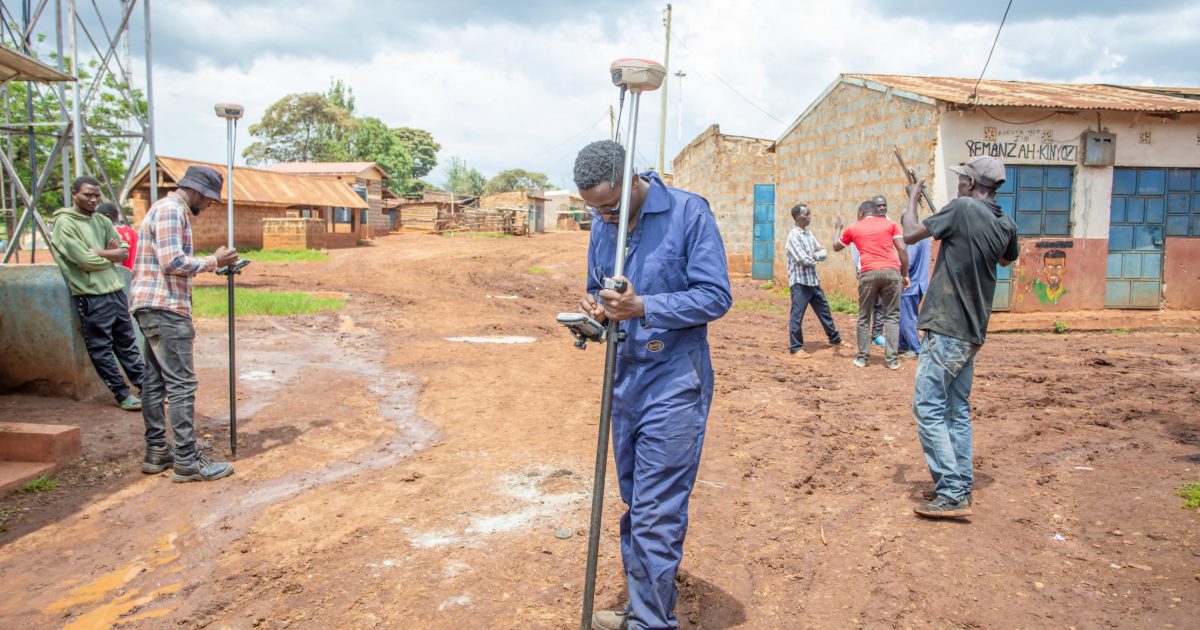
Kenya is inching closer to finalising a landmark border reaffirmation agreement with Tanzania, with over 558 kilometres of the 758-kilometre shared boundary already marked.
The exercise, which has been ongoing since 2021, aims to reaffirm the international border between the two nations to eliminate any ambiguities and enhance peaceful coexistence.
Leading a high-level government delegation to inspect progress on the ground, Deputy Head of Public Service Amos N. Gathecha praised the multi-agency team spearheading the effort, terming their work as very critical assignment for the government and for the people of Kenya.
Gathecha, who visited sections of the border stretching from Lake Jipe to Lake Chala, emphasised that the mission has far-reaching diplomatic and security implications, stating, “This is a collaborative effort between Kenya and Tanzania; once we finish, Presidents of the two countries will be able to sign an agreement to say that now the boundary is confirmed and we have no disputes.”
More than 80 officers drawn from the Ministry of Lands, Kenya Defence Forces (KDF), Immigration, and other agencies have been deployed in the exercise.
According to Gathecha, only around 100 kilometres, including lake sections, are remaining.
He expressed optimism that the remaining portion could be completed by the end of the year, allowing the heads of state to sign the agreement.
Standing near the clearly marked pillars that now mark the landscape, Gathecha highlighted the significance of the effort, noting that, “International boundaries are very critical because they are the ones that define the extent of the country and therefore, they become paramount when it comes to reaffirming them and making sure that we have very clear boundaries.”
Beyond the technical task, the Deputy Chief of Staff made a heartfelt appeal to local communities to safeguard the pillars.
“The most critical thing is for the communities living along the border to take care of the pillars. They should not destroy them because these are very critical features that define the two countries. So, we ask the populations that are living along the border to ensure that the pillars are not destroyed and they are kept as they are,” he said, stressing that the boundary markers are symbols of national sovereignty.
He further assured the field officers that he would push for more funding and recognition.
“When we get back to Nairobi, we will give a very strong justification for funding for completion, and when you finish, then we can justify telling the President these people have delivered.”
Head of the Kenya International Boundaries Office (KIBO) Juster Nkoroi, who is coordinating the entire exercise, lauded the dedication and patriotism demonstrated by officers working in often harsh and dangerous conditions.
“These officers have been sleeping in the bush for the last one month. They are walking hills, encountering snakes and wildlife, but they’ve displayed nationalism and love for their country,” she said.
Nkoroi emphasised that the reaffirmation goes beyond politics and maps, adding that it defines Kenya’s identity.
“The Republic is our mother. You will never have another one. This is the only country where you’ll be loved and taken for who you are,” she emphasised.
“Kenya is our home first and then we partition it into small places where each one of us now has a residence. So, it is very important for us to take care of our nation. It is very important for us to know where it ends and where it begins. It is very important to love and protect our country because the country is our mother,” she added.
She also clarified misconceptions around border operations. Contrary to fears that marking the border would limit cross-border movement, she explained that communities would continue interacting.
“We don’t disrupt the lives of farmers or communities. We only ask that they keep the vista clear for maintenance. If we find your house there, we don’t bother with it. We will put the pillar outside your house where it is supposed to be and let the communities continue living peacefully,” she said.
Technically, Nkoroi revealed that around 100 kilometres of land marking remains, while the 42 kilometres in water bodies like Lake Jipe would be handled differently, using control pillars on land to define the centre lines.
She also called for promotions and formal recognition of the officers who have worked under extreme conditions.
“If there is a group that deserves presidential recognition and a promotion, even if just one job group higher, this is the team,” she pleaded.
Surveyor Martin Dang’ana, representing the Ministry of Lands, has been coordinating field operations since the project’s inception.
He detailed the logistical challenges involved in transporting materials and building boundary pillars in difficult terrain.
“Getting materials to the construction points is the most difficult part. In some areas, workers carry cement in sacks for long distances,” he said.
Dang’ana also highlighted the importance of involving local communities in the process, stating, “The local communities have been benefiting by engaging them in the casual work and we also get artisans from the local communities.
We don’t pick from outside the local communities until we find maybe we don’t have a sufficient number. Also, our priority is to get construction materials from within the local sources. We only go externally when we are not able to find materials within. So that way the communities own up to the exercise and they even protect the pillars for us,” he said.
Despite the difficulties, the Surveyor affirmed the team’s determination to complete the remaining stretch.
“It’s not an easy task, but we are committed to seeing it through to the end,” affirmed Dang’ana.
Representing the Kenya Defense Forces (KDF), Major General John Nkoimo, the General Officer Commanding (GOC) Central Command, affirmed the military’s central role in the border reaffirmation exercise.
“For this particular task, we are a major stakeholder. Border security and external threats fall squarely under the purview of the KDF,” he said.
He noted that the military has been offering both logistical and technical support, ensuring that the mission runs efficiently and securely.
Their presence has also helped mitigate risks from wildlife and other hazards in remote border areas.
The reaffirmation of the Kenya–Tanzania boundary is not just a bureaucratic necessity but a deeply symbolic national project that blends law, diplomacy, and identity.
Over 6,000 concrete pillars, both primary and secondary, have been constructed since the beginning of the exercise, with each primary pillar costing approximately Sh30,000.
According to officials, the vast majority of the budget goes into mobilisation and logistics due to the challenging terrain.
If completed by December, the reaffirmation will culminate in the signing of a joint agreement by Presidents William Ruto and Samia Suluhu Hassan, cementing not just a geographical boundary but a powerful symbol of cooperation, stability, and shared history between Kenya and Tanzania.
By Arnold Linga Masila