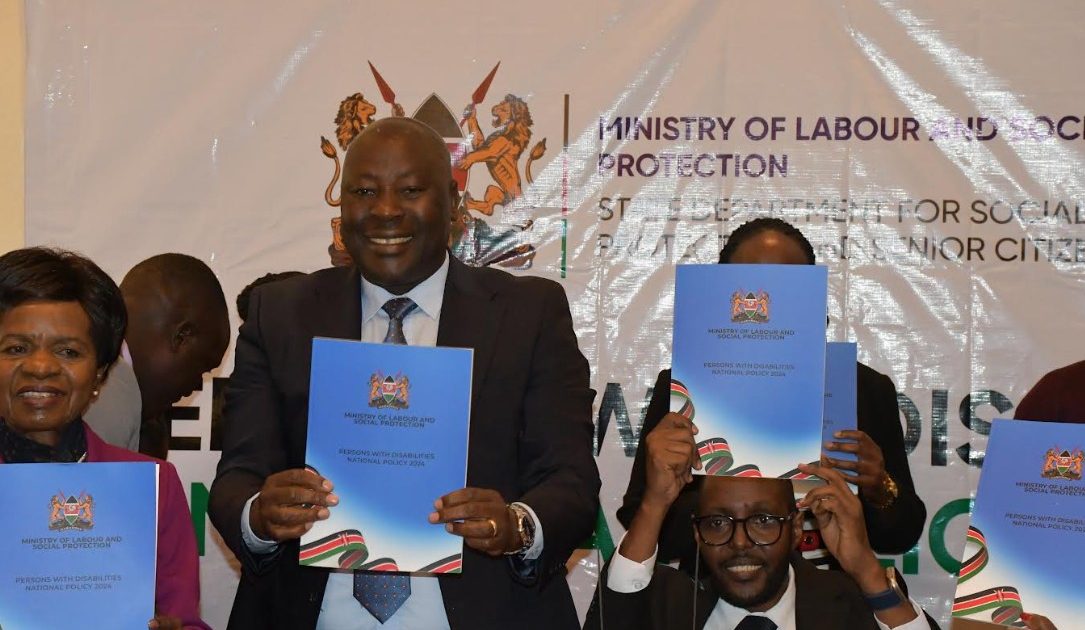
The government has launched the Persons with Disabilities National Policy 2024, signalling a transformative step towards realising equity, social justice, and full inclusion for Persons with Disabilities (PWDs) in Kenya.
Principal Secretary (PS) for Social Protection and Senior Citizens Affairs, Joseph Motari, who led the launch at a Nairobi hotel, acknowledged the contributions of veteran disability champions, including Professor Hassan Harun for the critical roles they played ahead of this milestone.
He also traced Kenya’s progress to other key milestones, such as the ratification of the UN Convention on the Rights of Persons with Disabilities in 2008 and the 2010 Constitution.
“This policy is about real, practical efforts such as expanding cash transfers, improving vocational training, and providing assistive devices to those in need,” stated Motari.
The PS criticised tokenism in addressing disability issues and urged all stakeholders to work towards genuine empowerment.
Further, he cited the new Persons with Disabilities Act 2025 as a critical breakthrough, replacing the outdated 2003 law and reinforcing legal protections, accessibility, and inclusion.
Additionally, Motari stressed the centrality of data in planning, announcing upcoming national surveys and a dedicated disability census. “We must integrate this policy into national and county budgets and work plans. Success will require urgency, dignity, and a shared commitment,” he urged.
Making his remarks, Harun Hassan, a Commissioner in the Public Service Commission (PSC), reflected on his long journey in disability advocacy, dating back to his time as Chief Executive Officer (CEO) of the National Council for Persons with Disabilities.
He cited key achievements such as decentralising medical approvals, enhancing stakeholder collaboration, and contributing to the passage of the Disability Act.
Hassan also emphasised the constitutional mandate for five percent representation of persons with disabilities in public service.
Furthermore, Hassan called for stronger inter-ministerial collaboration, urging sectors such as education, transport, and ICT to ensure inclusive infrastructure and service delivery.
“Everyone present today is an ambassador for inclusion in public service and governance,” said Hassan while he announced the formation of a new commission to fast-track disability inclusion.
Echoing similar sentiments, Eva Njoroge, CEO of the National Council for Persons with Disabilities (NCPWD), reaffirmed the government’s unwavering commitment to disability rights, noting that the policy aligns with international frameworks and Kenya’s legislative mandates, including the Persons with Disabilities Act No. 4 of 2023.
“Globally, 15 per cent of the population, that is, 1.2 billion people live with disabilities, and 80 per cent of them reside in developing countries. In Kenya, the 2019 census reported that 2.2 per cent of the population lives with disabilities, with 90 per cent either directly or indirectly affected,” she revealed.
In addition, Njoroge emphasised policy areas such as early identification, inclusive education, rehabilitation, access to justice, economic empowerment, and assistive technology.
She called for broad-based collaboration across government, civil society, and the private sector, insisting on the active participation of PWDs in all decision-making processes. “This is a living document that must be implemented with urgency and resolve. The Council is ready to lead,” declared the CEO.
In her remarks, Mary Mwiti, the CEO of the Council of Governors, underscored the alignment between the policy launch and the upcoming Devolution Conference in Homabay, themed ‘Devolution for People, Prosperity and Inclusion’.
On the other hand, Mwiti called for a clear description of responsibilities for the national and county governments to prevent duplication in programme implementation.
“Sections 4 and 5 of the new Act assign obligations to both levels of government. Without proper coordination, we risk overlapping efforts,” cautioned the CEO.
Further, she advocated for an intergovernmental framework that identifies the lead institution for each obligation.
Mwiti stressed that disability mainstreaming should go beyond specialised departments and be embedded in every sector from health and education to agriculture and transport.
“At the county level, we have tools such as County Integrated Development Plans (CIDPs) and civic education units. These must be used to embed disability inclusion in planning and public awareness,” directed the CEO, calling for a review of existing CIDPs and proposed guidelines to make them disability compliant.
“Let us harness devolved functions like culture and community outreach to change mindsets and eliminate stigma,” she added.
Meanwhile, the launch event marked a new chapter in Kenya’s efforts to create an inclusive society where all citizens, regardless of ability, can enjoy equal rights and opportunities.
The Persons with Disabilities National Policy 2024 is set to guide future action, but its success, as all speakers noted, will depend on multi-sector collaboration, sustained political will, and accountability in implementation.
By Rashid Naif and Wendy Sheilla