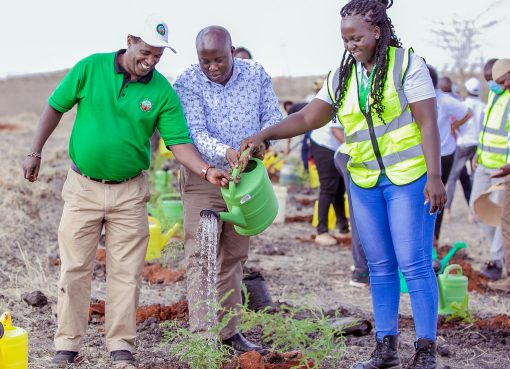
A new programme to restore and conserve the Mau Forest has been rolled out with the goal of restoring and protecting its vital ecosystem.
The ten-year ‘Mau Forest Complex Integrated Conservation Programme’ spearheaded by the State Department for Environment, Climate Change, and Natural Resources is said to build upon previous initiatives and focuses on community engagement, public-private collaboration and scientific planning.
The initiative that incorporates the County Governments of Nakuru, Kericho, Narok and Bomet; the Kenya Forest Service (KFS); Water Resources Authority (WRA); World Resources Institute (WRI); World Wide Fund for Nature (WWF); Kenya Wildlife Service (KWS); and other stakeholders aims to address threats like deforestation, encroachment, and unsustainable practices, ensuring long-term health for Kenya’s largest water tower and its surrounding communities.
Speaking when he hosted a delegation from the State Department for Environment, Climate Change, and Natural Resources, alongside representatives from various county and national government agencies to deliberate on the rollout of the Conservation Programme, Nakuru Deputy Governor David Kones said the strategy will include reforestation, community engagement, and promotion of sustainable livelihoods like beekeeping to reduce reliance on forest resources.
Kones elaborated that key components of the programme would include increasing agricultural productivity through climate-smart land restoration efforts and promoting environmental education and research to guide policy development and decision-making.
Schools, he added, will play a central role through the introduction of kitchen gardens and the strengthening of environmental clubs.
The 10-year programme, said Kone, will seek to enhance the functionality of the Mau Forest ecosystem through an integrated conservation model that he said was aimed at strengthening climate change resilience and improving the livelihoods of communities living around the forest.
“This project is aligned with the Climate Change Act and will focus on degraded landscapes in Molo, Njoro, and Kuresoi sub-counties within Nakuru County,” elaborated the Deputy Governor.
While indicating that the initiative was a landmark aimed at restoring and sustainably managing one of Kenya’s most vital ecosystems, Mr Kones voiced the County’s commitment to playing a leading role in the conservation of the Mau Forest, which he said serves as a key water tower for the region.
He underscored the importance of collaboration between stakeholders at all levels of government and the community in ensuring the success of the programme.
For decades, the Mau Forest complex suffered immense destruction from illegal logging, charcoal burning, and encroachment, with rivers drying up, rainfall patterns becoming erratic, and biodiversity dwindling.
Despite the devastation, local communities, conservation groups, and government agencies have united to reverse the damage to a once-pristine ecosystem.
Their collaborative efforts in reforestation, sustainable livelihoods, and conservation education are breathing new life into one of Kenya’s most crucial water towers.
The programme will also see Community Forest Associations and local communities working together to implement conservation strategies.
Encroachment, illegal settlements, unregulated grazing and logging have left more than 107,000 hectares of forest land destroyed, representing a staggering 25 per cent of the Mau’s total forest cover.
Director of Projects and Programmes from the State Department for Environment, Climate Change, and Natural Resources, Ms Vicky Betty Marisin, underscored the importance of restoring and conserving the water tower, as consequences of its loss will extend far beyond the Mau’s borders.
Ms Marisin noted that the water tower was once a steady source of rainfall and home to perennial rivers that sustained agriculture, wildlife and power.
She noted that the Mau Complex was the lifeline of rivers like the Sondu and Mara and numerous aquifers in Nakuru and streams in Njoro and Kuresoi sub-counties.
The Director was, however, happy that the initiative would help avert consequences of climate irregularities and biodiversity collapse that may yield ecological breakdown triggering water scarcity, food insecurity and economic losses across the country.
“We will continue and scale up a decades-long restoration effort pioneered by other programmes and initiatives,” the Director assured.
We’ve already seen what consistent community engagement, public-private collaboration and scientific planning can achieve. Now, we are formalising those efforts to ensure they last,” added Ms Marisin.
The Director indicated that the Mau Complex wasn’t just a forest but a lifeline and pointed out that it supports some of Kenya’s most iconic assets, such as the Maasai Mara National Reserve, Lake Nakuru National Park, the Sondu-Miriu Hydropower plant and the Kericho tea estates.
These sites, she added provides tourism revenue, jobs and food, and they also rely on predictable weather patterns and stable water flows, both of which, she observed, have been disrupted by environmental degradation.
The programme according to Ms Marisin, will support afforestation efforts with donated seedlings, map out degraded landscapes and develop sustainability plans with the county governments of Kericho, Bomet and Nakuru.
The official indicated that environmental education campaigns will also run parallel to enforcement, ensuring that forest management wasn’t punitive but participatory.
Ms Marisin was happy that the ‘Mau Forest Complex Integrated Conservation Programme’ was not starting from scratch but inherited a network of committed partners, including county governments, KFS, KWS, WWF and WRA among others, all of whom bring resources, technical expertise and political goodwill.
“The programme is here to ensure continuity, accountability and the long-term success of what is arguably Kenya’s most important forest restoration project,” she assured.
Nakuru County Executive Committee Member (CECM) for Water, Environment, Energy, Climate Change, and Natural Resources Dr Nelson Maara stated that the programme aims to address these challenges by strengthening community participation by empowering local communities to be stewards of the forest and promoting sustainable land use through the promotion of practices that protect the forest while supporting livelihoods.
Dr Maara indicated that the programme also incorporates environmental education and awareness initiatives targeting youth, cultural groups, and heritage conservation. The popular “shamba system”, he added, will be applied, allowing for intercropping within reforested areas while maintaining proper tree care.
The CECM explained that the project focuses on the restoration of riparian lands and forested areas, alongside sustainable waste management, particularly the reuse of agricultural waste to support a circular economy.
“Nakuru County, as the host and focal point of the programme, is poised to become a model for environmental restoration and climate adaptation in Kenya.
We are fostering partnerships through collaborations with various stakeholders to achieve conservation goals,” stated Dr Maara.
He said the programme aims to reverse the damage caused by illegal logging, charcoal burning, and encroachment, with communities actively participating in reforestation efforts.
Dr Maara noted that local communities, through Community Forest Associations (CFAs), are crucial partners in forest management, conservation, and monitoring activities.
He explained that the programme will support sustainable alternatives to destructive practices, such as promoting agroforestry and other income-generating activities that are compatible with forest conservation, adding that a significant component involves integrating environmental conservation into the school curriculum, aiming to instill a sense of responsibility and stewardship among young people.
By Esther Mwangi and Mary Ochieng