Kenya has taken a major leap forward in its fight against climate change and forest degradation with the official launch of the REDD+ Registry.
the inititative is an initiative designed to track, verify, and manage forest-based carbon credits under the country’s climate change framework.
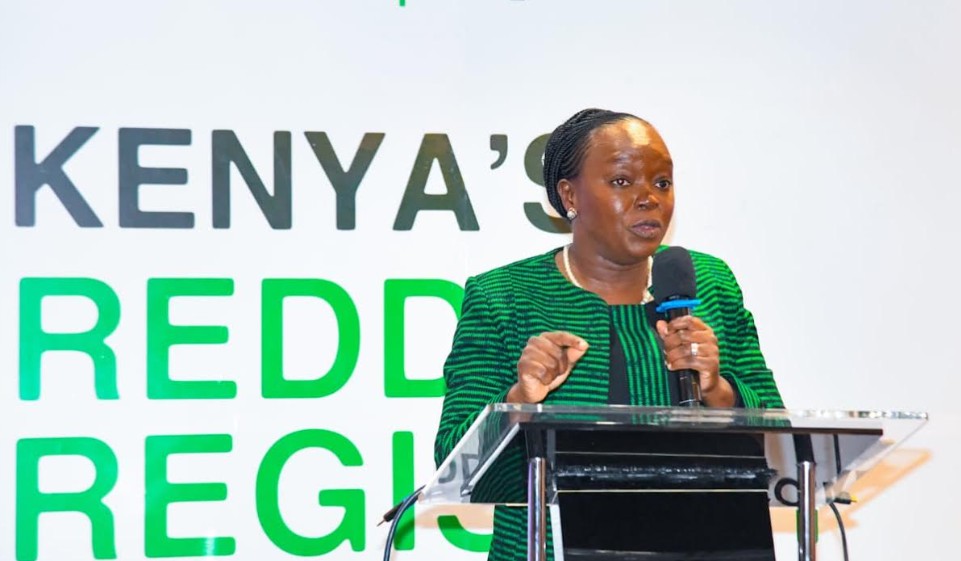
Speaking during the launch event, Cabinet Secretary (CS) for Environment, Climate Change and Forestry, Dr. Deborah Barasa, described the registry as a landmark achievement in aligning Kenya’s climate ambitions with inclusive development.
“This is not just a technical milestone; it is a national statement of intent towards environmental integrity and sustainable development.
We have crafted comprehensive documents and strategies over the years, and implementation is where the real impact lies, especially for the youth, women, and communities that depend on forests for their livelihoods,” explained Dr. Barasa.
The CS emphasised that the registry is anchored in the Climate Change Regulation 2024 and the amended Climate Change Act 2023 and it forms part of the national carbon market infrastructure, allowing Kenya to fulfil its commitments under Article 6 of the Paris Agreement through transparent, accountable emission reduction tracking.
She also urged for stronger inclusion of the Council of Governors (CoG) in the REDD+ implementation process, noting that county governments are critical in connecting national efforts to grassroots communities.
“The Council of Governors must be at the centre of this because they are our linkages to the people, and we cannot afford to leave them behind,” she reiterated.
Further, Dr. Barasa further disclosed that alongside the registry, the Ministry is launching REDD+ Nesting Guidelines, which will integrate community, NGO, and private-sector-led projects into the National Carbon Accounting System, guidelines she insists reaffirm Kenya’s commitment to Free, Prior, and Informed Consent (FPIC), equitable benefit sharing, and safeguards for carbon rights.
In addition, the CS thanked the British High Commission and Conservation International for their technical and financial support and applauded the efforts of her Ministry’s technical teams for steering the REDD+ process.
“As a Ministry, we will continue to monitor the outcomes of these tools to ensure they translate into improved livelihoods, environmental sustainability, and accountability in carbon trading,” assured the CS.
She at the same time reiterated the government’s commitment to advancing the Presidential Programme on growing 15 billion trees by 2032 and called on all stakeholders to embrace the REDD+ tools as a vehicle for driving climate-smart forestry and economic growth.
In his remarks, the Principal Secretary (PS) for the State Department of Forestry, Gitonga Mugambi, emphasised the need for inclusive dialogue and effective communication in the implementation of the REDD+ framework.
“We must not assume that everyone understands complex mechanisms like ‘Rent Plus’, and experts need to simplify their language and ensure that information is accessible to all stakeholders,” he said.
He continued, “Let’s bring all players, community members, project developers, county governments, and conservationists into this discussion. We need to know their expectations, challenges, and how we can support them.”
Meanwhile, concerns raised during the forum included the need for transparency in carbon transactions, capacity building for local communities, and ensuring that forest conservation supports livelihoods rather than displacing them.
Speakers, including representatives from civil society and the Kenya Wildlife Conservancies Association, stressed that communities must see tangible benefits from carbon credit schemes if such programs are to succeed.
In response, the PS noted, “This registry is more than a database; it’s a symbol of fairness, opportunity, and responsibility, and it demonstrates the government’s unwavering commitment, under the leadership of the President and our CS, to balance environmental conservation with economic empowerment.”
Moreover, Mugambi affirmed that the REDD+ framework complements the Presidential Programme to grow 15 billion trees by 2032 and promotes landscape restoration while unlocking climate finance for communities living adjacent to forests.
As Kenya positions itself as a regional leader in climate action, the REDD+ Registry is expected to play a central role in unlocking climate finance, restoring degraded landscapes, and empowering communities to participate meaningfully in forest conservation efforts.
By Amina Bakari and Wendy Sheilla