Whenever the word “WiFi” is mentioned, the immediate thought that comes to many people’s minds is a wireless access technology that allows devices to connect to the internet without physical cables.
Initially, WiFi technology was developed by the government to allow devices such as computers, mobile devices and other equipment, such as printers and video cameras, to interface with each other, creating a network that allows them to exchange information.
Thanks to the WiFi technology, students, professionals and community members in the country can now benefit from online resources where internet access isn’t available or is unaffordable to them.
This means that Kenyans can now gain digital literacy in resource-constrained settings where the electricity supply may be unreliable.
Other brains in the country have come up with new technology that complements the government’s efforts to improve on connectivity in areas where there is no electricity or internet connectivity (offline).
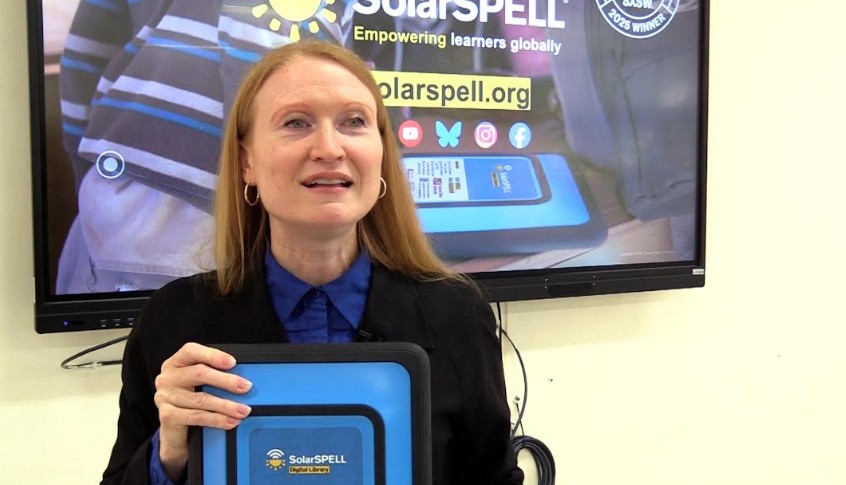
One such brain is Laura Hosman, an associate professor in the School for the Future of Innovation in Society at Arizona State University, who is the brains behind ‘Solar Powered Educational Learning Library’ (SPELL), a solar-powered portable library device that works without electricity or an internet connection.
The ‘Solar SPELL’ library involves setting up a local WiFi network in schools, institutions of higher learning and community facilities where individuals can connect via computers (laptops and desktops), mobile devices (smartphones and wearables) and other equipment and access educational and informative resources stored on an offline portable server or device.
The Solar SPELL team has completed an induction programme for trainers of trainers (TOTS) at the Centre for Mathematics, Science and Technology Education in Africa (CEMASTEA) on how to utilise the portable library in enhancing teaching research and development of Science, Technology, Engineering and Mathematics (STEM) subjects in Kenya.
The participants learnt about both the hardware and the content of the Solar SPELL, so that they would be able to train others in their communities.
SolarSPELL is a global initiative by Arizona State University (ASU) that provides offline, solar-powered digital libraries to communities lacking reliable internet and electricity.
The libraries offer access to a vast array of educational resources, fostering digital literacy and empowerment.
In an interview with the Kenya News Agency, Professor Hosman explained that the SolarSPELL Library approach allows portable digital libraries to bridge the digital divide and provide educational resources to students, professionals and community members who may not have reliable internet access at home or in their communities.
The library comes in the form of a waterproof plastic case containing a solar panel, lithium-ion battery, voltage regulator, USB cords, Raspberry Pi, and SD memory card.
“The portable library will complement hard copy textbooks in the schools, so this came as a good opportunity,” she says of the connection with SolarSPELL.
Professor Hosman explained that the ASU team loads the SD card with predetermined educational content, where teachers and other users are able to directly customise the content themselves.
She stated that each memory card holds reading and math tutorials, science projects, health information or English lessons that are chosen specifically for each location.
The content, she added, could be provided by the local community, drawn from open-source text and videos that are available for free on the internet or taken from textbooks that are used with permission.
Professor Hosman, however, gave four reasons that, for the time being, all the content was being centrally managed from Arizona, saying that SolarSPELL wanted to ensure that the initiative was free of copyright issues, was fully shareable, was age-appropriate and was secure.
She explained that the library creates a WiFi hotspot, either with a dedicated device or by repurposing existing technology. A computer or server stores educational materials like eBooks, videos, and other learning resources.
Students are then expected to connect to the local WiFi network using their devices (laptops, tablets, and smartphones). Once connected, students can access and download the materials, allowing them to learn even without a constant internet connection.
The system is also said to cater to a provision of ‘a kind of mobile librarian’ who can move from house to house or community to community so that students and community members may use the Solar SPELL to download textbooks and other educational materials to their electronic devices, such as laptops and smartphones.
The Don said that each case containing the portable library includes a small solar panel, a microcomputer and a micro digital memory card, which contains all of the library content and some code that allows it to be accessed by any type of browser.
The device creates a Wi-Fi hotspot, and users connect any Wi-Fi-capable device, such as smartphones, tablets or laptops, to access and download the content.
Professor Hosman indicated that the initiative mission was to empower communities in remote and rural areas with the digital literacy needed to participate meaningfully in the digital economy.
“When young people are equipped with the right skills, they not only improve their livelihoods but uplift entire communities,” she says.
The Don added that in a continent where connectivity challenges continued to hinder education, the initiative was committed to bridging the digital divide with the system providing curated content in collaboration with local stakeholders to ensure relevance and linguistic appropriateness.
By simulating an online experience, SolarSPELL added equipment to schools and health clinics with vital information ranging from science and mathematics to health and hygiene, all accessible in even the most off-grid locations.
To Professor Hosman, the education was about both the specific content and the parallel process of digital literacy, which she said was an opportunity to teach information literacy skills, digital skills and what I call internet-ready skills, even before the internet reaches people.
She noted that whenever she asked individuals how their community uses the internet, 100 per cent of the time, they would mention social media platforms. The problem with this, she went on, was that people don’t progress beyond the social media platform and they don’t learn information literacy skills.
“Teaching online skills while remaining offline is like teaching computer programming without using computers, a way to build IT familiarity amidst limited resources,” Hosman elaborated.
The Don further explained that since the initiative was rolled out, it had expanded to 15 countries across the globe, adding that respective authorities in these states charged with curriculum development and supervision were allowed to use the platform to provide access to textbooks and other learning materials, which could be added to the SD card as well.
She was happy that the SolarSPELLteam strived to provide content in local languages and about local settings, adding that the solar panel, which allows the SolarSPELL to be used in the absence of electricity, was useful because only 29 per cent of users interviewed by the SolarSPELLteam in East Africa and the Pacific Islands had access to electricity but sometimes was unreliable.
“The device holds a charge for 6 to 8 hours. About 25 users can connect comfortably without a noticeable slowdown in speed,” she elaborated.
Nearly 500 devices are being used in 15 countries, many in remote areas with little or no electricity or internet. The libraries are filled with content that is customised to the local community’s needs.
Professor Hosman said the library also comes with packages that teach farmers conservation agriculture and enhance the skills of community health workers, adding that the initiative was a key driver in bridging the digital divide and ensuring that no Kenyan was left behind as the country journeys toward a fully digitally enabled society.
By Esther Mwangi and Dennis Rasto