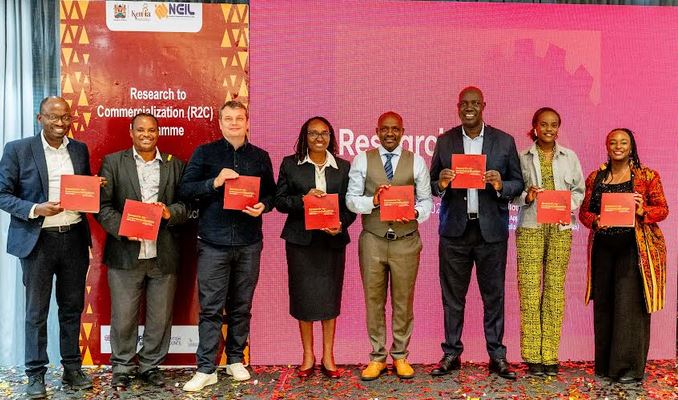
A major programme designed to transform how Kenyan research reaches the market has demonstrated that systemic institutional reform is the key to unlocking innovation-led growth.
The Research-to-Commercialization (R2C) Programme (2022–2025) an initiative by the Kenya National Innovation Agency implemented by Viktoria Venture under the Research and Innovation Systems for Africa (RISA) Programme and funded by the UK Foreign, Commonwealth and Development Office (FCDO), has directly contributed to mobilizing $4.68 million (Sh605.6 million) in capital and supporting 438 jobs, 76 percent held by women.
For years, Kenya faced an innovation paradox: producing high-quality, locally relevant research that too rarely translated into market-ready solutions, enterprises, or widespread socio-economic impact.
The R2C Programme was designed to address the core bottleneck, fragmented commercialization efforts, weak institutional systems, and over-reliance on individual champions within universities.
“Prior investments increased awareness, but not the durable institutional systems needed for scale,” noted Mark Lawler, Team Lead of The RISA Fund. “R2C’s evidence is clear: investing first in leadership alignment and governance reform unlocks sustainable commercialization pathways and delivers greater value for money,” he added.
Despite sustained investments in research across agriculture, health, climate resilience, water, manufacturing, and digital technologies, commercialization efforts in Kenya were historically fragmented: Technology Transfer Offices (TTOs) often lacked necessary authority and resources, policies were lacking or underutilized, and commercialization was treated as a peripheral or project-based activity.
The R2C programme directly tackled these challenges by working at the institutional and ecosystem levels, strengthening leadership engagement, governance structures, commercialization policies, and technology transfer capacity.
The programme repositioned commercialization as a core institutional mandate, embedded in decision-making structures and aligned with national development priorities.
“R2C helped shift commercialization from an abstract concept to an operational function within universities,” said Stephen Gugu, the co-founder and Director at Viktoria Venture adding; “By engaging national actors as system stewards, the programme aligned institutional reforms with Kenya’s emerging national innovation architecture.”
The programme engaged senior university leadership, strengthened Technology Transfer Offices (TTOs), and helped operationalize over 20 intellectual property and commercialization policies. A key achievement was embedding commercialization as a core strategic mandate within university governance structures.
This systemic shift enabled tangible results where 25 universities strengthened their research-to-commercialization systems, over 14 operational TTOs established or strengthened, 39 research-based innovations supported, with an additional 15 female innovators and two ventures transitioned to scale, reaching over 10,000 customers.
“These results are not one-off wins,” said Dr. Tony Omwensa, the CEO of Kenya National Innovation Agency adding: “They reflect systemic change, predictable pathways that link universities, markets, and finance within a coherent national system.”
The University of Kabianga illustrates how leadership-led reforms can rapidly unlock commercialization potential. Prior to R2C, the university had strong research activity but weak pathways to market impact. Commercialization structures existed largely on paper, with limited authority or coordination.
R2C engagement began with senior leadership through the Executive Leadership Training Programme, reframing commercialization as a strategic priority rather than an optional add-on.
As a result, commercialization was embedded into senior management decision-making, clear mandates were established for innovation and TTO functions and governance structures were adjusted to support IP and partnership decisions.
These reforms led to faster IP decisions, stronger industry engagement, and the university’s first credible pipeline of market-facing innovations.
The programme demonstrates that Kenya’s challenge is no longer piloting new approaches, but scaling what works. The next phase requires deepening proven systems.
“Kenya is ready to move from isolated pilots to national commercialization pipelines driven by leadership, sustained by institutions, and reinforced by markets and finance,” said Joseph Marabula, the CEO of Kenya Climate Innovation Centre. “Our role now, as a national system steward, is to anchor these institutional models within Kenya’s innovation architecture, ensuring replication and long-term public-sector ownership,” he explained.
Key priorities for the future include replicating leadership-led models across more universities, anchoring commercialization in national financing mechanisms, and deepening market integration to move innovations from pilots to sustained, demand-led growth.
By Joseph Ng’ang’a