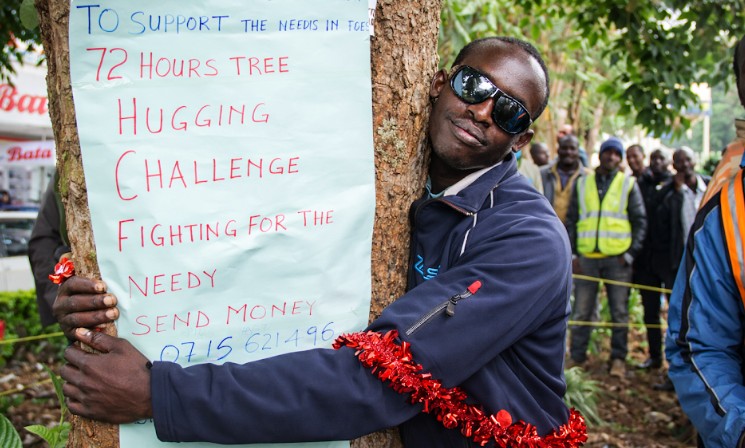
A youth from Kakiboi, Soin–Sigowet Sub-County, Pius Kibet, has embarked on a 72-hour tree-hugging endurance challenge in Kericho town to draw public attention to the challenges facing young people and persons living with disabilities.
The initiative has drawn curiosity from residents as Kibet remains attached to a single tree for three consecutive days, braving cold weather, intermittent rainfall and the scorching sun.
The endurance exercise is intended to symbolise resilience and perseverance in the face of adversity, particularly among vulnerable groups.
Speaking to KNA, Kibet said his decision was informed by personal hardship, noting that he was raised in difficult circumstances by a single parent before living with his grandmother later on, a situation that forced him to drop out of school after Grade Eight due to poverty.
“I grew up in a very challenging environment and education became impossible for me because of poverty. Many young people are going through the same struggles today, and some end up losing hope. Through this challenge, I want to show that even when opportunities are limited, one can still choose resilience and a positive path,” he said.
Kibet said the tree was chosen deliberately as a symbol of life, stability and endurance, adding that the challenge was meant to inspire hope and encourage reflection on the support systems available to young people and persons living with disabilities.
“A tree gives life, shelter and strength. By holding onto it for 72 hours, I want to pass a message that even in difficult times, people can remain firm and survive. This challenge is about hope, especially for the youth and persons living with disabilities who often feel left behind,” he said.
He added that the initiative was also motivated by his personal journey through despair, which he said pushed him to embrace advocacy rather than surrender to hopelessness.
During the exercise, Kibet said he would not consume solid food and would rely on glucose to sustain his energy.
“There was a time I felt completely hopeless, but I decided to turn my struggles into something meaningful. I hope this challenge will encourage others to seek positive ways of dealing with difficulties and to believe that their lives still have value,” he said.
Members of the public expressed mixed reactions, with some residents praising the initiative as a peaceful and creative form of advocacy, while others questioned its long-term impact, urging young people to also focus on skills development and economic empowerment.
Kibet said beyond raising awareness, the challenge was intended to draw the attention of leaders, policymakers and well-wishers to the persistent barriers faced by persons living with disabilities, including limited access to education, employment and healthcare.
He appealed for moral and material support to initiatives aimed at empowering vulnerable groups, noting that collective action was necessary to create sustainable opportunities for young people and promote inclusive development.
By Gilbert Mutai