As we walk through the narrow path, evading shrubs and thorny trees, the landscape changes and we are welcomed by rows of tall sorghum stalks heavy with grain.
The farm is dotted with “watchtowers” of small hills, each with someone seated on top to scare away the birds and prevent them from invading the farm or else the harvest is ruined.
This is a 35-acre farm situated in the Kobulwo location in the Kerio Valley where a section of the members of the Kobulwo Farmers Cooperative Society have come together to grow sorghum under contract farming.
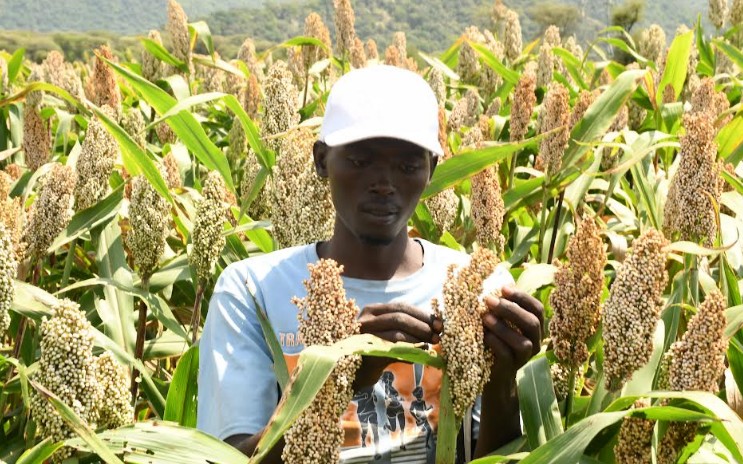
Twenty-seven-year-old Yusuf Kipchumba is not only a member but the chair of this group, which comprises 126 members. It is not a youth group but a society comprising people of all ages who saw qualities in the young graduate and entrusted him with the leadership of their sacco.
Kipchumba, who graduated from Kenyatta University with a BSc degree in animal health and production, says he has been engaged in farming since childhood and even used proceeds from the farm to meet part of his education expenses.
Immediately after his graduation in July 2023, the youth was hired at a poultry farm in Uganda but after six months he quit his job. “The pay was too little and the working environment was not conducive so I quit,” he said.
The father of one says having engaged in agriculture, he just came back home to continue with his passion. “Here on my own farm, I have peace of mind; I am my own boss, set my own targets and despite challenges here and there, I confront them as they come,” he said.
He said sorghum, being a drought-resilient crop, does well in the Kerio Valley, saying it takes 3-4 months for it to mature, with an acre producing 15-20 bags of 110 kg each.
“Currently we have a contract with an organisation called Crops soko which we have agreed will be buying a kilo of sorghum at Sh52. This means a farmer will be earning between Sh70,000 to 90,000 per acre. I have 3.5 acres so am expecting to earn 250,000 at the end of the harvest,” he said.
He said marketing of their produce was one of the major challenges that they have been facing as farmers in the area.
“In 2023 there was an organisation which promised to buy our produce at a certain price but immediately we harvested, they gave us a lower price and because we had not signed any contract, there was nothing we could do,” he said.
Last year, according to Kipchumba, they decided to sell their produce through a Sacco from the neighbouring village. However, while they had agreed that they would sell at Sh52 per kilo, they reduced the price to Sh45.
As the saying goes, once bitten, twice shy, the Kobulwo sacco decided that this year they will not settle for anything other than a written contract with any organisation that promises to buy their produce.
“This year we signed a contract with crops soko and therefore we are confident that they will buy our sorghum at the price we agreed,” he said.
He is also calling on the government to provide water to the area, saying most crops that do well in the area take 3-4 months to mature and because they depend on rain-fed agriculture, they only have one planting season.
“There are streams flowing downstream which run dry during drought times and therefore, if we had a dam, we would be doing irrigation farming, thus having more than two planting seasons, which would increase our earnings,” he said.
He reveals that the cost of production is exorbitant since they harvest manually and hire about 20 people per acre for harvesting who are paid Sh300 per day in addition to another cost of Sh300 to hire people who scare away birds. We are lucky to have a small sheller machine, which takes around 5-10 people to shell the 15-20 bags per acre at a cost of Sh300 per day also.
“On top of this, the sorghum has to be clean and we therefore hire women who are good at winnowing and because the job is tough with a lot of dust, we pay them Sh500 per day,” he said.
While they offer employment for quite a number of people, Kipchumba says with mechanisation, they would be able to cut down on expenses and save quite a substantial amount of money, thus increasing their earnings.
Their farm is next to the Rimoi game reserve, which has a lot of elephants and while they are beneficial both to the county and the country in terms of tourism, they are a threat to farmers as they can destroy a whole harvest in a day.
He is therefore appealing to the county government to fence the Rimoi game reserve to save them the many sleepless nights they spend guarding their farms against invasion by elephants.
Kipchumba says they have an aggregation store built at the Kobulwo centre where they all take their produce before selling, saying that the 126 farmers engage in different crops like ground nuts, finger millet and green grams.
The graduate says for the last three years that they have engaged in large-scale farming of sorghum, their animals have not died of hunger during drought.
This is where his education in animal health and production comes in. Kipchumba says sorghum stalks are very nutritious to animals, so he teaches farmers how to store the feeds, thus ensuring that their animals have pasture all year round.
He, however, says despite the challenges, farming pays and calls on youth to stop staying idle at home waiting for white-collar jobs and instead redirect their energy to farming, saying the jobs will find them as they earn a living.
He has also introduced his wife, who is also a bachelor of education graduate to farming, which they do together. On this day she is one of those scaring birds in the farm and with their earnings, they are able to meet their daily needs as a family, including educating their child who has just joined PP1.
The youth say as part of their future plans, they plan to approach Seed companies like Kenya Seed and others to contract them for seed production, saying most farmers in the area lack certified seeds for planting.
They are also planning to start a value addition project which will earn them more money, adding that they are also planning to establish a petrol station at the Kabulwo centre to diversify their income-earning activities.
He says he is the youngest member in the executive and thanks his members for having faith in him. Kipchumba says he hopes that in the next 5 years, members of his sacco will be able to meet their financial needs through farming.
“I foresee a situation where members will take their children to school without waiting for bursaries, will be able to feed themselves and become economically independent because farming pays,” he said.
By Alice Wanjiru