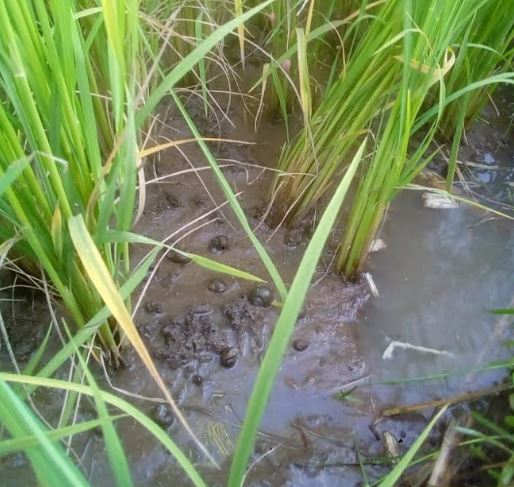
Rice farmers in Kiharu, Murang’a County, are calling for urgent government intervention following a persistent snail infestation that they say is threatening their livelihoods.
The farmers report an increased invasion of their paddies by snails that have proved difficult to control, despite repeated attempts using pesticides and manual collection.
Peter Mwangi, a farmer from Thanju village, said the snails have plagued the area for more than eight years, severely disrupting rice production.
He stated that the outbreak can be traced to a nearby farm where a farmer had been rearing the snails commercially; problems started when during a past rainy season floodwaters swept the snails into surrounding farms, spreading them across the region.
“We have tried every pesticide we thought could eliminate the snails, but none has worked,” Mwangi said.
“We even tried collecting them by hand, but they are too many and they multiply very fast.” He added.
He pointed that the snails feed on the tender rice seedlings, often forcing farmers to replant multiple times, an exercise he described as both costly and exhausting.
Another farmer, James Kuria, said the infestation has persisted for years and many farmers are on the verge of abandoning rice farming altogether.
Kuria said they had turned to rice cultivation as an alternative source of income, but the losses caused by the snails are making the venture unsustainable.
“Rice farming is a good venture, but we are unable to get good returns because the snails keep destroying our crops.” He said.
Kuria noted that researchers have identified the pest as the golden apple snail, an invasive species known for devastating rice fields across affected regions.
The farmers are now urging the Ministry of Agriculture to collaborate with researchers so as to develop effective containment strategies to prevent further losses and safeguard their livelihoods.
By Purity Mugo