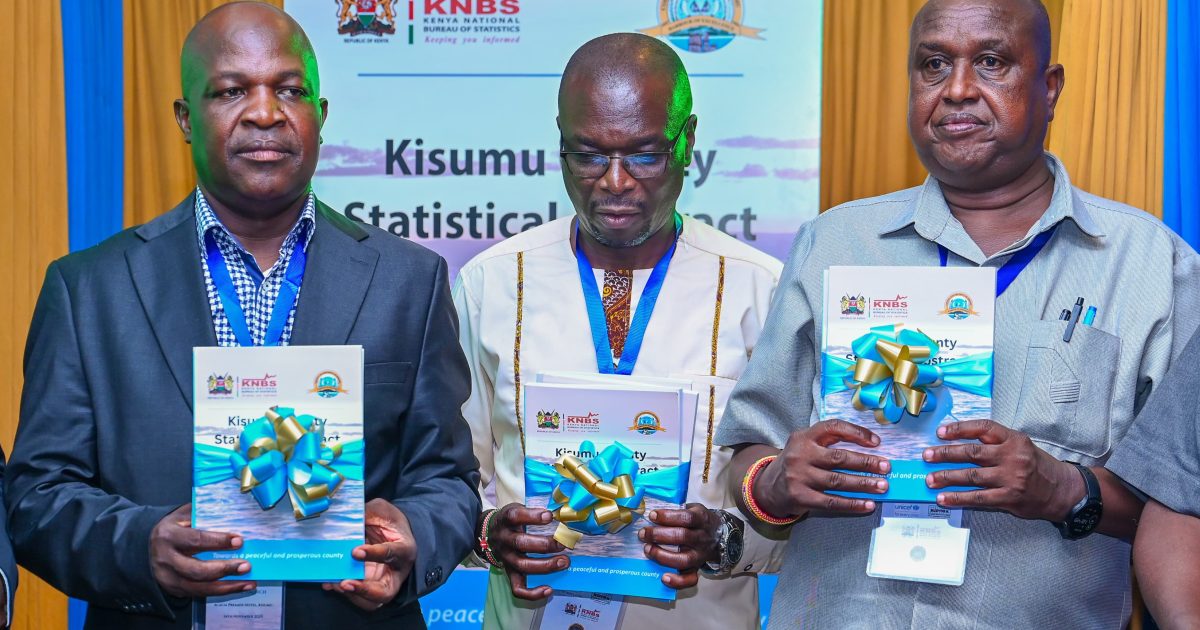
Kisumu County has launched its first County Statistical Abstract to strengthen how the devolved unit plans, budgets and allocates resources by grounding decisions in accurate, verified data.
The publication, developed with support from the Kenya National Bureau of Statistics (KNBS), brings together key indicators on population, education, health, infrastructure, economy, governance and other cross-cutting sectors.
Speaking during the launch, KNBS Director General Dr. Macdonald Obudho described the abstract as an indispensable planning tool that will help Kisumu align its development priorities with actual needs on the ground.
“The statistical abstract that has just been launched for Kisumu County is a very important document because it provides statistics that are useful for planning,” Dr Obudho said.
He said the publication gives a comprehensive picture of the county’s state across multiple sectors, helping departments identify gaps and determine where investments will have the greatest impact.
“It is a milestone that has been achieved by the county government of Kisumu because it is a document that is seriously needed to help them put resources where it would matter most,” he said adding: “It covers the economic side, the social side, the governance side and the cross-cutting issues, all of which are very important.”
Kisumu now becomes the ninth county in Kenya to develop a statistical abstract.
Dr. Obudho noted that while eight counties completed theirs earlier, 36 others are currently working towards producing their own versions for 2025.
“My appeal to those who have not done it is that, you cannot plan without statistics. If you are to provide for education, how many people are you planning for? At what ages and for what levels? If it is about hospitals, who are you providing for? What is the disease burden? All that information must be known in advance,” he said.
He stressed that without accurate data, counties risk misallocating resources.
Decisions such as where to build new health facilities, how many personnel to deploy, or which areas need urgent interventions, he said, must be based on clear indicators rather than assumptions.
Speaking during the same occasion, Kisumu Deputy Governor Dr. Mathew Owili said the document will now inform all the county’s major planning instruments, including the County Integrated Development Plan (CIDP), annual budgets and the Annual Development Plan (ADP).
“This county-specific statistical abstract is going to be very useful for Kisumu. If you are in government, you must plan in each and every sector so that you deliver for the people,” he said.
He gave examples of how the data will guide real-world interventions, noting that the abstract provides details on Early Childhood Development (ECD) centres, including where shortages are most acute.
“That means when we are planning in the department of education, we know exactly where to build new ECD centres,” he said.
The deputy governor said the same applies to infrastructure and other sectors. Dr. Owili added that the data will also strengthen Kisumu’s case when negotiating for more national revenue and donor support.
“In this country, statistics are used as a basis for revenue allocation and sharing. If we get data showing that because we are a city, we receive a daily influx beyond our population, can we use that to push for more revenue allocation,” he said.
He added that the county will also use its disease burden data—such as malaria and HIV prevalence—to lobby for increased investment from the national government and development partners.
“If the burden is high, can we then push the national government, in the absence of USAID, to put more resources here?” he said. “Statistics give us that ground.”
County Executive Committee Member (CECM) for Finance and Economic Planning Mr George Okoth Okong’o said the abstract was a live document and will be refined with feedback from users.
“We are going to rely a lot on the actual users of the data to tell us whether it is responding to their needs. More importantly, we want feedback on how to improve data collection and analysis for the next editions,” Mr Okong’o said.
He urged residents, businesses, researchers and organisations inside and outside the county to actively use the publication which is available on the county government website and share insights that will enhance future versions.
“We are urging all the residents and businesses and other entities in Kisumu County and outside Kisumu County to make use of the publication and also give feedback to the process,” he said.
He said the county will continue updating the document to reflect emerging priorities, demographic changes and new data, as Kisumu deepens its commitment to evidence-based governance.
By Chris Mahandara