Doctors at the Kenyatta National Hospital (KNH) have embarked on a groundbreaking reconstructive surgery for seven-year-old Ian Baraka, who sustained devastating facial injuries after a gunshot wound by bandits in the Meru-Isiolo border.
Baraka, whose mother Daisey Kinyua described the ordeal as ‘a miracle of survival’, was referred to KNH early this year after initial stabilization at a primary hospital.
He was admitted to the Intensive Care Unit (ICU) for three weeks, during which doctors discovered that his upper jaw had been completely destroyed while his lower jaw was fractured.
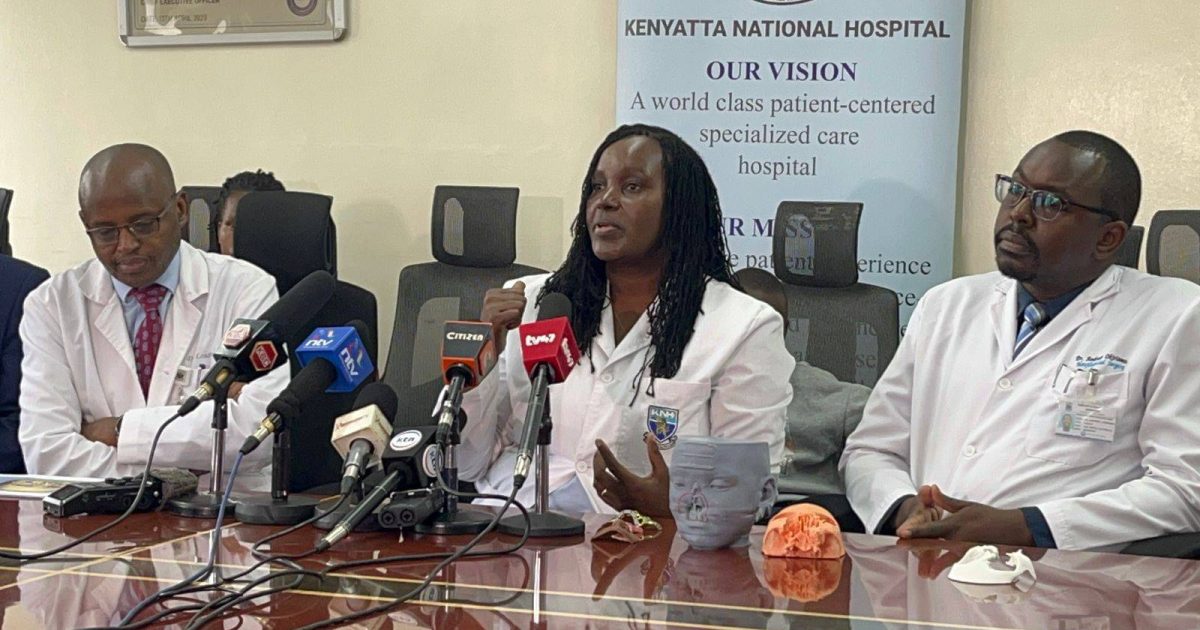
Speaking during a media briefing at the hospital’s boardroom, the hospital’s Senior Director of Clinical Services Dr. Joel Lessan said the case demanded a rare multi-disciplinary approach involving plastic surgeons, prosthodontists, and oral and maxillofacial specialists.
“This is not a case where you can make quick decisions,” explained Dr. Lessan. “We had to bring together a whole team of specialists and even colleagues from the University of Nairobi to plan how to reconstruct the missing bones and tissues”.
The team has adopted advanced technology, including 3D printing, to design titanium alloy implants customized for Baraka’s facial structure.
According to a consultant prosthodontist Dr. Margaret Mwasha, this innovation is crucial for ensuring that the implants fit precisely and accommodate the growth of a young child.
“We are not just replacing lost tissue; we are restoring his ability to speak, smile and live without stigma,” assured Dr. Mwasha, adding that the 3D printed models would allow the doctors to tailor implants that would grow with the patient.
In a quick rejoinder, Dr. Andrew Okiariamu, an oral and maxillofacial surgeon, said the complexity of Baraka’s injuries required not just surgical expertise but also cutting-edge technology.
“This is among the first such cases handled locally. In the past, patients with similar conditions would be referred abroad. But this case demonstrates that Kenya has the expertise and tools to manage complex facial reconstruction right here,” he noted.
Meanwhile, Baraka’s story also highlights the human side of medical innovation. His mother, Daisey, expressed gratitude to the KNH team for restoring hope.
“My son has suffered not only physically but emotionally. He has been bullied because of his condition. I thank the doctors for giving him a chance to live a normal life,” she narrated tearfully.
The hospital revealed that funding for the procedure partly came from Dr. Branice Munyasa, a master’s student in occupational surgery, who ran two marathons—the Standard Chartered Nairobi Marathon and the Chicago Marathon—to raise part of the funding for Baraka’s care. Additional support is expected from the hospital’s management and external donors.
KNH Board Chair Mr. Abbas Gullet, who also addressed the press, hailed the initiative as a milestone for the 124-year-old institution.
“This hospital has served as a referral centre for more than a century, and today it continues to be a hub of innovation and hope,” he declared. “Cases like Ian’s remind us why Kenyans need not travel abroad for advanced treatment. We have the skills, the brains, and the will to do it here.”
Gullet further called for investment in local manufacturing of medical implants, noting that Kenya still relies heavily on costly imports.
“If we can develop the capacity to produce implants locally, many more patients will benefit at lower costs,” he added.
KNH, which handles between 20,000 and 30,000 walk-in patients daily, remains Kenya’s largest teaching and referral hospital, with over 2,400 beds and more than 500 consultants. The Board Chair emphasized that despite challenges, the hospital continues to deliver life-saving interventions.
“We often hear about the negatives, but what is happening here with Ian is the true story of Kenyatta National Hospital,” he asserted. “With limited resources, our doctors are proving that home-grown solutions are possible.”
As Baraka awaits further stages of his reconstructive surgery, his case stands as a symbol of resilience, innovation, and the power of collaboration in Kenya’s health sector.
by Mustafa Mohammed & Darlene Wambui