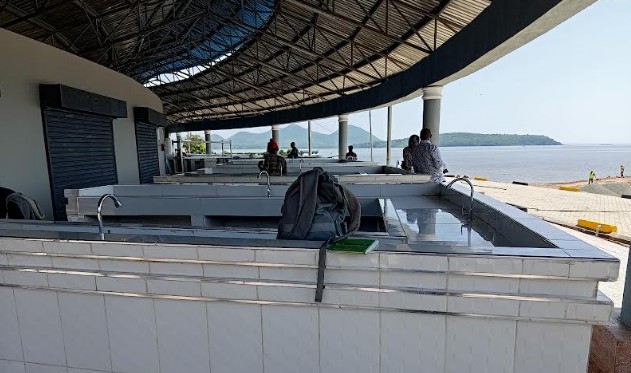
A State-of-the-Art fish market in Kogimbo, Homa Bay Town, which is at 99 per cent complete, signals a major milestone for the region’s fishing industry and economic development.
The multi-million facility, now nearing completion, is ahead of its projected December 2025 completion date and is expected to serve approximately 400 fish traders.

It features modern amenities, including cold storage rooms, roller shutter stalls, and modern trading spaces designed to enhance fish handling, preservation, and trading efficiency.
Additional components include a mooring deck for landing fish, processing zones comprising designated scaling areas, and an outlet system, all supported by cold storage to minimise post-harvest waste and improve product quality.
Lilian Kiani, Director for Urban Developments at the State Department for Housing and Urban Development, praised the project, highlighting its potential to unlock Kenya’s untapped maritime resources.
“For a long time, as a country, we have not fully tapped into our maritime potential. The completion of this fish market marks an important first step in that direction,” Kiani said.
Constructed under the national Affordable Housing Programme in partnership with the County Government of Homa Bay, the market was officially commissioned by President William Ruto in late May, with traders expected to begin operations in the coming weeks.
“The County government is responsible for the allocation, management, and maintenance of the market,” she added.
The Market will cater to a wide range of traders, including fishermen, omena sellers, fish vendors, and Beach Management Units (BMUs) involved in wholesale fish trade.
The facility is intended to streamline fish trade operations and strengthen the fish supply chain across Homa Bay.
Designed with functionality and dignity in mind, the facility also includes a lactation room (crèche), clean water infrastructure featuring a 110,000-litre underground tank and a 50,000-litre overhead tank, and access to electricity and other essential services.
“That is a lot of water since it’s a model market. There is also provision of electricity and a lot of other accessories required in a market,” Kiani said, adding, “We really want to dignify the traders so that they operate in a safe environment, and we made sure to provide all the facilities to support that.”
Mark Ogeno, an Architect from the State Department for Urban Development leading the design team, said the project was developed through extensive stakeholder consultation with the County Government, who gave them details for the market design.
“The comprehensive design was informed by the client after a robust discussion on how the market was to be structured,” he said.
He noted that Phase II of the development will focus on beautifying the lakefront with the construction of an overhead viewing deck.
“What you are seeing is part of what has been actualised in Phase I. We want to beautify the lakefront in Phase II of the project and part of it is having an overhead viewing deck,” he highlighted.
By Sitna Omar