Kiambu farmers are set to benefit from a new partnership between the County Government of Kiambu and the Republic of Korea aimed at transforming agriculture through technology and skills transfer.
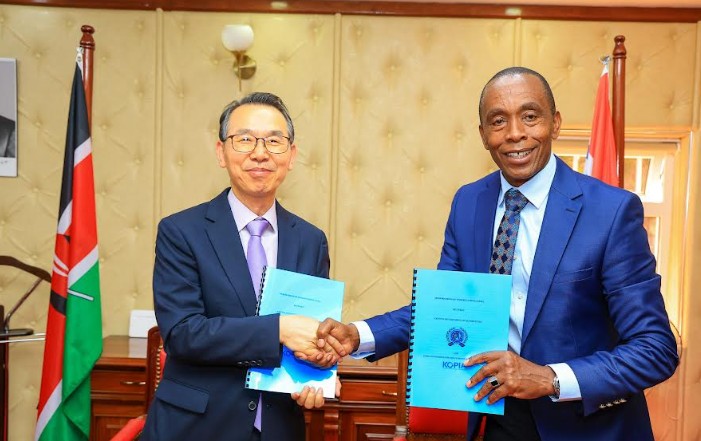
The two on Tuesday signed a Memorandum of Understanding (MoU) to promote agricultural development and food security by introducing advanced farming technologies and expertise to local farmers.
The signing was witnessed by Kiambu Governor Kimani Wamatangi and the Ambassador of the Republic of Korea to Kenya, H.E. Kang Hyung-shik.
The collaboration seeks to empower small-scale farmers across the county by facilitating access to modern agricultural innovations and best practices.
Governor Wamatangi said the initiative would be implemented through the Korea Program on International Agriculture (KOPIA) Kenya Centre in Muguga, Kiambu County, which has been instrumental in driving agricultural research and demonstrations.
“This partnership marks a turning point for our farmers. Through KOPIA, they will gain hands-on experience with modern technologies that will boost productivity and increase yields,” he said.
The governor added that agriculture remains the backbone of Kiambu’s economy, contributing 60 per cent of the county’s Gross County Product (GCP). “This MoU will not only improve food production but also enhance household incomes and promote agro-industrial development,” he said.
Ambassador Kang Hyung-shik described the agreement as a continuation of Korea’s commitment to supporting Kenya’s agricultural transformation.
He said the partnership would focus on capacity building, mechanisation, crop diversification, and sustainable farming methods.
“Korea is honoured to work with Kiambu County in strengthening agricultural resilience. This collaboration will bring tangible benefits to farmers and communities,” he said.
The MoU outlines several key initiatives, including farmer training program, demonstration farms, and research collaborations aimed at improving crop management, irrigation efficiency, and post-harvest handling. By linking research institutions with farming communities, the project will bridge knowledge gaps and promote innovation in food production.
Wamatangi said that small-scale farmers, who form the majority of Kiambu’s agricultural workforce, stand to gain significantly from the new partnership.
“Our farmers are the engine of Kiambu’s economy. By equipping them with knowledge and technology, we are investing directly in food security and economic empowerment,” he stated.
According to the County Government records, industrialisation contributes 30 per cent of Kiambu’s GCP, while mixed economic activities account for 10 per cent. The integration of technology-driven agriculture is expected to stimulate growth in the agro-processing sector, creating employment opportunities and boosting exports.
The KOPIA Kenya Centre has previously supported similar initiatives in other counties, focusing on high-yield crop varieties and sustainable farming techniques.
The Kiambu partnership expands this model, with an emphasis on empowering local farmers to adopt modern, efficient, and environmentally friendly practices.
“The partnership between Korea and Kiambu is a practical demonstration of international cooperation that directly benefits ordinary farmers,” said Ambassador Kang. “Through technology and knowledge sharing, we can create a more productive and sustainable agricultural sector,” he added.
By Grace Naishoo