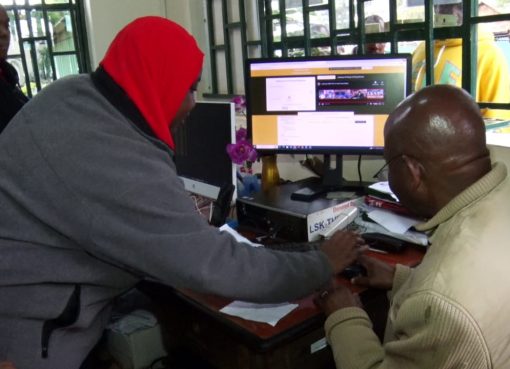
The Kenya Revenue Authority (KRA) has stepped up a targeted tax education campaign, designed for young people and health professionals, as it seeks to build a sustainable culture of voluntary compliance by engaging future taxpayers before they enter the labour market or private practice.
Through the initiative, KRA is targeting learning institutions, with medical and health training colleges identified as a key entry point due to the growing number of health professionals transitioning into self-employment soon after graduation.
Speaking at the Kendu Adventist School of Medical Sciences (KASMS) in Homa Bay County, KRA Commissioner-In-Charge of Micro, Small and Medium Enterprises (MSMEs) and Small Taxpayers, George Obell, said the Authority data shows that individuals aged between 21 and 30 account for about 42 percent of registered individual taxpayers, making the group the largest and most strategic segment in the tax system.
“These are young people either joining the workforce or starting income-generating activities early in life. If we support them at this stage, compliance becomes a habit rather than something imposed later,” he said.
Obell said health professionals are a particular focus of the drive because many quickly move into private clinics, laboratories, consultancy, locum work and other forms of self-employment, often without a clear understanding of their tax obligations.
“Nurses, clinical officers, laboratory technologists and other health workers increasingly operate small businesses alongside their professional roles. These activities contribute significantly to the economy, but many practitioners are not adequately prepared for the tax responsibilities that come with them,” he said.
He added that health professionals occupy a position of trust in society and their conduct influences public attitudes, making their compliance critical to strengthening confidence in the tax system and financing public services, including healthcare.
The Commissioner said KRA was shifting from enforcement-heavy approaches to early and continuous tax education, targeting students while they are still in training institutions.
“The Authority is exploring partnerships with colleges and professional schools to integrate structured tax education before graduates begin earning income. We want people to leave college already understanding what a PIN means, how to file returns and what applies to them depending on whether they are employed or self-employed,” he said.
He noted that fear and misinformation continue to discourage compliance among young taxpayers, despite existing reliefs designed to cushion low-income earners and startups.
Obell said KRA was simplifying digital compliance, particularly for the large number of young people required to file nil returns.
“While filing remains a legal obligation even for those without income, the process is being redesigned to make compliance quick and accessible. If you have no income, compliance will be a matter of clicking, declaring and closing. By February, we will roll out tools that make nil return filing very simple,” he said.
At the same time, Commissioner Obell said KRA was using data analytics to distinguish genuine nil filers from individuals earning income, but under-declaring, noting that fairness in the system depends on everyone paying their rightful share.
He added that the Authority has introduced administrative safeguards to protect taxpayers from financial distress arising from tax debts linked to delayed government payments.
These include payment plans and issuing agency notices to government institutions owing taxpayers, rather than attaching bank accounts.
“Tax should not be the reason someone is pushed to the extreme. Where debt arises from pending government bills, we engage and agree on a settlement plan,” he said.
The Kendu Bay engagement, he said, was part of a broader national strategy targeting similar learning institutions, with KRA also engaging education stakeholders on introducing tax education as early as high school.
“Our goal is to make compliance easy, build a culture of responsibility early and support young taxpayers as they grow,” he said.
By Chris Mahandara