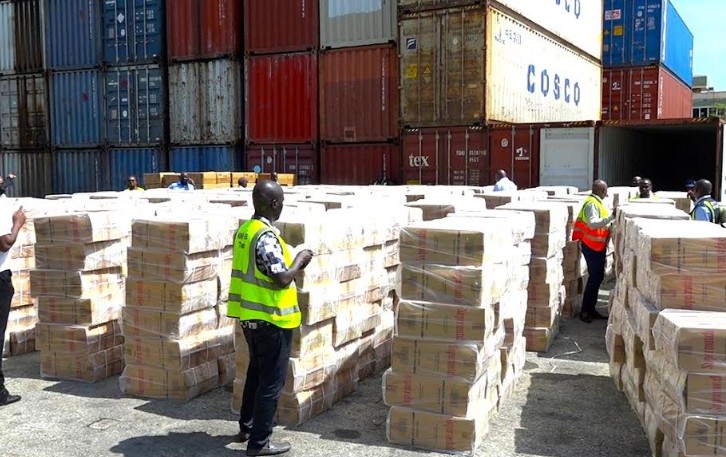
A multi-agency team led by the Kenya Revenue Authority (KRA) has intercepted a 40-foot container at the Port of Mombasa carrying 9.5 million illicit cigarettes disguised as sanitary towels, valued at Sh200 million, that could have cost the country Sh76 million in lost tax revenue.
The intercepted consignment, packed in 954 boxes, is a breakthrough in the ongoing war against illicit trade and tax evasion.
Each box contained 500 packets, each packet with 20 cigarettes.
According to the shipping manifest, the container, which arrived from Thailand aboard a CMA CGM vessel, was declared to contain 1,100 boxes of sanitary towels. The consigner was listed as Igma Trade, while the consignee was Lotec Foundation, based in Nairobi.
KRA Deputy Commissioner of Customs, in charge of Border Control and Enforcement, Chege Macharia, lauded international coordination and timely information sharing that led to the interception of the illicit tobacco.
“Upon arrival, we did our risk assessment based on the information that we had gotten from U.S. Customs and Border Protection. We were able to confirm that the container was suspicious, or the content was suspicious,” stated Macharia.
A verification exercise at the Port Police Station, witnessed by officials from Interpol, the Directorate of Criminal Investigations, and the Kenya Ports Authority, revealed that the first three rows contained 146 boxes of genuine sanitary towels, each with 408 pieces.
The remaining boxes were filled with Supermatch brand cigarettes marked ‘made in Uganda’ and for export with Uganda Revenue Authority (URA) stamps. The consignment will undergo further tests to confirm its authenticity.
“What we have intercepted here demonstrates the true meaning of international coordination and information sharing. This collaborative approach has proven essential in disrupting the flow of smuggled cigarettes and many other products,” said the KRA Deputy Commissioner of Customs.
He noted that the smuggling of illicit tobacco products not only robs the country of vital revenue but also poses significant health risks.
Macharia highlighted that KRA’s investment in modern scanning technology has greatly enhanced the enforcement and detection of suspicious cargo at the country’s Points of Entry and Exit (PoEs).
“We have scanners across all major entry points, including Mombasa, Busia, and Malaba. All containers entering the country undergo scanning, which aids in risk assessment and helps identify those requiring full verification,” he said.
He further explained that once suspicious containers are identified, KRA customs officers first conduct non-intrusive verification before deciding on physical inspection.
“The good thing with the way we have streamlined our process is that all the containers that are coming into our country must undergo scanning. One of the good things about scanning is that it assists in risk assessment. When it comes to risk assessment, we identify the containers that should undergo full verification,” said Macharia.
The Authority is also rolling out Artificial Intelligence (AI) in its scanning operations to improve speed and accuracy in container analysis.
“If it takes five minutes to analyse a container, it will now only take a few seconds to do that analysis and give a report on the spot. Not where we have officers based at the control centre doing a report and sharing it with us. That process for each container normally takes, let’s say, five minutes,” stated the Deputy Commissioner.
“But for now, the process will be immediate and on the spot, whereby you get a report and you can go ahead to release or detain the consignment,” he added, emphasising the need for multi-agency cooperation.
By Sadik Hassan