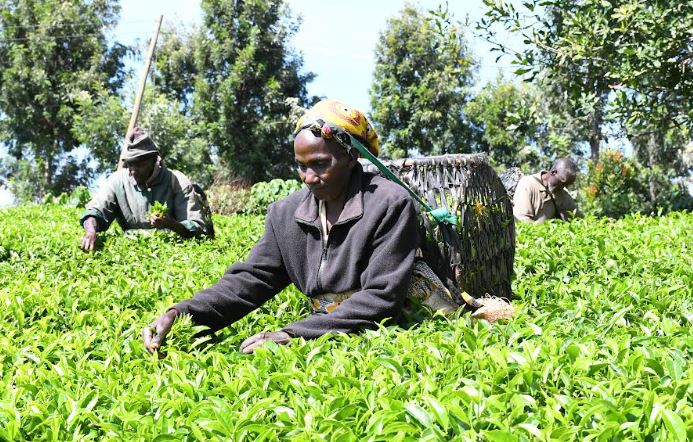
The Kenya Tea Development Agency (KTDA) has attributed drop in this year’s bonuses to over 680,000 tea farmers to shifting global tea market trends.
In a statement, KTDA says that this year’s second payout to the smallholder tea farmers was largely affected by weaker exchange rate of the Kenya Shilling against the US dollar.
The agency says whereas in 2024, the Kenya Shilling traded at an average of Sh 144 to the dollar this year, the rate averaged at Sh129 that even in instances when the international tea prices were stable, the amount realized in Kenya Shillings remained significantly lower.
“The drop in earnings is mainly attributed to international market conditions and currency exchange movements that were less favourable compared to last year. While understandably disappointing to many, this year’s final payout is a direct reflection of the global trading conditions beyond KTDA’s control,” read the statement.
According to the agency the tea growing counties in the West Rift have recorded the highest dip.
For instance the price of made tea for factories in Kericho was Sh245 representing a Sh101 drop while the price of tea for factories in Bomet was Sh209 representing a drop of Sh85 from last year’s earnings.
A kilogram of tea from factories in Nyamira was purchased at Sh266 representing a Sh106 drop whereas a kilo of made tea from Kisii was Sh246 representing a Sh95 drop. For Nandi and Vihiga a kilo of made tea fetched Sh208 representing Sh66 drop.
However, tea factories in East Rift recorded the least drop in earnings.
For instance, factories in Kiambu fetched Sh371 per kilogram of made tea representing a drop of Sh46 from last year.
Murang’a earned Sh376 for every kilo down by Sh42, Nyeri earned Sh 388 a Sh42 drop, Kirinyaga earned Sh400 down by Sh38, Embu earned Sh404 down by Sh34 and Meru earned Sh381, a reduction of Sh46 from last year.
Furthermore KTDA has attributed this difference between East and West of the Rift Valley to quality factors, market dynamics and cost structure.
The agency noted that teas from high-altitude zones naturally fetch better prices due to the quality which favoured in global markets, further resulting in the payment margins.
In Nyeri, the rates per kilogram of green leaf delivered to the factory averaged at Sh 40 as the least amount while the highest rates for the farmers is Sh56 for a kilogram.
Farmers who spoke to KNA said that despite the slight reduction, they were nevertheless content with this year’s bonus rates.
“For many factories in Nyeri, the difference is less than Sh10 which is not a very big difference compared with what we are witnessing in other zones where farmers’ earnings have reduced by Sh19,” stated Charles Chege a farmer affiliated to Gathuthi tea factory.
Out of the five factories, farmers who deliver their greenl0-eaf to the Gathuthi will be paid Sh56 per kilogram compared with the Sh57 that the agency paid last year.
Farmers affiliated to Chinga tea factory will receive Sh43 per kilo representing a Sh7 reduction while farmers who deliver green leaf to Gitugi tea factory will take home Sh42.50 per kilogram. For Gitugi, this year’s payout is a Sh10.5 reduction from last year’s earnings.
Farmers from Iria-ini and Ragati will be paid at a rate of Sh40 per kilo.
For Iria-ini, the farmers will take home Sh6 less than what they earned last year while those in Ragati, there will be a Sh5.5 reduction from the previous years.
The agency has cautioned against politicizing the tea subsector as this will only infuriate the framers.
The agency said that to help stabilize the farmer’s earnings, plans are underway to increase the production of orthodox teas which fetch higher prices in niche markets.
KTDA also announced that it was partnering with the government to promote value addition on tea, reduce packaging costs and open new tea markets
“The surest way to safeguard incomes is through maintaining high quality green leaf, disciplined factory management and adherence to good agricultural practices. We assure our tea farmers that KTDA remains committed to their welfare and to ensuring the long-term sustainability of the sector.
The challenges we face are global and systemic but by focusing on quality, efficiency and innovation, we will overcome them and secure better earnings in the future, “the agency said.
By Wangari Mwangi and Samuel Maina