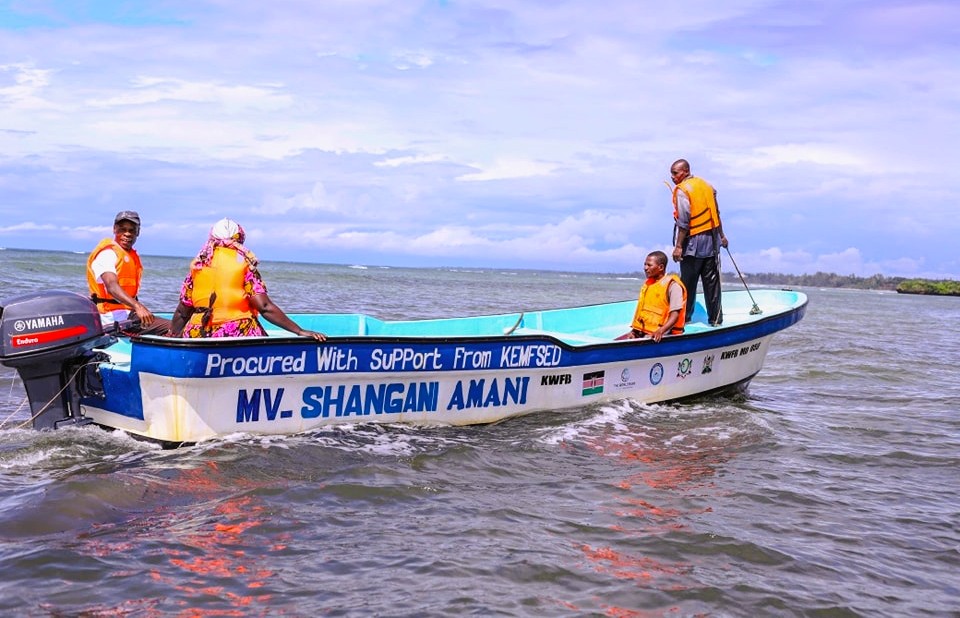
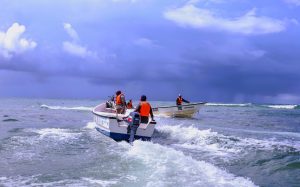
Kwale County, in collaboration with the Kenya Marine Fisheries Socio-Economic Development (KEMFSED) project, has distributed 13 fibre boats to local fishermen and seaweed farmers to make their businesses a lot easier.
The 2020-2025 KEMFSED project, worth Sh10 billion, is implemented by the State Department for Blue Economy and Fisheries with support from the World Bank.
The project is being implemented in the coastal counties of Mombasa, Kwale, Kilifi and Lamu to improve livelihood activities in coastal communities.
The donor-funded programme aims at expanding access to livelihood support, food security services, and grants for poor and vulnerable households and businesses, contributing to the overall socio-economic development of the coastal counties.
Kwale county government underscored the importance of these initiatives in enhancing food and nutrition security and supporting local fisheries and agriculture.
In collaboration with coastal county governments, KEMFSED provides farmers with extension services, seeds, and other inputs to increase production, improve value addition, and raise household incomes.
Governor Fatuma Achani highlighted that the boats that come with outboard engines and other auxiliary fishing equipment were distributed to boost productivity and improve the livelihoods of the coastal communities.
She commended the KEMFSED project and the national government on the partnership to uplift the artisanal fisheries value chain in the coastal region.
Achani underscored that ocean fishing played a significant role in the coastal region’s economy and food systems but noted that sustainable practices were essential to protect fish stocks and the livelihoods that depended on them.
She said the boats distributed to the local fishing and seaweed farmers were part of a commitment to supporting the fishery value chain, as the fisheries sector has been facing multiple challenges, including climate change and the depletion of marine resources.
Speaking during the distribution event held at Mkunguni Beach Management Unit in Ramisi Ward, Msambweni Sub-County, Governor Achani urged beneficiaries to use the boats responsibly.
Achani said that six boats would be used by seaweed farmers to harvest seaweed from the Indian ocean while the remaining seven boats would be used by fisherfolk to enable them to undertake deep-sea fishing activities in the sea and increase the fish catch per person per trip from 2.3 kg to 1.5 tonnes on a daily basis.
Governor Achani, who was accompanied by the County Executive Committee Member in charge of Agriculture and Fisheries, Roman Shera, termed seaweed farming as an ‘untapped treasure’ adding that the devolved government is committed to supporting its growth through various interventions.
“So far, we have established 21 seaweed farming groups with about 420 active farmers in Msambweni and Lunga Lunga sub-counties. We are also supporting seaweed farmers every year with seaweed farm inputs including ropes, gumboots, gloves and weighing scales,” she said.
Achani said the devolved government through the KEMFSED project has in the past provided the fish farmers with free fish feeds, nets, ropes, floats, deep-sea fishing vessels and sinkers.
Deep sea fishing is undertaken beyond the limit of territorial waters, which is seven nautical miles from the shore, and within the Exclusive Economic Zone (EEZ) of 200 nautical miles from the shore.
Kenya’s Exclusive Economic Zone (EEZ) is a 200 nautical mile (370 km) area extending outwards from its coastline, granting the country sovereign rights over its resources, such as fisheries, oil and gas and other seabed minerals within that zone.
“The main focus of the partnership with the KEMFSED scheme is to provide assistance to farmers in order to enhance their productivity and create wealth across the agricultural value chain,” said Achani, noting that Kwale would continue to support sustainable practices by small-scale fisheries and aqua-farmers.
She said Kwale is seeking to boost seaweed farming operated by coastal communities along the shores of the Indian Ocean to increase production and enhance sustainable livelihoods.
The various species of red, brown and green seaweeds found in Kwale are cultivated by fishing communities for both domestic and industrial use, offering profitable opportunities.
Achani said seaweed plays a key role in ocean ecosystems, supports diverse marine life, and benefits a wide range of human industries from nutrition and agriculture to scientific research and climate solutions.
The coastal county boss said her administration is constructing a seaweed store at Mwazaro, noting the purchase and distribution of the six boats would be used for transportation of farmers and harvesting of seaweed.
“Kwale has purchased and distributed assorted seaweed value addition equipment such as a disc mill, pulverising machine, and soap plodder to eight seaweed farmer groups,” she said.
Some of the beneficiaries of the empowerment initiatives expressed their gratitude and shared their optimism about the positive changes the interventions would have on their lives.
Msambweni Beach Management Unit Network Chairman Mtengo Omar thanked the Kwale County government and KEMFSED for recognising them as fishermen worthy of support.
“So far, we have been given 62 boats free of charge, which has made fishing easy for local fishermen,” said Omar.
Ashura Sheboi, a representative of Tumbe Seaweed farmers, welcomed the empowerment initiatives, noting that the county government and donor programmes were changing lives for the better.
Sheboi called on the local fisherfolk communities to explore seaweed farming, which he hailed as an untapped, climate-friendly resource.
Seaweed is used in making various products, including soap, shampoo, seaweed powder for food, and as a raw material for pharmaceutical and cleaning products.
Maritime industry stakeholders contend that seaweed known as ‘climate-smart algae’ plays an important role in the marine ecosystem as it absorbs significant amounts of carbon and reduces ocean acidification.
However, global warming is reducing the quality of seaweed in the ocean.
Seaweed is celebrated as the ‘wonder plant of the sea’ and offers a renewable source of food, energy, chemicals and medicines for a wide range of industries, agricultural, biomedicine and personal care applications.
Coastal communities dive underwater to harvest the seaweeds and sell them in two forms: dried and fresh seaweed, which fetches them between Sh40 to Sh70 per kilogram.
By Hussein Abdullahi