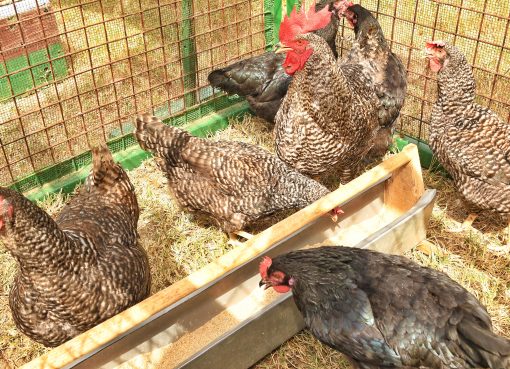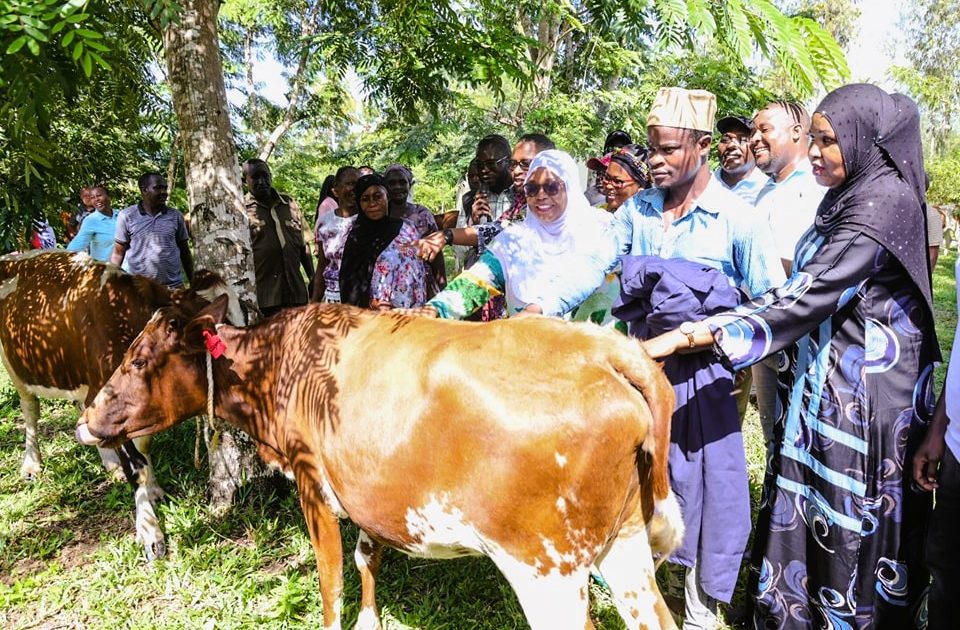
Kwale County Government has distributed 30 hybrid dairy cows and 144 hardy gala goats to small-scale farmers to boost milk production and living standards in the coastal county.
The devolved government in collaboration with the Kenya Marine Fisheries Socio-Economic Development (KEMFSED) project has initiated the dairy cattle stocking program for smallholder dairy farmers.
The KEMFSED project worth Sh.10 billion is implemented by the State Department for Blue Economy and Fisheries with support from the World Bank with the project duration lasting between 2020-2025.
The KEMFSED project is being implemented in four coastal counties of Mombasa, Kwale, Kilifi and Lamu to improve livelihood activities in coastal communities.
Each beneficiary received a dairy cow, personal protective equipment (PPE), vaccines and supplements, starter feed packs, grass seeds, and sexed semen to support breeding.
Governor Fatuma Achani, who has presided over the milk cattle and goats’ distribution exercise at Mafisini area of Msambweni Sub County noted that the initiative was to improve smallholder producer incomes and household food and nutrition security through enhanced milk production.
Governor Achani stated that the move was a progressive intervention by the devolved government to promote dairy farming and boost the rural economy.
Achani says the county has been providing robust support to local farmers through various veterinary and agricultural extension services.
She said the distribution of dairy cows and hardy gala goats is central to boosting the milk income for local farmers.
The Governor noted that the hybrid dairy cows and gala goats’ donation is one of the agriculture value chain programmes aimed at increasing ‘productivity and profitability’ in the region.
“The partnership with KEMFSED is a deliberate drive towards diversifying the economy and its commitment to long term sustainability in food security as well as adding value and enhancing efficiency in the local dairy sector,” she said.
She said since the launch of the KEMFSED program, the county government has distributed over 100 dairy cows and more than 5200 dairy goats, benefiting numerous households across Kwale.
The introduction of high-yielding galla goats is expected to significantly improve household incomes through milk production, breeding, and eventual sale.
The coastal county boss says the increase in the population of quality dairy cows is expected to boost domestic milk production and cut down dependence on outside dairy products.
“This is a long-term strategy to increase food and nutrition security with the help of dairy products,’ she said.
“The partnership between Kwale and KEMFSED is committed to strengthening the livestock and animal health sub sectors to achieve milk self-sufficiency, improve farmers welfare and ensure the availability of fresh milk for the people,”.
According to the governor the hybrid dairy cows’ varieties have more milk producing capacity of 12 litres per day as compared to their local counterparts.
Achani who was accompanied by the County Executive Committee Member (CECM) for Agriculture and Livestock, Roman Shera, urged the beneficiary to maintain appropriate care of the animals received in order to reap maximum benefits noting that it was a pass-on project which must benefit other farmers.
She says the livestock distribution is part of a broader initiative to support smallholder farmers and increase both animal production and personal household incomes across the coastal region.
“The programme is not just about distributing animals but about creating a sustainable cycle of agricultural development that empowers local communities,” she said.
She said the department of agriculture and livestock development will closely monitor the livestock’s performance and ensure successful pass-on of the animals.
Achani says local livestock farmers in each of the 30 administrative wards of the county were being trained on herd management, feeding programmes, artificial insemination, milk cycles and calving for a long-term sustainability in food security.
Priscilla Kyulu, one of the farmers who received heifers and galla goats says she is already looking forward to increased milk production and by extension increased personal income.
“The success of this project will enable us to overcome the various challenges that we have been facing, especially for the basic needs,” said Kyulu.
By Hussein Abdullahi