The coastal county of Kwale is actively working towards revitalizing the agricultural sector through value addition initiatives by building farmers’ capacities to enhance value chains.
The initiatives include establishing special agro-industrial processing zones, improved farming practices, climate-smart agriculture, and promoting mechanization by deploying tractors and other machinery to enhance productivity and market access for agricultural products.
Governor Fatuma Achani says the new efforts are aimed at boosting food production, creating economic opportunities, especially in rural areas and enhancing the overall quality of life for residents.
Governor Achani says the devolved unit is cognizant of the potential of agriculture as a powerful economic driver and is keen to establish agribusiness ecosystems throughout the coastal county with emphasis on adding value to raw agricultural products.
She said smallholder farmers in Kwale are slowly adapting to climate-smart agriculture practices to improve productivity, enhance resilience to climate variability, reduce greenhouse gas emissions and store carbon.
Climate-smart agriculture is an integrated approach to managing landscapes such as cropland and livestock that addresses the twin challenges of food security and climate change.
Confronted with the reality of erratic rainfall patterns and low yields, farmers across the coastal county are ‘opening their arms’ for climate-smart agriculture practices in the hope of increasing crop yields and farm income.
“We are seeking to reposition agriculture as a key driver for socio-economic transformation, job creation, and diversification which ensures a steady supply of food throughout the year,” she said.
Achani said the devolved unit is turning its focus on innovative farming techniques, value chain optimization, strengthening small-scale farmers’ resilience, and strategic investments in climate-smart agriculture, which is more resilient to climate shocks.
She said climate-smart agriculture practices like improved water management, drought-resistant crops, and diversified farming systems can help farmers mitigate the impacts of climate change, increase productivity, and improve their livelihoods.
“Through these initiatives the devolved government aims to improve food security, enhance the livelihoods of small-scale farmers, and create a more diversified and resilient agricultural sector,” she said.
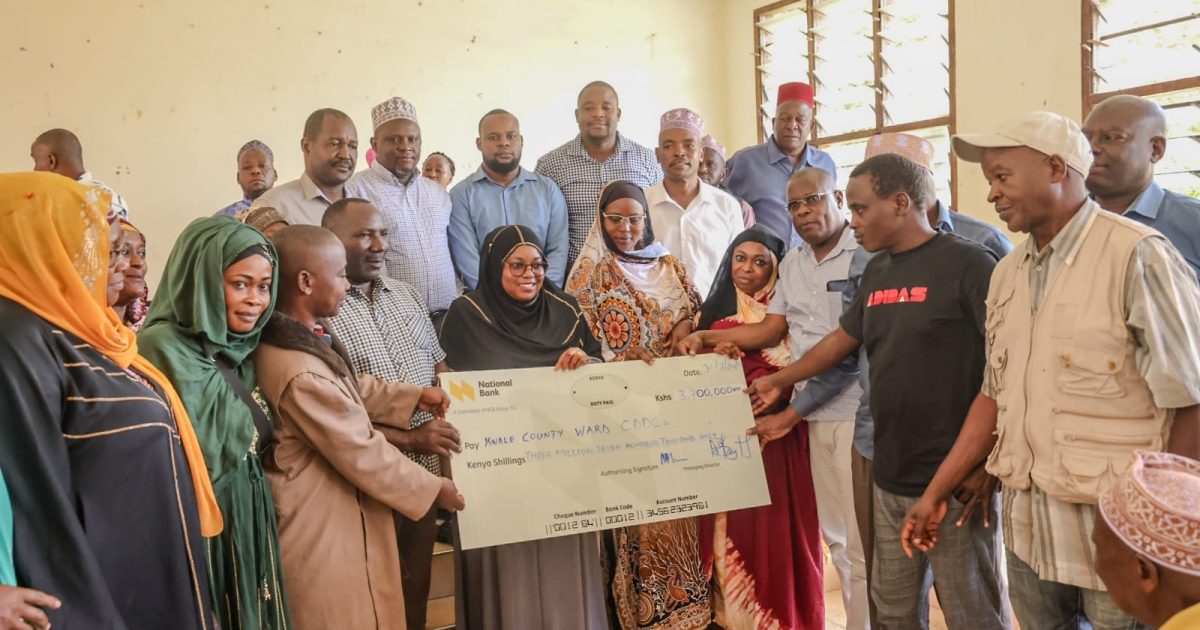
Achani was speaking in Tiwi ward, Matuga Sub County, during the issuance of a Sh3.7 million cheque to Community-Driven Development Committees (CDDCs) through the National Agricultural Value Chain Development Project (NAVCDP).
The NAVCDP is implemented by the Ministry of Agriculture and Livestock Development and funded by the World Bank. It is a five-year project which commenced in September 2022 and runs until December 2027.
Achani said the funds aim at supporting the NAVCDP project implementation at the grassroots level through increasing market participation and value addition to farmers.
The Governor said the funding is aimed at supporting practical farmer-driven demonstration projects that showcase modern and climate-smart agricultural techniques in key value chains across the county.
Achani, who was accompanied by County Executive Committee Members (CECM) Roman Shera (Agriculture, Livestock and Fisheries) and Michael Mutua (Trade and Tourism), said the devolved government will support the national governments and international partners’ efforts to revamp the agricultural sector.
“Kwale will continue to collaborate with the national government, development partners and other stakeholders in enhancing the livelihoods of our people,” she said.
The coastal county boss says the new investment will empower local smallholder farmers with the knowledge and skills they need to improve yields, reduce post-harvest losses, and increase household incomes.
Roman Shera, the county agriculture executive, says Kwale is working to revamp the agricultural sector by focusing on value addition and agribusiness.
He says the new efforts involve initiatives to enhance the quality and marketability of agricultural commodities, create more value-added products, and promote sustainable practices.
“Our goal is to improve smallholder farmer incomes, boost food and nutrition security, and foster socio-economic growth,” he said.
Shera says the county through the department of agriculture is spearheading initiatives like establishing agribusiness hubs, promoting agro-processing industries, and creating linkages between farmers and markets.
The goal, he said, is to enhance food security, create jobs, and foster economic growth within the agricultural sector.
By Hussein Abdullahi