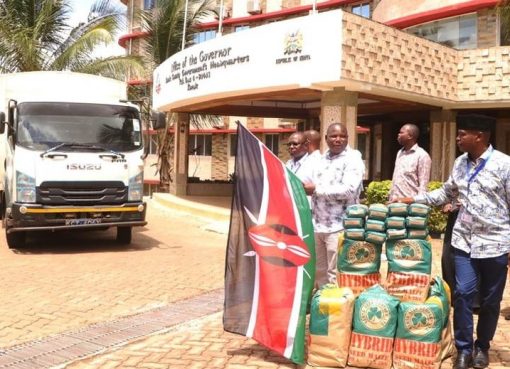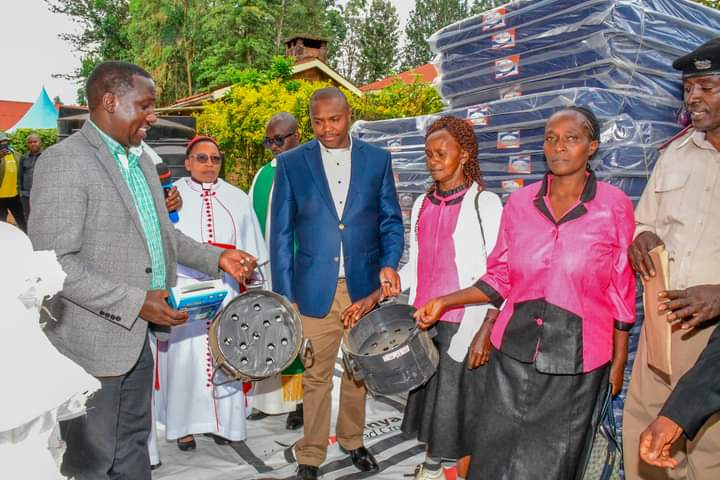
It has been a year and a half since 21 families from Mucoco village in Kangema Constituency were displaced from their homes by devastating landslides during the March-April 2024 long rains.
What began as a temporary refuge in a nearby primary school has since turned into a prolonged stay at a camp on the compound of ACK St Andrews Kiarathe Church.
Here, the families try to pick up pieces of their lives with uncertainty about the future.
When the landslides struck, massive cracks ripped through the hilly terrain, destroying houses and swallowing farmlands destroying thousands of tea stems and coffee bushes in its wake.
The government swiftly conducted seismic studies and geological surveys, which confirmed the area as inhabitable as it was found to be unstable and highly seismic.
As a result, permanent relocation was recommended.
Other recommendations included planting of trees in the area to prevent soil erosion by stabilizing the soil and providing protective cover and digging up terraces so to reduce both the amount and velocity of water moving across the soil surface to reduce soil erosion.
KNA visited the families to find out how they were faring on at the camp eighteen months later.
At the camp, some modest two-bedroom houses have been put up to shelter the displaced families.
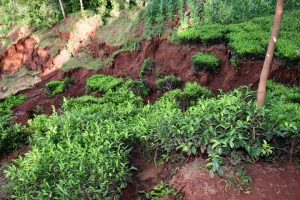
For many the walls feel too tight for comfort as parents share small rooms with their children, their privacy stripped away.
“We are grateful for the shelter, even as we await permanent relocation even though space is very limited as there is no privacy, yet this is the only refuge we have,” said a resident James Irungu.
“During the day, we still return to our former homesteads to work on the small patches of land that escaped the landslide’s wrath,” he adds.
He observes that the land started sinking in 2017 and they relocated temporarily before moving back there, only for a massive landslide to hit the area last year in which the families lost all their source of livelihood.
Irungu lost over 1200 tea bushes when the earth shifted.
Notably, to make ends meet, the families have become inventive.
Outside the small homes, sacks and containers sprout with kale, spinach, and onions as they craftily nurture kitchen gardens to supplement their diets.
“We are hardworking people. If we are given land and settled permanently, we can develop ourselves economically as we don’t want to depend on handouts forever,” says Mary Muthoni as she picks a handful of kales for dinner.
She notes that the families still go to tend their livestock in the danger zone, even as fresh cracks open on the ground with every rainfall.
For them, survival is a delicate balance between risk and resilience.
In Mucoco village, the onset of every rainy season brings renewed anxiety as memories of the April 2024 disaster remain vivid, and each downpour is a grim reminder that the land beneath them is still fragile.
“With every heavy rain, we fear for our lives. We don’t know when the ground will give way again,” added a mother of four, her voice heavy with worry.
Kangema Member Parliament Peter Kihungi acknowledges the plight of the displaced families and says he is still following up with the government and relevant ministry for a lasting solution.
“Our people will not live in camps indefinitely as the surveys have already shown that their former land is unsafe, we are engaging the government to ensure these families are relocated permanently to safer ground,” he said
The MP noted that the landslides in the area date to a decade ago.
“In 1917 the first landslide happened and it left many casualties, in 2018 after 100 years, the ground started sinking and the people were moved albeit shortly before reoccupying their land,” he said.
By Florence Kinyua