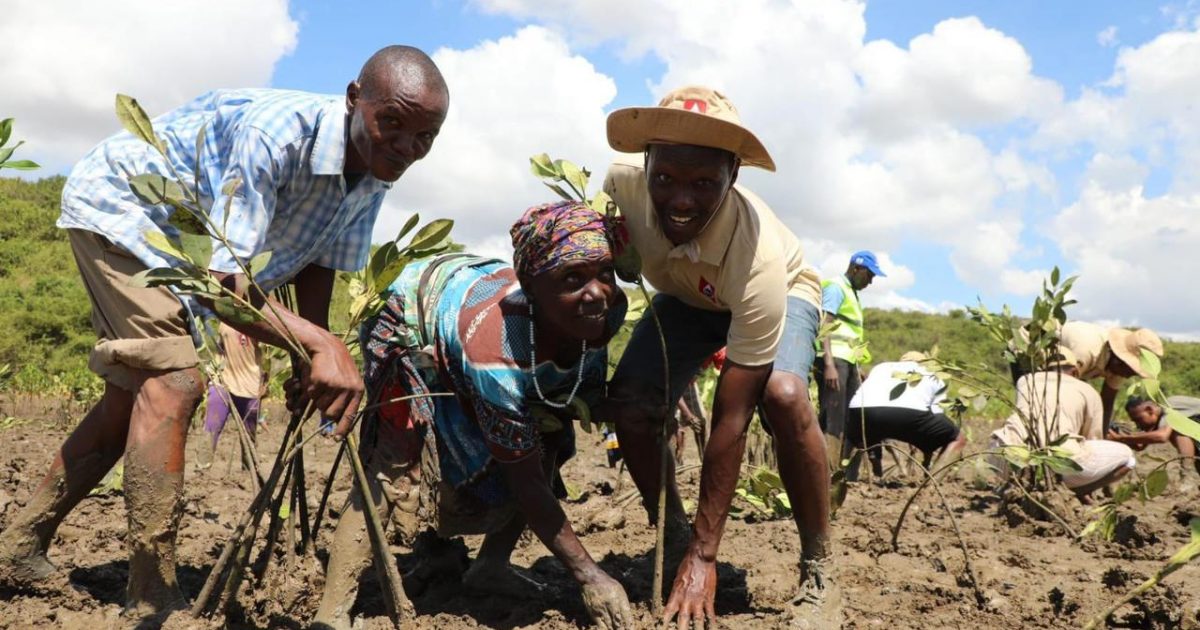
The Majoreni Mangrove restoration initiative in Kwale County is transforming both the local ecosystem and community livelihoods, with women taking the lead in reviving degraded coastal forests.
Led by the Pongwe Kidimu Community Forest Association (CFA), the project is rehabilitating vast stretches of mangroves that had been destroyed by unsustainable harvesting and climate-related impacts.
According to CFA Chairman Mshemanga Hamis Riziki, popularly known as Matata, the group composed mainly of women has been replanting mangroves with support from the Kenya Ports Authority (KPA).
“The restoration of mangroves not only protects our coastline from strong winds and erosion but also provides breeding grounds for fish, which boosts our local fishing economy,” said Riziki.
The Majoreni project stands as a model of community-driven ecosystem restoration where environmental recovery, women’s empowerment, and climate resilience converge to sustain both people and the planet.
Through a powerful collaboration between KPA and the Pongwe Kidimu CFA, the coastal landscape through community-led mangrove restoration has been restored while improving local livelihoods.
Riziki said the community has already planted thousands of mangrove seedlings on previously degraded sections of the coastline with funding and technical support from KPA.
“KPA bought 10,000 mangrove seedlings from us, and the money we received helped families buy food and pay school fees,” he said, adding that the initiative has proven that environmental conservation can sustain livelihoods.
The partnership has also introduced improved planting methods. Previously, the community relied on traditional techniques, but with KPA’s support, they have adopted nursery-based seedling propagation, which ensures higher seedling survival rates.
Despite the progress, the CFA acknowledges that the scale of degradation in Majoreni remains vast. Riziki said that while KPA’s contribution has had a major impact, the area is large and requires stronger support from more stakeholders.
He appealed to other conservation groups, corporate entities, and government agencies to join hands with the community, noting that restoring the coastline demands collective effort.
“Today, the once-degraded mangrove ecosystem in Majoreni is showing visible signs of recovery, serving as a windbreaker, a nursery for fish, and a source of pride for a community that has learnt that restoring nature also restores dignity,” he said.
KPA’s Head of Corporate Communication, Jones Bushere, noted that the project, which recently won an international environmental award from the International Association of Ports and Harbours (IAPH), is a model of how partnerships between local communities and national institutions can deliver lasting ecological and economic benefits.
The award recognised KPA’s outstanding contribution to sustainable coastal conservation, aligning with Kenya’s national tree-growing agenda and the government’s broader climate action goals.
Bushere noted that the restoration initiative not only supports Kenya’s national goal of planting 15 billion trees but also aligns with the authority’s Green Port Policy, which promotes sustainable operations along the coastline.
Among the most active participants is Mwambikao Hatibu Haga, a local woman who said the group has innovatively reused plastic bottles as seedling pots to nurture young mangroves. Despite challenges in accessing adequate materials, she said the initiative has empowered women both economically and socially.
“This work has given us income, pride, and a sense of ownership over our environment,” Haga said.
While the community provides most of the labour, mainly by women, external partners such as KPA supply vital materials and logistical support. Haga, who leads the nursery work, explained that they currently use recycled plastic bottles collected from the sea as pots.
“We do this with passion, but we hope the government or partners can provide proper nursery pots to make our work easier and more environmentally friendly,” she added.
By Chari Suche