The government has reaffirmed her commitment to scaling up the Galana-Kulalu irrigation project, terming it a game changer in securing the country’s food supply and stabilizing the economy.
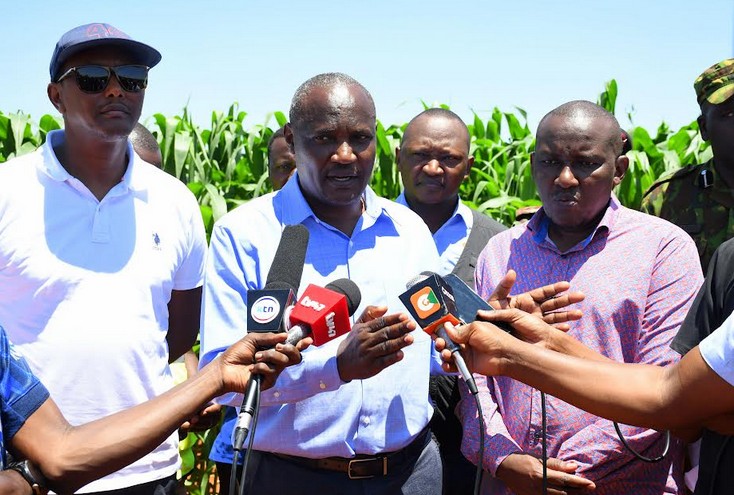
Speaking during an inspection tour of the mega Project in Kilifi, National Treasury and Economic Planning Cabinet Secretary, John Mbadi, lauded the remarkable progress being undertaken at the expansive scheme.
Mbadi said the project aligns with the Bottom-Up Economic Transformation Agenda (BETA), which prioritizes food security as a critical pillar.
He noted that the Kenya-Kwanza government has placed irrigation at the centre of Kenya’s food security and economic growth strategy.
“For years Kenyans have heard about Galana-Kulalu. Today, we are walking the talk. What I have seen here is impressive as this is a massive project,” said Mbadi.
The project is being implemented in three phases. The first phase, covering 10,000 acres, is already underway, with 1,500 acres of maize planted under a public-private partnership. The first harvest is expected next week, while an additional 1,700 acres will be planted in the next season, gradually scaling up to 10,000 acres by mid-2026.
Phase two targets 200,000 acres, which will rely on the planned Galana Dam. Agreements for financing have already been concluded, with groundbreaking expected soon. The ambitious Phase three aims to expand irrigation to 1 million acres by 2027.
The CS added that the project will eliminate Kenya’s perennial maize deficit that is estimated at 10 to 15 million bags annually.
“Just 200,000 acres can produce 14 million bags of maize per year. That will cover our deficit and end maize imports. Beyond food security, it saves foreign exchange, strengthens the shilling, creates jobs, and drives overall economic growth,” he explained.
In addition to Galana-Kulalu, the government is scaling up other irrigation projects including Bura, Ahero, West Kano, Lower Kuja, and Hola, targeting maize, rice, and sugarcane production. Plans are also underway to revive cotton farming to support Kenya’s textile industry.
The CS linked the initiative to broader macroeconomic stability, noting that reducing food imports eases pressure on foreign reserves and stabilizes the shilling.
“People ask why the shilling has remained stable. It’s because the government has reduced major imports, especially food and fuel. Projects like Galana-Kulalu directly support that stability,” he said.
He emphasized that public-private partnerships (PPPs) are crucial to delivering such large-scale projects without overburdening public finances.
“Private sector brings efficiency, capital, and a business mindset. Globally, no country has developed without involving the private sector. PPPs are not scandals but the way forward,” he stressed.
The Treasury CS projects that with sustained investment, Kenya will be self-sufficient in maize and rice production within the next few years, positioning agriculture as the backbone of industrial growth, job creation, and economic resilience.
Principal Secretary (PS) for Irrigation, Ephantus Kimotho, emphasized the economic impact of irrigation, noting that just 10,000 acres under irrigation at Galana can generate Sh2.8 billion annually while creating over 500 jobs.
He added that irrigation also builds climate resilience by ensuring year-round food production.
“Irrigation is a key driver of the County Aggregated Irrigation Plans (CAIPs), which anchor agricultural development at the grassroots. The rice deficit, for example, will be tackled through collaboration between large-scale projects and smallholder producers,” he said.
Accompanying the CS were National Irrigation Authority CEO Eng. Charles Muasya, Secretary for Land Reclamation and Climate Resilience, Joel Tanui, and Senior Economic Advisor, Mohamed Hassan, among other senior officials.
by Chari Suche