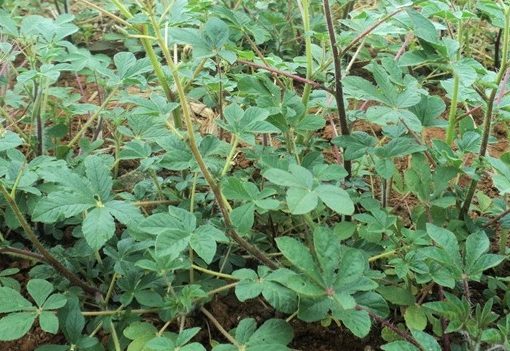
Climate change continues to threaten the future of planet Earth, with the destruction of natural forests for human settlement and production remaining one of its principal drivers.
In response, Kenya, under the leadership of President William Ruto, has embarked on an ambitious initiative to plant 15 billion trees by 2032.
The programme seeks to increase national tree cover from the current 12 per cent to 30 per cent, create green jobs and strengthen climate resilience.
Tree planting and forest restoration play a critical role in rehabilitating water catchment areas, reducing carbon emissions and safeguarding livelihoods. However, forest cover remains low in several regions of the country.
In Migori County, forest cover has increased from about 0.3 per cent over the past decade to nearly two per cent, a figure still far below the recommended minimum of 10 per cent.
Across Kenya, Africa and globally, tree-planting efforts have often been undermined by a lack of sustainable and scalable forest husbandry, with many planted trees failing to survive to maturity.
With the growing threat of climate change, many poor households in Kenya face declining crop yields and livestock productivity, jeopardising their livelihoods and food security.
To address these challenges, tree farmers in Migori County are set to benefit from a new initiative that will see them paid to plant and nurture trees to maturity, generating income while conserving the environment and contributing to poverty eradication.
Over the next three months, 10,000 farmers in the county are expected to be enrolled in the programme, which aims to improve household incomes while boosting forest cover.
The initiative is being implemented by the Tree Company (Treeco) Fund under a programme dubbed “People–Planet–Profit”, an environmental sustainability and poverty mitigation model designed to reverse climate change while catalysing investments among low-income communities in Kenya and Africa.
Treeco Fund Founder and Chief Visionary Officer Eddy Oketch said one of the biggest challenges in tree-growing initiatives is the lack of proper care after planting, resulting in low survival rates despite heavy investment in seedlings.
“In Kenya and across Africa, a lot of money is spent on tree seedlings, but very few survive to maturity because no one takes responsibility for nurturing them,” said Oketch.
Under the programme, Treeco Fund is distributing free tree seedlings to farmers in Migori County and providing financial incentives for every tree planted, nurtured and verified to have survived.
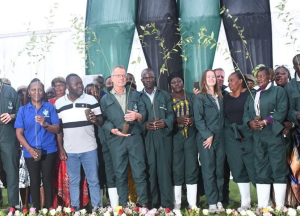
“The Fund will give out 365 tree seedlings to each farmer, where land and capacity allow, with an incentive of Sh10 per tree per month for the first year, translating to Sh3,650 monthly or Sh36,500 annually,” said Oketch.
He explained that the programme is designed to shift the mindset from simply planting trees to growing and managing them sustainably.
“It is time to empower our communities not just to plant trees, but to grow them. Treeco Fund will pay farmers to nurture trees so that after eight years they can earn substantial income from timber sales, while also contributing to climate change mitigation,” he said.
Already, 350 farmers in Nyatike Sub-County, a semi-arid region, have been enrolled in the programme. The initiative is expected to improve forest cover, support climate change mitigation efforts and supplement livelihoods traditionally dependent on fishing and gold mining.
Although the programme targets the distribution of 365 seedlings per farmer, those with limited land have been encouraged to take fewer seedlings to ensure adequate spacing and healthy tree growth.
“We want trees to grow well and mature faster. Adequate space is essential to ensure quality timber and higher returns for farmers,” noted Oketch.
Treeco Fund has also partnered with the United States-based Bale Company, one of the largest lumbering companies in the US, to secure a reliable market for timber produced by participating farmers.
Oketch said farmers will be able to begin harvesting trees after eight years, with guaranteed market access through the partnership offering prospects for better and more stable returns.
He further disclosed that there are plans for Treeco Fund and Bale Company to establish a wood products company using a vertical integration model.
The facility would process logs sourced from farmers using modern technologies such as debarkers, saws, presses and sanders to produce high-value wood products.
According to Oketch, the initiative is designed to provide immediate income through monthly incentives while enabling long-term wealth creation through timber sales.
“Farmers are guaranteed an income that can lift their households out of poverty if they consistently monitor and nurture their trees to maturity,” he said.
One of the beneficiaries, Silas Ochieng from Suna West Sub-County, said the 365 seedlings he received will allow him to establish a small forest on his two-acre farm.
Ochieng said the initiative offers both short-term income through incentives and long-term financial security once the trees are harvested.
“This programme will empower me and my family by providing income during the nurturing period and even more returns in the future,” he said.
However, he urged fellow beneficiaries to exercise discipline in caring for the trees, not merely for the incentives but also for environmental conservation.
Another beneficiary, Caroline Atieno from Wasimbete Ward in Suna West Sub-County, said tree growing presents a practical solution to climate change mitigation and poverty reduction.
Atieno encouraged women to embrace tree planting as an additional income-generating activity alongside initiatives such as table banking, fish trading and vegetable farming.
“With trees, all you need is space, security and watering during dry seasons. Once the trees survive, you earn incentives every month while waiting for your long-term investment to mature,” she said.
By Makokha Khaoya and George Agimba