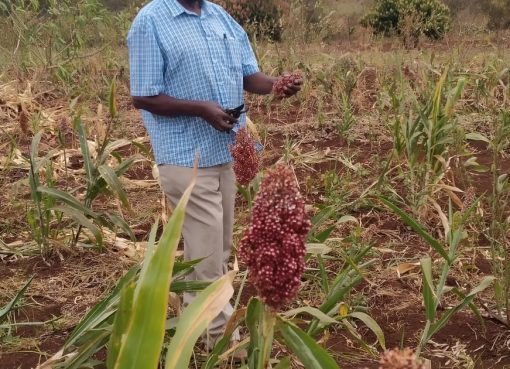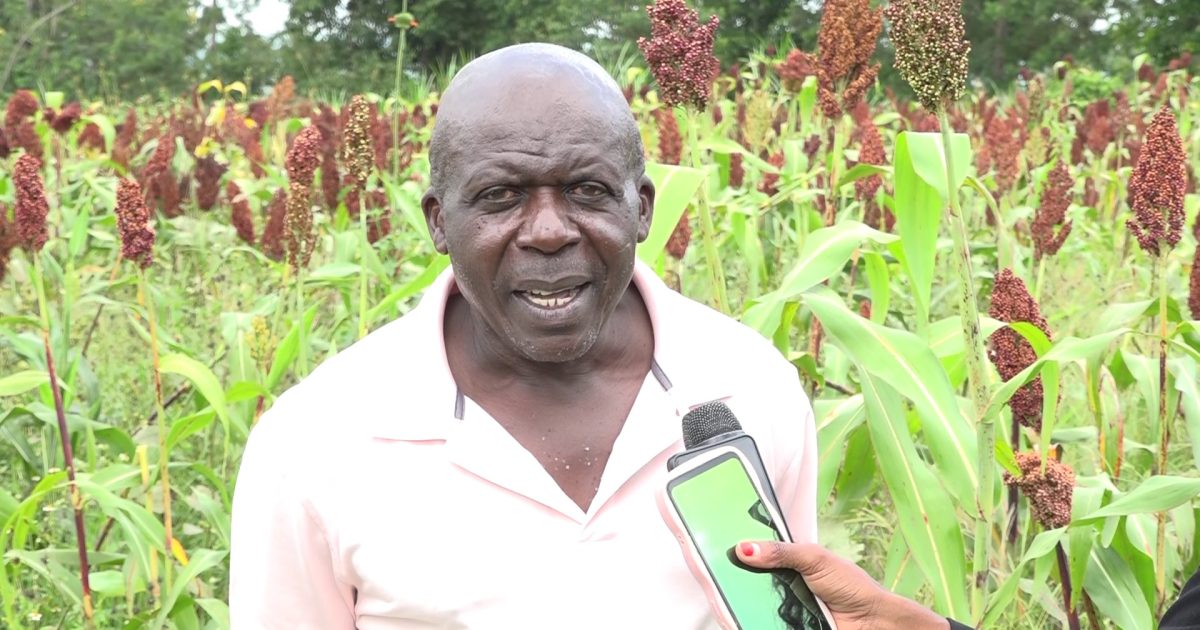
When he retired from teaching in 2019, Wilson Alunda Nyaoro resolved to settle down as a farmer.
Nyaoro, who hails from Ndere village in North Gem location, Siaya County, tried his hands on several crops, among them maize but all were demanding and returns were minimal.
When a team from the Cereal Growers Association and Kenya Breweries Limited visited the area to promote Sorghum and Millet farming in the area, the teacher did not hesitate to join a group that was formed by village mates to try their hands at growing the once-popular crop that had been abandoned and replaced by maize in the larger Nyanza region.

“This is my first time farming millet. It may not be good but I am trying,” he told the Kenya News Agency during a field day organised on his farm.
Nyaoro, who says that he planted a bit early when there were no rains, pledges to double his efforts during the next season, adding that he was expecting more money once he harvests and sells his produce to KBL that has guaranteed him and other farmers a ready market.
Nyaoro is not alone. Within the Ndere area, several farmers, among them Mary Akinyi Odhiambo and Yahuma Okoko, have joined the race towards reviving sorghum and millet farming.
“Millet is good, as it also helps fight hunger at the household level,” says Mary Akinyi Odhiambo, adding that she needs just a small amount to mix with maize and cassava for her family to enjoy a sumptuous, healthy meal.
She says that the current variety that is being promoted in the area has better yields and is not liked by birds, the main challenge to the farmers.
For Yahuma Okoko, millet growing is the in thing, as it does not only assure them of money in the pocket but also ensures that they live healthy and long lives.
“It is medicinal. Old men who use it in their diet live for long,” says Okoko, adding that it is good for diabetic people compared to maize.
Okoko calls on the Kenya Breweries Limited to consider supplying farmers with fertiliser and seeds as loans to be recovered once they deliver their crops to the company.
The patron of the area sorghum farmers, Engineer Sam Opot hailed the initiative and called on local farmers to leverage KBL’s initiative to increase production and improve their socio-economic wellbeing.

Eng. Opot said the reintroduction of the crop in the area through support from the beer manufacturing company saw local farmers earn Ksh. 3 million last season.
“We started with 60 farmers who produced 76 tonnes. The harvest was bought by Kenya breweries that paid sh. 3 million,” he said.
Opot said that the number of farmers has now increased to 1,000, scattered across Nyabeda, Asayi, Sirembe and Got Regea sub-locations.
He urged local farmers to take advantage of the ready market to venture into sorghum farming.
Nyabeda sub-location assistant chief, Tom Aruwa, led the local residents in appreciating the re-introduction of the crop in the area, saying that it has helped ensure food security.
“With the ready market, money will be in the pockets of the farmers and this will address both food and general security in the area,” he said, adding, “diseases like diabetes will be a thing of the past.”
The Kenya Cereal Growers Association field officer, James Oduori, urged Siaya farmers to take up sorghum and millet growing as a source of income now that there was an assured market.
“Farmers must ensure that they have enough cereals for both domestic and commercial use” said Oduori adding that as an association, the CGA will ensure that they get the best harvest to sell to the market.
His sentiments were equally shared by Kenya Breweries Limited’s field officer, Collins Onyango Magaga who said the company will continue assisting farmers with seeds and teachings on the best agricultural practices for maximum yields.
According to nutritionist with Kenya Medical Training College Nairobi Samuel Maina, millet Ugali has high fibre content which can help prevent sudden spikes in blood sugar after meals
This means millet raises one’s blood sugar slowly and gradually. It is low in cholesterol can help one lose weight. All these are helpful to those suffering from diabetes and obesity, says Maina.
An agricultural research scientist Dr. Chris Ojiewo said it is now widely accepted that eating whole grains can help one lose weight.
Dr. Ojiewo, who is in charge of strategic partnership and seed systems for the dryland crops programme at the International Maize and Wheat Improvement Centre (CIMMYT), urges Kenyans to embrace millet and its related products to tackle soaring obesity rates and enhance food nutrition.
Recognising the urgency of the situation, experts in food security are now focusing on millet as the best food crop to combat the problem.
Dr. Ojiewo said millet is the answer to keeping at bay many lifestyle diseases. Millet, with its adaptability to dryland conditions and high nutrition value, has the potential to play a critical role in combating obesity and diabetes by improving overall nutrition in Kenya.
Despite these many health benefits of millet, currently, production in Kenya remains significantly low. Kenya imports a significant portion of its millet from neighbouring Uganda and Tanzania, despite its capacity to produce the crop locally.
The need for diversification becomes apparent, as heavy reliance on maize, wheat and rice leaves farmers vulnerable to catastrophic crop losses due to unpredictable weather patterns.
As a versatile grain, millet can thrive in regions with high temperatures and limited rainfall, thus making it a viable option for areas where traditional cereals, like maize, struggle to survive.
The eastern and northeastern parts of Kenya, often overlooked for cultivation due to misconceptions about the harsh climates, could potentially benefit from millet production, says Dr. Ojiewo.
Millet production in agribusiness can improve food security, support sustainable agriculture, promote healthy diets and provide a potential source of income for youth and women.
Integrating millets into school feeding programmes can improve children’s nutrition and brain development.
The increased demand for millets, even in urban supermarkets, shows their growing popularity. Additionally, exploring value-added millet products could open up new markets and boost overall production and the economy.
By Philip Onyango.