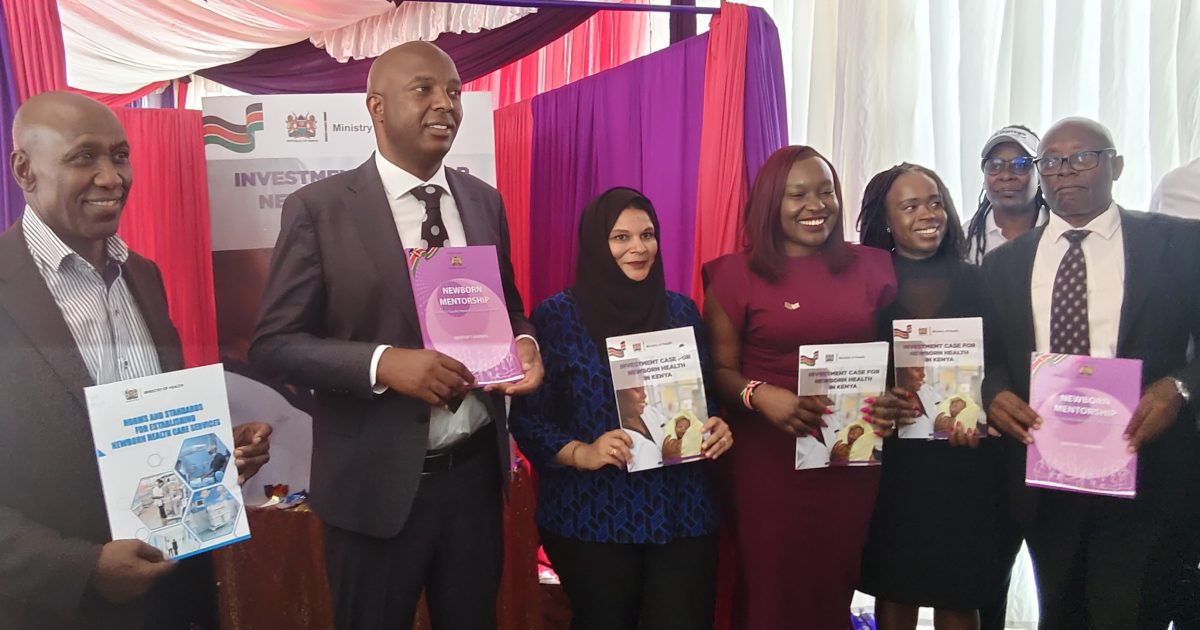
The Ministry of Health has completed a plan that will guide in preventing preterm births which have been cited as a leading cause of neonatal deaths.
Health Cabinet Secretary, Aden Duale, said the plan dubbed National Every Woman Every Newborn (EWENE) Acceleration Plan is aligned to the global EWENE agenda and designed for national scale beginning from community to sub-county to county hospitals.
In a speech read on his behalf by Director of Health Products and Technologies, Dr. Nazila Ganatra, during celebrations to mark World Prematurity Day on Monday at Murang’a Level 5 hospital, Duale noted that the plan prioritizes facility readiness, health-worker capacity, family support, and public accountability so no newborn is left behind.
“Prematurity remains a leading cause of neonatal deaths. Each year, too many families face preventable loss. These numbers are sobering yet they do not define our destiny.
“With timely, high-quality, scalable interventions, we can change this story everywhere, not just in a few facilities,” Duale stated.
According to statistics from the Ministry of Health, 92 children are born prematurely every day in Kenya while Murang’a County has been recording between 20 to 30 preterm births in every month.
Duale said three quarters of neonatal deaths can be prevented through cost effective interventions.
Neonatal mortality accounts for 51 percent of under 5 deaths and 66 percent of infant deaths in the country.
In the plan, Duale remarked that the country is working on newborn investment care by upgrading more than 80 percent of sub-county health facilities and all county hospitals to a standard of saving tens of thousands of newborn lives by 2030, with strong social and economic returns.
“Other enablers include a national mentorship package for newborn care which involves a low-dose, high-frequency model to build frontline skills within routine services.
“National norms and standards for newborn care are based on minimums for infrastructure, staffing, equipment, and protocols to ensure quality is consistent everywhere,” he explained.
The CS observed that reversing newborn and maternal mortality is a national pledge saying the Ministry will embed EWENE actions within maternal and perinatal death surveillance response (MPDSR) using a no-blame and act-fast culture
“We will integrate Community Health Promoters for early post-discharge follow-up and publish quarterly county EWENE scorecards so gaps trigger immediate corrective action,” he added.
Some interventions that were listed to prevent premature births include social and behaviour change practices such as smoking cessation, increased physical activity, improved nutrition, immediate adoption of Kangaroo Mother Care (KMC) after birth, and strong family involvement in supporting mothers and newborns.
Speaking during the occasion, Murang’a governor Irungu Kang’ata, said his administration has rolled out various programmes aimed at supporting maternal health care.
Kang’ata noted that the county government has expanded mother and new born units in various local health facilities adding that they have increased incubators to support infants born prematurely.
“In Murang’a County we have ongoing initiatives such as the Maternal Health Programme, which encourages expectant mothers to attend antenatal clinics consistently.
“The county government is also giving free iron and folic acid supplements to all expectant mothers across county health facilities to safeguard the health of both mother and child,” he added.
“This effort is complemented by continuous upgrades to health facilities and the procurement of essential newborn care equipment, including radiant warmers and continuous positive airway pressure machines,” Governor Kang’ata said.
Country Director of Nutrition International, Kenya, Ms Martha Nyagaya noted that her organization joined other development partners to collaborate with the national and county governments, to assure every newborn child a fair chance at life, starting from their very first moments in life.
Nyagaya remarked that globally, one in every ten babies are born before term, and later predisposed to life threatening conditions such as respiratory distress and hypothermia.
“Most are born underweight and require the right nutrition and care for growth. Sadly, a significant number of these babies die of prematurity-related complications, while some live with lifelong disabilities that impede their chance to realize their full potential,” she added.
Ms Nyagaya revealed that Nutrition International has supported some counties to build the capacity of healthcare workers through training on comprehensive newborn care using the latest guidelines.
“We have also supported a baby-friendly hospital initiative that promotes timely initiation of breastfeeding for all newborns, and exclusive breastfeeding for all children under 2 years; and maternal, infant and young child nutrition,” she added.
by Bernard Munyao & Purity Mugo