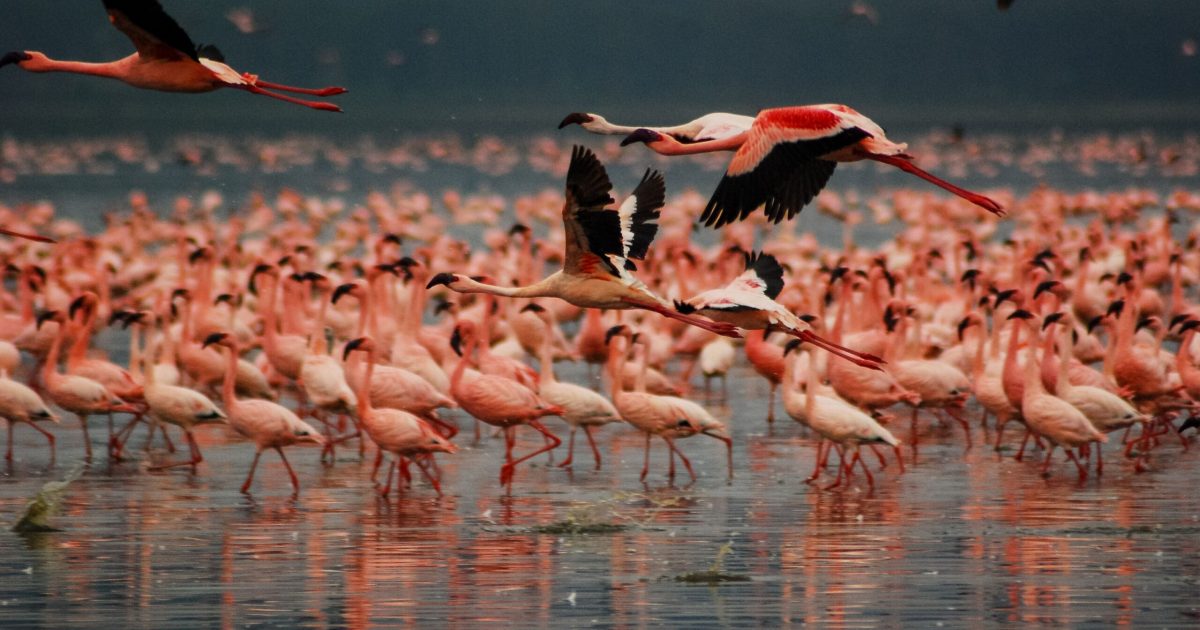
Nakuru County government, in collaboration with United Nations Educational, Scientific and Cultural Organization (UNESCO) and the Kenya Wildlife Service (KWS) have conducted data collection on lesser and greater flamingoes at Lakes Nakuru and Elementaita to establish factors fanning the reported alarming decline of the birds’ population.
The exercise, under a project dubbed “Safeguarding the Unique Ecological Gem of the Kenya Lake System in Lake Nakuru and Lake Elementaita,” comes at a time when scientists have expressed concern over the rising water levels, climate change and habitat degradation which they claimed were driving flamingos in alkaline Rift Valley lakes to the brink of extinction.
Nakuru County Secretary, Dr Samuel Mwaura, said the exercise, which was part of the implementation of the UNESCO/Netherlands Funds-in-Trust (NFiT) project, involved identification of the challenges contributing to their decline, investigation into environmental degradation and assessment efforts aimed at maintaining and restoring the lakes’ ecosystems.
Dr Mwaura disclosed that the data collected during the visits will be analyzed during an in-house workshop for UNESCO, KWS and the County Government’s officials to be held before the end of May 2025.
He added that the experts will be studying the impact of factors like food availability, lake chemistry, and climate change effects on flamingo populations, adding that rapid urbanization had also escalated threats to the survival of flamingos.
The county secretary spoke during deliberations on the NFiT project with UNESCO officers led by its Programme Officer Faith Manthi and officials from both KWS and the County Government.
Dr Mwaura pointed out that during the exercise the local community, including youth, Persons with Disabilities (PWDs), and tourism and environmental champions active around the lakes, had been engaged to provide indigenous knowledge and insights.
Data collection on the lakes involved observing and counting bird populations, as well as monitoring their habitat and feeding habits, and involved using aerial surveys, satellite tracking, and ground-based observations to assess population sizes, distribution, and seasonal movements, according to Dr Mwaura.
The county official further said that the data collection exercise integrated studying the types and quantities of food sources in the lakes, such as the cyanobacteria Spirulina, diatoms, and other plankton, which are the main food items for flamingos. This, he said, would help determine how much food is available to support the flamingo populations.
He said the county government was now focused on public awareness campaigns, evidence-based research and pollution mitigation in large water bodies within the devolved unit as part of efforts to boost conservation of flamingos.
“Understanding flamingo populations and their habitat needs is crucial for conservation efforts, particularly as some populations are facing challenges due to environmental changes,” Mwaura said.
While noting that flamingos were a major tourist attraction in Rift Valley, Dr Mwaura emphasized the need for monitoring their populations, saying it could help ensure sustainable management of the resource.
Bird experts and conservationists have indicated that though several East African states have domesticated international treaties on protection of migratory species as part of concerted efforts to save flamingos, which sustain tourism besides stabilizing ecosystems, human-induced threats such as pollution of wetlands have aggravated an already worse situation for the birds.
According to Senior Researcher at the Kenya Wildlife Service (KWS), Joseph Edebe, increased volumes of water at Lake Nakuru and Bogoria have destroyed large portions of the birds’ habitats, leading to a decline in their numbers.
He noted that unpredictable weather patterns have disrupted the migration of flamingos from Tanzania to Kenya, adding that curbing lake pollution and increasing public education was vital to strengthening protection of the migratory birds.
The researcher explained that the increase in water levels had reduced the alkalinity of the lakes and, as a result, weakened their capacity to sustain blue-green algae that flamingos feed on.
In the months of January and July every year, KWS, the National Museums of Kenya, Kenya Wildlife Nature Kenya, Site Support Groups and volunteers partner in carrying out a census of water birds.
Between 2008 and 2015, statistics from the census, particularly in Lakes Nakuru and Bogoria, confirmed a declining trend in lesser flamingos, while the population of greater flamingos remained stable.
Lesser flamingos totally depend on blue-green algae as food, whereas greater flamingos feed on a wider variety of food within the alkaline lakes.
“In 2010, more than one million lesser flamingos were recorded in total in the water bird counts but in 2014, only 5,000 were recorded,” the report stated.
In 2017, the Status of Key Biodiversity Areas report observed that the overall status of the sites, which included major flamingo feeding sites, were unfavorable. Lakes Nakuru and Bogoria were among the 38 sites that recorded unfavorable status during the monitoring period.
The UNESCO/Netherlands Funds-in-Trust (NFiT) project is a long-standing collaboration between UNESCO and the Netherlands, established in 2001 to support the implementation of the World Heritage Convention.
It aims to reinforce the conservation and management of World Heritage sites, providing financial and expertise support. The NFiT project in Nakuru focuses on safeguarding the Kenya Lake System, a UNESCO World Heritage site, by addressing threats like pollution and climate change.
By Esther Mwangi