27.7 per cent of girls between 10 and 14 years old have received the full dose of anti-Human Papillomavirus (HPV) in Narok County this year, the County Director of Health, Dr. Francis Kiio, has said.
Dr. Kiio, who spoke to Kenya News Agency (KNA) at his office, said another 40.1 per cent had received the first dose and was yet to get the second dose that is given after six months.
The director described the intake as fair, saying their main target is schools and those that walk to the medical facilities to receive the dose.
“This year, we have a target of immunising 118, 968 girls in our 182 health centres and 1070 schools that are spread across the county. We encourage the residents to embrace the vaccine so that we can score our target,” he underscored.
He observed that the sub-county with the highest number of girls is Narok North, which has 22,880 girls between the ages of 10 and 14, Narok South (21,692), Narok West (17,759), Trans Mara West (15,215), Narok East (10,474), Narok Central (13,727), and Trans Mara East (10,074), and the least is Trans Mara South with 7,147.
Trans Mara East sub-county is leading in HPV immunisation as it has achieved 79.2 per cent of targeted girls this year who have received the two doses.
At the same time, Narok North Sub County is trailing behind with only 8.2 per cent of its targeted population having completed the two doses.
Dr. Kiio observed that the greatest challenge the programme is facing is lack of facilitation to reach schools in remote and rural areas where health facilities are far from the homesteads.
“The main barrier to optimal uptake of the essential service has been inadequate logistical facilitation by the field vaccination team to move in order to reach the schools where the girls are,” he said.
He said vaccination is a sure way of eliminating cervical cancer, as the disease is caused by HPV that is spread through sexual intercourse.
The Centre for Behaviour Change and Communication (CBCC), in partnership with UNICEF, has been working with the county governments to sensitise the residents to the vaccine through training health stakeholders who give information to society.
The County Immunisation Coordinator, Shadrack Beru, said they did not experience any opposition from the community because the officials first held sensitization forums before engaging in the vaccination exercise.
He, however, cited long distances and lack of facilitation as the main challenges that have contributed to the low numbers of girls that have so far been vaccinated.
Beru challenged parents to take their girls to the nearest health facilities for immunisation to prevent the disease that he said has caused a huge negative impact on the economy.
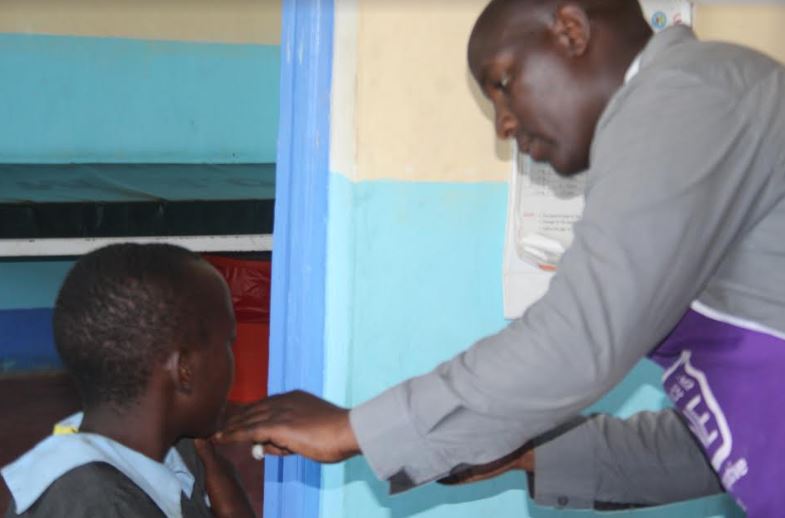
The officer reiterated that the vaccine has no side effects except for the pain that the young girls feel when being injected.
However, for the women above 14 years old, the officer recommended they visit the health facilities for regular screening so as to avert cervical cancer.
Other vaccines that are recommended by the National Vaccine and Immunisation Programme are Bacillus Calmette-Guerin (BCG) for tuberculosis, Oral Polio Vaccine (OPV) for poliomyelitis, Rota Virus (RV) for diarrhoea, Diphtheria, Tetanus, and Pertussis (DTP) for diphtheria, whooping cough, tetanus, measles, and rubella.
Narok South Deputy County Commissioner Felix Kisalu said they have instructed the chiefs and their assistants to sensitise the residents on the need to get the free vaccines in their nearest health facilities.
“The chiefs hold at least two barazas every month. One of the messages they are encouraged to communicate during these forums is the importance of getting an anti-HPV vaccine,” said Kisalu.
Mrs. Irene Kipai, from the Loita area and a mother of two teenage girls, is a happy mother as her two girls received the dose at Morijo Primary School, where they are.
She, however, called on the medics to intensify the campaign and move to schools in remote areas where the locals cannot afford to travel to health centres.
By Ann Salaton