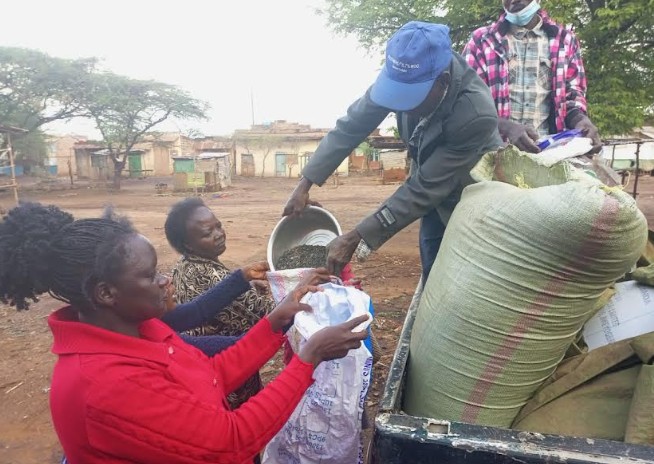
In the semi-arid village of Ndalani in Yatta sub-county, Machakos County, farmers are steadily abandoning their traditional maize and bean fields in favour of drought-resistant crops such as sunflowers and cotton in a bid to free themselves from years of low yields and hunger.
The shift, the farmers say, comes after successive seasons of disappointing maize harvests caused by inadequate and erratic rains.
Their Chairman, Uvouni Farmers’ Cooperative Society, which is revolutionising the two crops in the area, Francis Kilango explains that maize yields had become unreliable under the low-rain typical of the area, and that the sunflower crop offered a better fit as the plants tolerate lesser rainfall, require fewer chemicals and labour, and offer the promise of a more assured income.
Available data show that sunflower grows well in areas with sparse rainfall and requires fewer inputs than maize.
Under a government scheme aligned with the Presidential Economic Transformation Agenda, the farmers in Ndalani have received about five tonnes of sunflower seed, enabling them to farm the crop this season.
Cooperative members say they will also diversify further into millet, sorghum and sweet potatoes to ensure food security in the face of climate stress.
“The sunflower will flourish here,” the cooperative chairman Kilango said, “since it needs less rain, no heavy pesticides or farm work, and it can keep us fed while we build up our income.”

Residents led by David Kaloki and Mwikali Ngugi lauded the government’s efforts to revolutionise agriculture in the area through such incentives.
At the same time, they appealed for greater seed availability, noting that while the five-tonne grant was welcome, more seed would allow them to increase acres under sunflowers significantly.
“When maize fails, we are left hungry; with cotton and sunflower at least, we will get income and plant food that survives the dry seasons,” said Kaloki.
Sunflower farming in the country is gaining traction as a smart rotation and drought-tolerant crop. Experts note that sunflower serves as a break crop, improves soil structure through deeper roots, controls weeds more easily, and can mature fast within 3-4 months in favourable conditions.
Statistics show that the area under sunflower in the country rose from some 7,128 hectares in 2023 to some 40,675 hectares in 2024, and production rose from around 10,151 metric tonnes to 41,288 metric tonnes in the same period.
For Ndalani farmers, sunflower offers more than just survival food: it connects to a market for edible-oil and animal-feed by-products.
The farmers have got another boost with the government announcing that it will provide a ready market as well as construct a processing unit in the area.
Meanwhile, the local farming community has also been embracing cotton. The cooperative says that for the past few years many farmers have turned to cotton alongside their shrinking maize/bean fields.
This has also been bolstered by a local Thika-based textile firm that provides free seed and a guaranteed off-take market. Some have even been getting more than Sh150,000 as income from the sale of their produce, amounts they could not even dream of when practising maize and bean farming.
Nationally, the cotton sector is being revitalised under the Bottom-Up Economic Transformation Agenda, and farmers in Yatta/Machakos have begun to benefit from improved pricing: a recent price review raised the farm-gate price to Sh72 per kg from Sh50, signalling improved returns.
With the ongoing season of rains, the cooperative urges other farmers to take advantage, adding that with better access to seeds, land under sunflower and cotton could double before next season.
By Muoki Charles