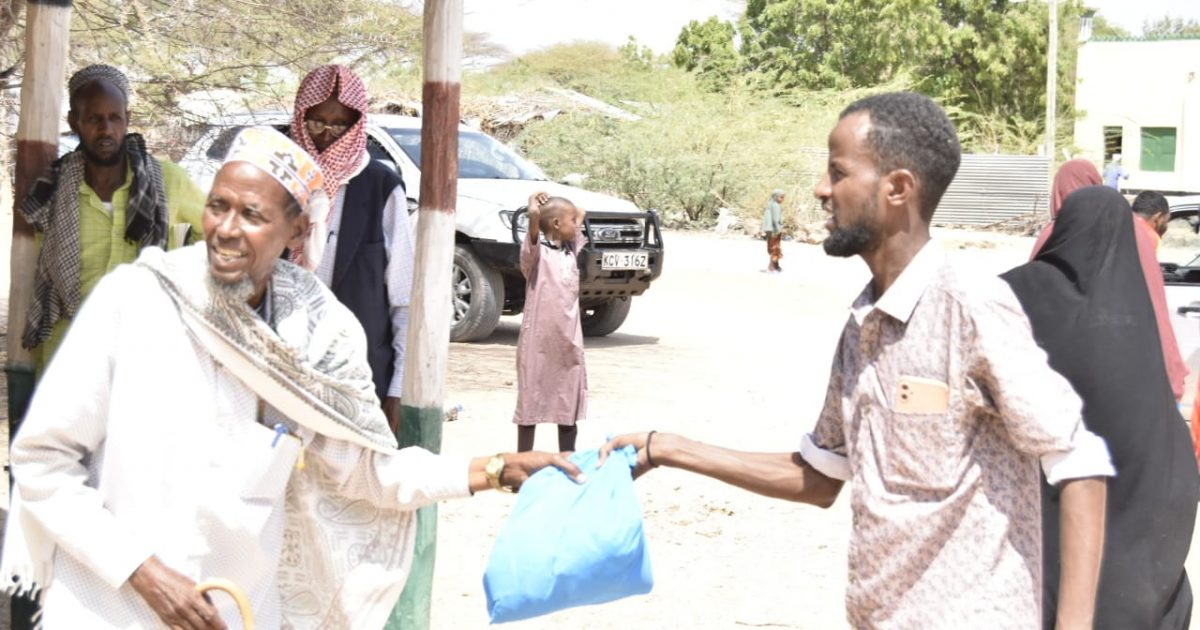
The National Drought Management Authority (NDMA), in partnership with a Non-Governmental Organisation (NGO), International Relief for Africa, today, donated assorted foodstuffs to more than 500 elderly families in Modogashe town, Garissa County.
The foodstuffs that included fortified rice, nutritive porridge, and sugar targeted the most vulnerable in the society who are aged 65 and above. The donation is part of NDMA’s Corporate Social Responsibility (CSR).
The two institutions also donated umbrellas to over 100 small-scale traders operating in the streets of Modogashe town. Both the elderly and the traders were identified by the community.
Speaking after distributions, Dr. Allan Mugambi from the NGO said that the essence of the programme was to assist the elderly in the society who are ‘mostly neglected’.
“As an organisation, I want to give an assurance that we will continue partnering with NDMA and other state agencies to support the very vulnerable in our society,” Dr. Mugambi said.
Koome Kirago, a Board of Directors member with NDMA, hailed the partners for extending their support to the vulnerable members of the society.
“This is a very vulnerable age group that requires our support. This is one age group that is a bit neglected and they require that kind of support, especially in the ASAL areas,” he said.
Kirago called on other donors and partners to come on board and offer assistance to the vulnerable in society, saying that the number of those in need of assistance was growing by the day.
“We sincerely thank our generous donors for their unwavering support in providing food aid to the most vulnerable in this part of the country.
We want to humbly call on other donors and partners to also come on board and support this worthy cause because our need for food in this country is huge,” Kirago said.
NDMA CEO, Hared Adan said the organisation is putting a lot of emphasis on the improvement of water infrastructure in the 23 Arid and Semi-arid counties that it operates from.
Hared said the emphasis is meant to enhance access to water for the communities in the counties that are ‘typically dry, with scarce and unreliable rainfall’.
The CEO said water remained the single biggest challenge facing the 23 counties, noting that ‘once it is sorted out, then most of the problems that residents encounter will be minimised’.
“Water remains the single most critical challenge in ASAL counties, underpinning nearly all aspects of life, ranging from health, education, economy, and security. If we have water, we will have solved almost 90 per cent of the problem of our communities,” Hared noted.
Hared said that the Agency ‘was alive to this fact: water is a critical necessity and was seeking to have permanent solutions to the problem’.
He said the Agency was focused on building the community’s resilience so that they can be able to withstand the drought shock.
“As an Authority, we are putting a lot of effort into water infrastructure and based on the budget support from the national treasury, we are going to put a number of infrastructures in the arid and semi-arid counties that will support our communities to withstand drought shocks,” he added.
By Jacob Songok