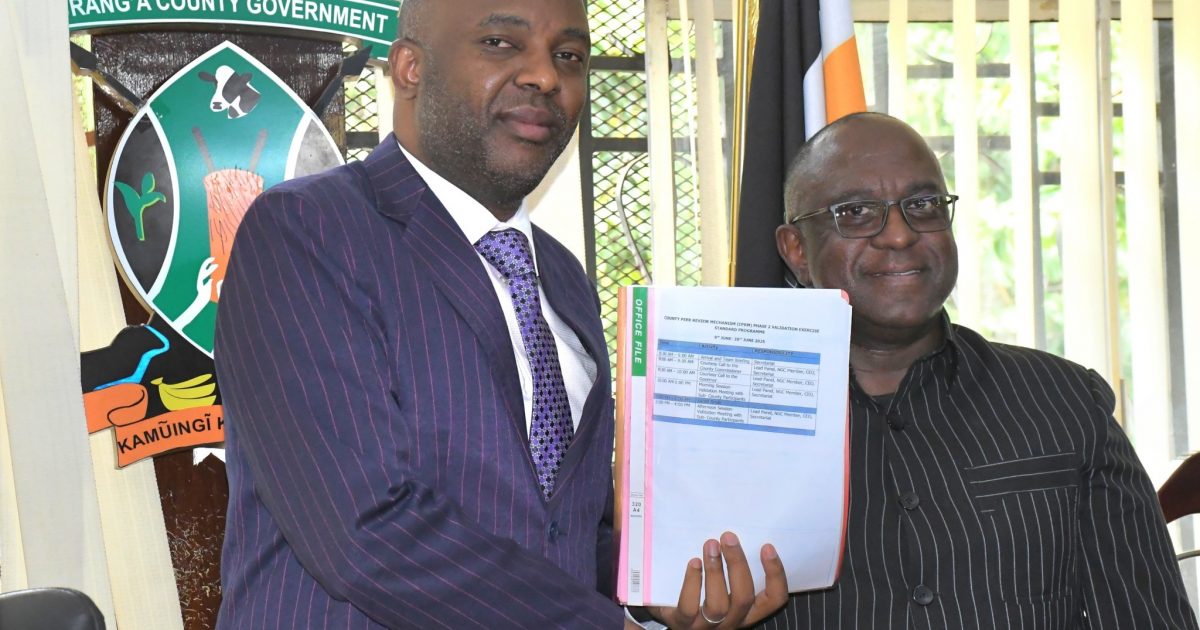
The New Partnership for Africa’s Development (NEPAD)/Africa Peer Review Mechanism (APRM) Kenya Secretariat has handed over the interim Self-Assessment Report to Murang’a County as part of the validation of the County Peer Review Mechanism (CPRM).
Speaking at the Murang’a county headquarters Thursday, Sospeter Ojaamong, the Chairperson of the NEPAD/APRM Kenya secretariat, explained that the peer review programme is a voluntary initiative that allows independent reviews and recommendations on how counties can improve in provision of services.
“This is a voluntary programme; the governors cannot assess themselves but with the help of APRM we can come independently and review them for the sake of pointing out areas where counties have excelled or are failing and how they can improve,” he said.
The NEPAD /APRM Kenya Secretariat is a semi-autonomous government agency under the National Treasury and Planning that has a panel of eminent persons who are independent people who have served this country in various capacities and who visit counties and listen to suggestions from the public.
“They listen to the opinions of the focus groups on how the governor has performed in devolved functions such as infrastructure, water and Early Childhood Development Education (ECDE) among others and come out with an independent report,” he said.
“We are here today to validate what we collected from the public,” he added.
The overall objective of establishing the CPRM is to promote good governance practices and facilitate peer learning of best practices for balanced socio-economic development across the country.
The ten counties involved in this validation phase include Nakuru, Embu, Uasin Gishu, Kericho, Baringo, Murang’a, West Pokot, Laikipia, Nyandarua and Taita Taveta.
These counties have completed comprehensive self-assessments addressing key governance areas such as public participation, service delivery, economic development, transparency and accountability in the devolved functions.
He said the participating counties will then discuss their reports at a summit scheduled for august this year, noting that one of the common challenges across the counties is the control of drugs and substances.
“We will be having a summit where the 10 counties we are reviewing will come to discuss their reports and suggest the best way to handle suggestions from the grassroots,” he said.
Ambassador Rukia Ahmed Subow, the lead panellist for Murang’a county said the secretariat gives reports that are based on feedback from the public.
She highlighted that based on the feedback received from the public, the issues of drugs and alcohol as well as gender-based violence (GBV) are among the top concerns across counties.
“We need to put more effort and allocate more funds for sensitising the communities, especially the youth, against the use of drugs and alcohol,” she said.
She explained that the panel only looked at 14 devolved functions and she noted that there are other crosscutting functions that need concerted efforts from both national and county governments.
Murang’a governor Irungu Kang’ata, on his part, welcomed the peer review initiative, saying it helps counties evaluate their performance as well as learn from each other through the feedback received from the public and peers.
“In the county peer review mechanism, surveys are conducted among residents through focused group discussions where certain people are selected and asked questions,” he explained.
He noted that in Murang’a the assessment revealed that the county is performing poorly in matters related to control over alcohol and drugs and gender-based violence (GBV).
Irungu also noted that the report revealed that Murang’a County is excelling in the implementation of ECDE, healthcare and agriculture.
The governor said that the report also included recommendations such as bringing seeds and fertiliser distribution closer to the people at polling stations instead of at location or ward level that, when applied, will improve the delivery of devolved functions.
By Purity Mugo and Bernard Munyao