The full implementation of the Competency-Based Education and Training (CBET) curriculum has begun yielding positive results in Kenya’s Technical and Vocational Education and Training (TVET) sector.
Preliminary assessment indicated that technical institutions were reporting improved practical skills acquisition and higher absorption of graduates in the both the respective job market and related industries since the inception of the initiative.
Stakeholders at PC Kinyanjui Training Institute have hailed the Ministry of Education for supporting the transition from theory-heavy curricula to industry-focused training.
Simon Thuo, Deputy Principal in charge of Administration at PC Kinyanjui, highlighted the significance of modernizing infrastructure and workshops to align training with industry requirements.
“Improving our workshops across multiple departments is critical. We benchmark against industry standards to ensure equipment and machines reflect current trends, giving our trainees practical exposure comparable to the industry,” he said.
Speaking during a visit at the facility, Thuo noted that competition in the TVET sector was increasing stressing the graduates while seeking job openings hence the need to include skills that were compatible with the industry requirements.
Mr. Paul Osoro, Registrar Administration, emphasised that the CBET curriculum’s practical approach has enhanced trainees’ readiness for the job market.
“For the CBET curriculum, which we currently call BEST, the practical component is designed to be industry-related. To adequately prepare trainees, there is a need to improve equipment and training environments, some of which are expensive. We are training by the industry and for the industry, incorporating industry trips and practical sessions to ensure students relate theoretical learning to real-world applications,” he said.
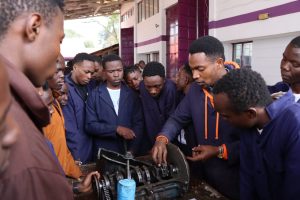
He highlighted the adoption of virtual labs to complement physical training where acquiring equipment is a challenge.
Mr. Soitanae Kaleke, Dual TVET Coordinator, shared progress in dual training courses where students split time between classroom instruction and industry practice.
“We started with three courses and 23 graduates. Currently, we have eight courses with 92 trainees, including automotive level 4, science lab technology level 5, building technician level 5, and social work. Female trainees make up 34.78 per cent, while males are 65.23 per cent. Our January intake will include three additional courses targeting 60 students in general level 5, electrical operations level 5, and cosmetology level 5. We already have 15 industry partners for training agreements,” he said.
Mr. Kaleke cited examples of successful absorption of trainees into industry, including Subaru Motors, Swiss Lenana Mount Hotel, and Primrose Food Express Limited, demonstrating the effectiveness of CBET in producing industry-ready graduates.
Registrar Academics, Jane Gatacha, explained that the CBET courses offered across departments ranged from three to six depending on the programme.
“We offer courses in environmental studies, agriculture, applied sciences, hospitality and tourism, electrical and electronics engineering, as well as business and liberal studies. We have successfully implemented six levels, except in business and liberal studies, where level 3 is not offered,” she said.
She explained that modularization of courses has been completed, allowing trainees to progress efficiently and providing flexibility for industry absorption.
“The modular curriculum is flexible, industry-friendly, and ensures graduates can be absorbed immediately into the job market,” she added.
Mr. Joseph Ouma, Head of Research and Innovation, highlighted the institution’s achievements in fostering practical skills and innovation.
“Our research and innovation department has grown significantly, participating in competitions at internal, regional, and national levels. For instance, at the Nairobi regional competition in September, our GSM-based solar panel cleaning project won first place, while a solar wireless charging station secured second.
At the national level in Mombasa, we presented multiple innovations and skills, securing top positions in tiling, plumbing, masonry, beauty therapy, and electrical installation,” he said.
Mr. Ouma added that the institution also participated in the Green Energy Innovation Forum in Kitui, where it secured second place among 20 TVET institutions.
Brenden Katuva, Recognition of Prior Learning (RPL) Coordinator, explained how Recognition of Prior Learning (RPL) complements CBET, enabling professionals to validate their skills and access formal certification.
“Our first cohort included 100 candidates who were assessed and awarded certificates through SIDAC. This programme has encouraged community members, including retirees from Masai Mara, to gain qualifications and establish small businesses, such as tour companies,” he said.
Katuva added that sensitization of candidates was ongoing to expand access to RPL programmes across the country.
Simon Thuo highlighted that improving infrastructure remains a priority, particularly workshops in the building, mechanical, and electrical departments.
“We strive to match equipment to industry standards, ensuring trainees gain hands-on experience. Industry collaboration, including training visits and adoption of new technologies, has become integral to our approach,” he said.
Osoro noted that CBET’s implementation also faced challenges, particularly in harmonizing curricula across institutions and reducing theoretical content.
“Initially, curricula were not standardized, complicating trainee progression and transfers between institutions. By September 2024, we reduced basic units to create a more practical, streamlined curriculum in Cycle 2. This modular approach has proven effective, with Module 1 graduates now entering the industry and Module 2 trainees preparing for industrial blocks,” he said.
He added that market-driven programmes, such as barista, beauty therapy, and driving school courses, have attracted significant student interest and boosted employability.
The introduction of CBET has been complemented by co-curricular activities and sports, fostering holistic development.
“Our trainees participate in athletics, basketball, handball, rugby, drama, and music competitions. This year, we took our lady rugby team to Nationals and secured three national awards in drama and music. We also promote special needs inclusion and skill-based competitions, producing national-level achievers in bricklaying, masonry, and other technical areas,” Thuo said.
The institution offers integration of gender-responsive initiatives and innovative programmes targeting women, particularly in greening industries.
“Our upcoming January 2026 intake will include hairdressing, baking, cosmetology, food and beverage, carpentry and joinery, solar and electrical installation, and fashion and design. We are targeting 133 trainees, including 95 women, to enhance skills in growing sectors,” she said.
She confirmed collaboration with JSN for support in women-focused programmes.
The Ministry of Education has been commended for supporting the shift to CBET, which aligns training with Kenya’s labor market needs. Stakeholders praised the government’s role in ensuring trainees gain practical competencies and graduate with employable skills.
The structured modular approach has facilitated flexible learning, industry engagement, and improved graduate absorption, transforming TVET training in the country.
As PC Kinyanjui Training Institute continues to implement CBET, the institution remains focused on enhancing infrastructure, expanding industry partnerships, promoting research and innovation, and offering market-driven programmes.
This multi-faceted approach demonstrates the transformative impact of CBET in equipping Kenya’s youth with the technical and practical skills required for the modern workforce.
By Naif Rashid