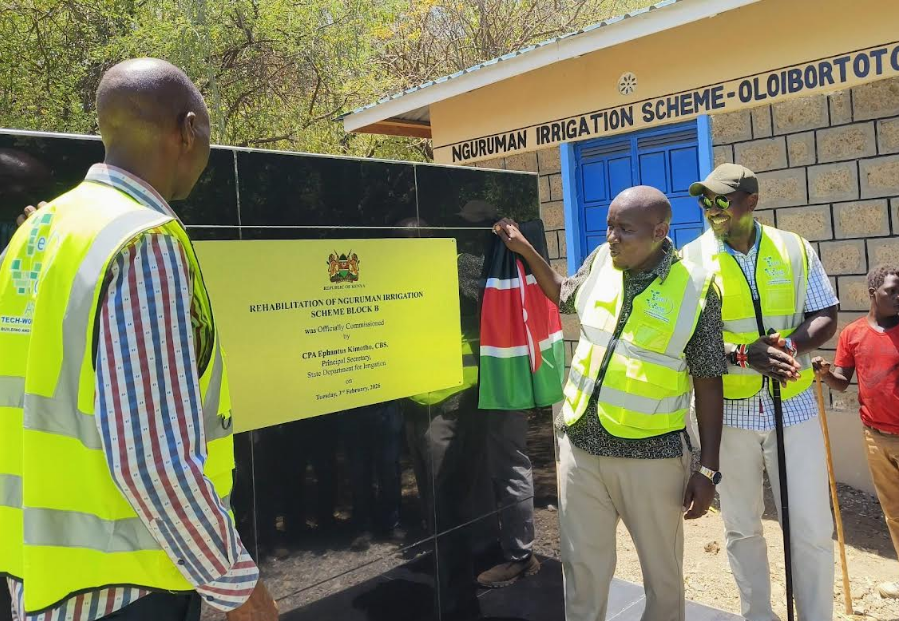
At least 10,000 farmers in the Kajiado West sub-county are set to improve their agricultural productivity following the rehabilitation of the Nguruman irrigation scheme.
The rehabilitation project set to strengthen climate resilience and boost food security began in 2024 after devastating floods destroyed canals and water intake systems, forcing many farmers to abandon the irrigation scheme.
The project has since restored water flow to farms in Congo Village, marking a major milestone in the revival of agriculture in the region.
Speaking during the commissioning ceremony, Irrigation PS, Ephantus Kimotho said the irrigation scheme, rehabilitated to the tune of Sh396 million, covers about 2,000 acres of land and supplies food to Magadi, Kiserian, Ongata Rongai and major Nairobi markets, including Marikiti.
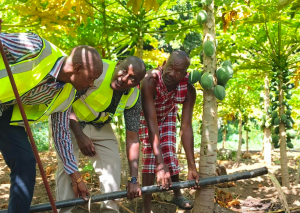
He revealed that through the adoption of climate-smart agricultural practices, the scheme has significantly improved productivity and resilience.
The availability of reliable water, piped over a distance of 51 kilometres, has enabled farmers to grow high-value cash crops, boosting household incomes.
“Water has successfully reached farms and farmers are already resuming irrigated agriculture. This project demonstrates how strategic investment in irrigation can transform rural livelihoods and build resilience to climate change,” Kimotho said.
The PS noted that beyond food production, the project is also expected to reduce human-wildlife conflict, a long-standing challenge in Nguruman.
He added that by stabilising livelihoods and improving agricultural productivity, the scheme limits encroachment into wildlife habitats as communities rely less on natural forests and conservation areas for survival.
“The availability of water will also minimise human-wildlife conflict by preventing wild animals from encroaching on farms in search of water,” he said.
Kimotho emphasised that the project aligns with the government’s Bottom-up Economic Transformation Agenda (BETA), which prioritises empowering smallholder farmers, strengthening food systems and enhancing climate-smart agriculture.
“The Nguruman Irrigation Scheme is a practical example of how well-planned irrigation infrastructure can drive economic transformation at the grassroots while protecting the environment,” the PS added.
Farmers have already resumed the cultivation of a wide range of crops, including okra, bananas, pawpaw, mangoes, vegetables and maize, significantly improving household incomes and food availability in the area.
According to Makarios Wachira, a local farmer, the restoration of water supply to their farms has transformed their lives, ending years of uncertainty caused by unreliable rainfall and damaged irrigation infrastructure.
“With reliable water, I now grow pawpaws, mangoes, bananas and vegetables, which earn me more than Sh4,000 every week. Farming is no longer a struggle but a reliable source of income for my family,” Wachira said.
He added that the steady water supply has enabled farmers to plan their planting seasons better, diversify their crops and supply local markets consistently.
“We can now farm throughout the year, pay school fees on time and meet our household needs without depending on relief food,” he said.
Levina Sororo, another farmer under the scheme, said the rehabilitation has restored hope among farmers, who had nearly abandoned irrigation after repeated flood damage.
“Before the canals were repaired, water would either flood our farms or fail to reach them at all. Now the supply is controlled and reliable, and our crops are doing well,” Sororo said.
She noted that access to steady irrigation has improved household food security and incomes, adding that families can now harvest regularly and sell surplus produce in nearby markets.
“With reliable water, we are growing vegetables throughout the year, which has improved what our families eat. As women, we also have our own income from farming and this helps us support our children’s education and other household needs,” she said.
By Rop Janet