Our interview is interrupted three times by anxious mothers seeking answers about their children living with disability.
One is seeking reassurance that her autistic son, who also has Cerebral Palsy, is on the right medication for his seizures.
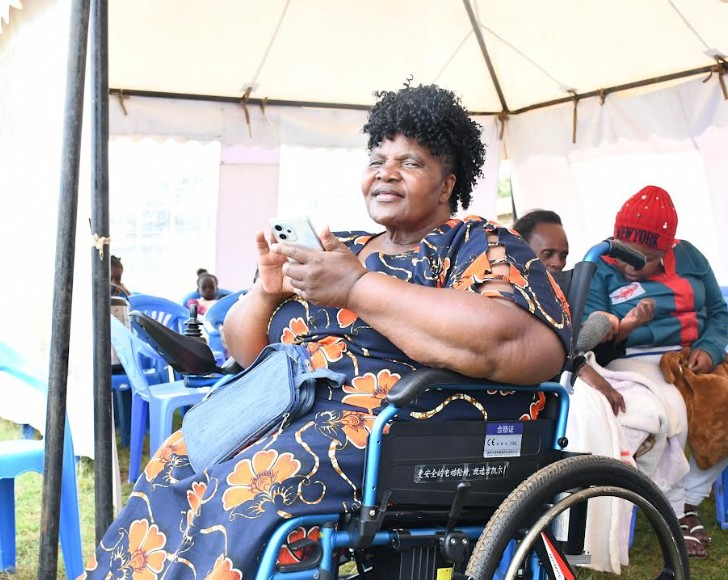
The medic, Dr Agnes Mithamo, listens to these women intently from her wheelchair. She understands their fears not just personally, but professionally.
“They are more comfortable talking to me, maybe because they tend to think that since I am in a wheelchair, I understand them better,” she tells us.
Dr Mithamo was born in Kirinyaga County some 64 years ago as a normal child. However, at the age of five months, the course of her childhood was altered when she contracted Polio which left her with a physical disability.
Despite being in the 70s, her parents, whom she describes as very loving, insisted that she would go to school just like any normal child despite the stigma.
She began her education at a village kindergarten which was founded by residents before her defining break came, she was admitted to Joytown school in Thika as a Standard two Pupil.
It was here that she developed a deep interest in medicine, a dream she pursued at the university.
“When I completed my ‘A’ levels at Bishop Gatimu Ngandu Girls High School, I decided to do medicine and pursued a master’s in Children Diseases,” says Dr Mithamo.
Today, she works as a paediatrician at the Nyeri County Referral Hospital. Beyond treating sick children, she also heads the county’s Disability Assessment Programme, where she vets children and adults for registration with the National Council for Persons with Disability, allowing them to access Cash Transfers and essential support.
Her work places her at the Centre of the challenges facing families of children with disabilities.
Dr Mithamo notes that it is mothers who carry the biggest responsibility of caring for these children.
She reveals that of all forms of disability, parents with children with Cerebral Palsy, are confronted by the biggest social crisis.
“Most of the caregivers I see are mothers. Many fathers leave when they realise that the child has a disability,” she says.
The result is financial hardship and psychological strain as the mothers are left to raise children with special needs while also providing for their siblings.
Some, she says, are forced into impossible choices, including leaving children unattended while they seek casual work. But the mother of two urges society to be more compassionate.
“When we hear a child has been locked up in the house, we never look at the challenges the mother is going through. Sometimes, she locks up the child so that she can go look for food for that child and for the other children,” says Dr Mithamo.
“Most of these mothers need a lot of counselling and psychotherapy because some of them are also not able to access the therapy which their children need so much due to lack of money,” she adds.
While using her own journey as motivation, the medic is quick to dispel the belief that disability automatically limits a child’s future. She advises parents to seek medical help early and explore available interventions.
She cites cases of individuals with disabilities who have gone on to work in offices or are earning a living through vocational skills, which she notes are outcomes made possible through early interventions and education.
“I am where I am because someone took me to school,” she says.
“One thing we have to appreciate is that disability is not the same for all children. The ones who are not so severe when given an education support can even be trained to work in offices, while others can be trained in vocational jobs like beadwork, carpentry, tailoring or weaving and they can be able to live a full life,” adds Dr Mithamo.
She believes greater government investment is necessary both in public special schools and in direct support for caregivers.
She advises the government to be cautious in its push to promote integration of learners with disabilities into mainstream schools, noting that inclusion must be practical.
For her, the government should double its efforts and set up more special institutions where these children can receive the specialised care.
“If the government can come up with these institutions where they are supporting these caregivers, then we can have a better outcome because some of the caregivers I find do not take their children to these institutions because they cannot afford it or they do not have the facilities.
But a special school is catered to meet the specific need of this child. So as much as we are talking about integrating some of these children into these schools, there is a need for special schools because that is the best place they can be,” she says.
As we wind up our interview, another caregiver –this time a grandmother – eagerly shares a progress report on the changes she has noticed with her five-year-old granddaughter since she started her on regular therapy.
Her words sum up Dr Mithamo’s assertion that early interventions can significantly improve quality of life for some children.
By Wangari Mwangi and Samuel Maina