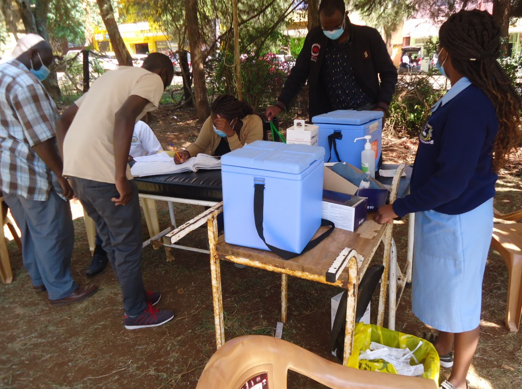
Nyeri County is hoping to attain a 100 per cent vaccination target with a planned countywide inoculation campaign against measles and typhoid for children aged nine months and 14 years.
The Department of Medical Services and Public Health has already released notification of the planned vaccination exercise that kicks off from July 5th to July 14th 2025 under the National Measles-Rubella and Typhoid Conjugate Vaccine Campaign.
The county hopes to inoculate a total of 66,509 children aged between nine and 59 months with measles-rubella jabs and another 213,509 children aged between nine months and 14 years with typhoid-conjugate vaccines.
Nationally, the 10-day campaign is targeting approximately 3.9 million children across all 47 counties, after which both vaccines will be incorporated into Kenya’s routine immunization schedule.
“We are targeting a 100 per cent success rate in our vaccination campaign but the number could be low due to the small number of staff we have on the ground and a slim budget for the same. But we are trying hard to make it just like during the Covid-19vaccination campaign when we ranked first in the country.” Says Joyce Maina, County Expanded Program on Immunization Logistician.
She has also underscored the need for parents to avail their children for the exercise, terming it a critical undertaking in curbing mortality rates among growing children.
Maina told KNA the Department for Medical Services is employing the help of Community Health Promoters (CHPs) to sensitize the public about the upcoming event through door-to-door campaigns.
The medic says the county government is also working closely with grassroots government administrators such as chiefs and their assistants together with religious leaders in creating publicity over the program.
“Measles vaccination is a World Health Organization recommendation done after every five years. We do a measles vaccination campaign because when children are immunized, not every child picks up immunity.
In 100 children, only 85 pick immunity and so there are that 15 per cent that don’t pick immunity.
So, after five years there’s always an accumulation of numbers and that’s where we get an outbreak of measles.
Therefore, there is a recommendation that every five years we do a catch-up to be able to vaccinate those who didn’t pick immunity and now that we can’t know the child who picked immunity and those who didn’t, the only way is to vaccinate everyone. We call these zero conversions’,” she explained.
The need to do a routine vaccination campaign against the diseases is also derived from the fact that majority of the children born during the Covid-19 pandemic period defaulted on their vaccination schedule due to the lockdowns.
On the other hand, the need to undertake vaccinating against typhoid has been arrived at following an emerging trend of drug-resistant strains of the disease.
Maina says part of the problem has been linked with frequent use of antibiotics to treat other diseases leading to weakening of the body’s immune system and in the process lowering its ability to ward off bacterial infections.
The challenge has also been linked to poor sanitary conditions, especially among children living in informal settlements due to lack of quality sanitation facilities such as toilets and clean running water for drinking.
“Typhoid has been seen to be rampant in affecting children under five years and it’s a very fatal disease. Due to its antimicrobial resistance, there has come a time when even curing it is almost impossible because of resistance to antibiotics; hence, the only way to handle it is through vaccination so that we can protect our children.
By the time they reach the age of 15 years, they may have gotten typhoid and what we call natural immunity, but children under 14 years who may not have been affected by the disease need to be protected, especially those under five years of age because their immunity is low,” she pointed out.
By Samuel Maina