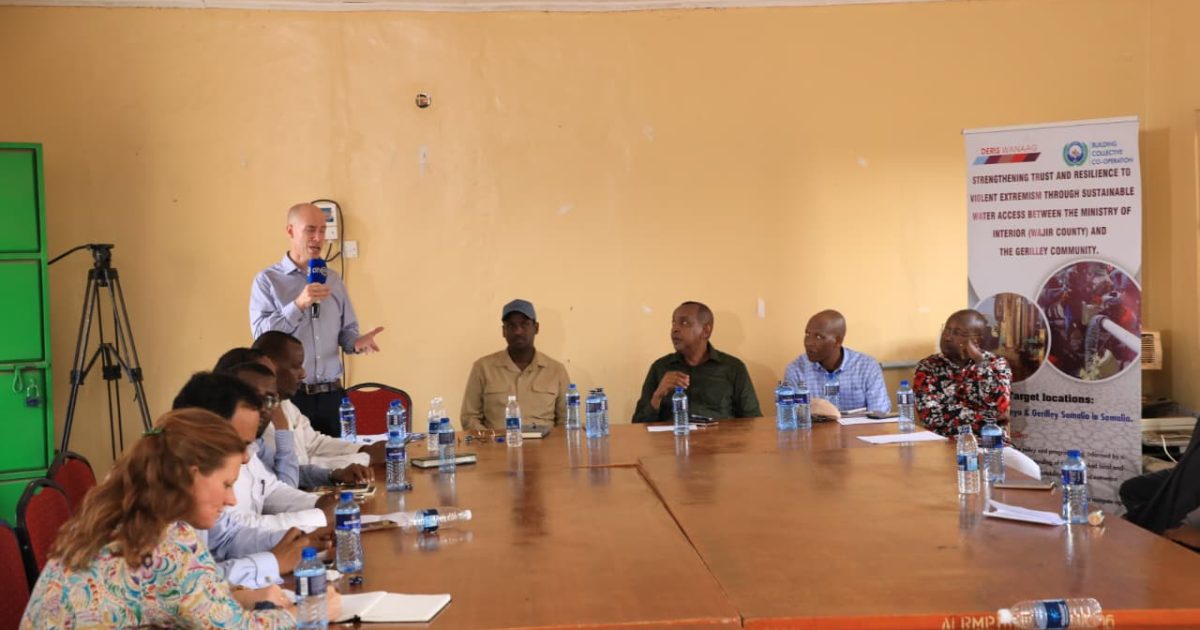
The United Kingdom, in collaboration with Ministry of Interior and National Administration, has unveiled the Geriley Community Borehole in Wajir County, marking the final intervention under the UK-funded Deris Wanaag regional peace and security programme.
The borehole, identified by local residents, aims to address the effects of climate shocks that have contributed to recurring drought, water shortages and insecurity in the Kenya–Somalia–Ethiopia borderlands.
Speaking during the launch, Deris Wanaag Project Team lead Mr Ibrahim Hussein Somo said the intervention reflected community-driven solutions to local challenges.
“This borehole is an example of how flexible and agile donor programming approaches can meaningfully address community and government priorities. Deris Wanaag was not initially designed to deliver a borehole initiative, but the programme was able to respond to genuine needs on the ground and deliver for the people,” said Somo.
He added that as the project phase concludes, the team is proud of the partnerships built, resilience strengthened and progress made in supporting vulnerable groups and promoting peace across the borderlands.
Mr Ben Fisher, Head of the UK’s Integrated Security Fund and Senior Regional Conflict Advisor at the British High Commission Nairobi, said the UK remains committed to working with the Ministry of Interior, local leadership and communities to enhance stability in the region.
“This borehole is a practical example of how collaboration can help communities cope with climate pressures, the influence of violent groups like al-Shabaab, and the risk of conflicts over limited resources,” he said.
Fisher noted that creating a stable and secure environment requires continued investment in security, development, service delivery, education, water, health and economic support to reduce the risk of radicalization and recruitment by extremist groups.
The Wajir County Government supported the technical assessment, hydrological survey and installation of a power generator for the borehole to ensure sustainability and strengthen collaboration between local authorities and communities.
According to project officials, the Geriley borehole will benefit approximately 3,500 households and 20,000 livestock by providing reliable, clean and safe water.
The intervention is expected to reduce reliance on unsafe cross-border water sources, ease pressure on women and pastoralists, and mitigate resource-based tensions.
With UK funding of Sh2.5 billion, the Deris Wanaag programme blended security, development and peacebuilding approaches.
The initiative incorporated conflict resolution, community dialogue, early warning systems and rapid response mechanisms alongside targeted interventions identified by the Ministry of Interior.
Local leaders and residents welcomed the project, saying improved access to water will ease daily hardships, support pastoralist livelihoods and reduce tensions during drought periods.
By Hamdi Buthul