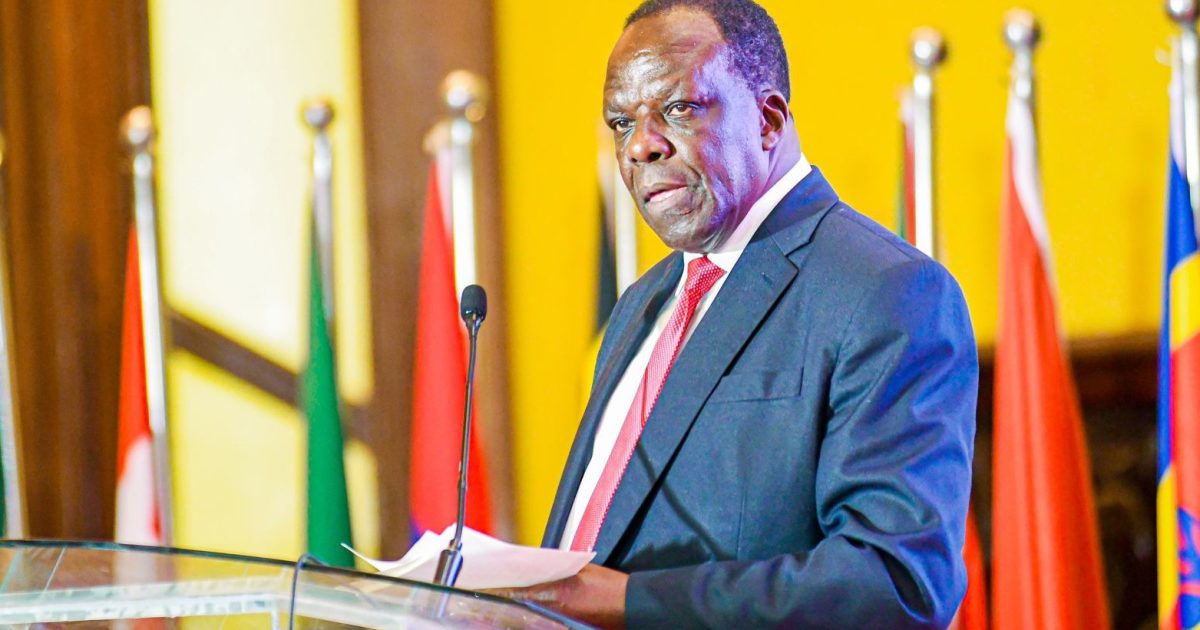
The Cabinet Secretary (CS), Cooperatives and Micro Small and Medium Enterprises (MSMEs), Dr. Wycliffe Oparanya, has called for the formulation and implementation of supportive polies and regulatory frameworks that foster cooperative growth.
Speaking when he presided over the 14th Africa Ministerial Cooperative Conference (AMCCO) in Nairobi, the CS said it was the government’s responsibility to invest in education, capacity building, research and international cooperation, not only to fortify their own cooperative systems, but also to learn from one another how cooperatives drive sustainability, empower communities, and support local initiatives.
Governments should emphasize the importance of cooperatives in promoting sustainable development by fostering visionary leadership, facilitating cooperation among cooperatives, and enhancing institutional strength through organizational development.
“Cooperative business model offers one of the most powerful pathways to building a resilient, inclusive, and prosperous Africa. However, our partnerships must evolve into strategic, outcome-driven collaborations and must prioritize integration of rural and underserved communities into the wider economy, transforming the lives of the ordinary citizens and tackling structural inequalities,” he said.
Dr. Oparanya highlighted projections from the African Development Bank, indicating a positive growth trajectory for the continent. Specifically, growth is expected to increase from 3.4 percent in 2024 to 3.7 percent in 2025, ultimately reaching 4.0 percent in 2026.
Thus, this upward trend is attributed to recoveries in significant economies across Africa and the potential for enhanced regional integration facilitated by the African Continental Free Trade Area.
“The AfCFTA, when fully operational, will be a game-changer and the largest free trade area in the world by membership, offering a unified market that unlocks opportunities in trade, integration, and financial harmonization,” he added.
Additionally, Kenya’s Savings and Credit Cooperatives, have surpassed the one trillion-shilling mark in total assets, firmly positioning themselves as the cornerstone of the country’s financial ecosystem, providing direct employment to over 300,000 people, and contributing approximately 43 percent of Kenya’s GDP.
The CS commended the International Cooperative Alliance–Africa and the Pan African Parliament for their work on the Cooperative Model Law for Africa, saying that this law will serve as a vital reference point for countries seeking to enact new legislation or to improve existing frameworks, harmonizing cooperative practice across the continent and embedding best practices that respond to today’s realities.
“I urge us all to move boldly from commitment to action. Let us build stronger partnerships, starting from the communities where we come from, regional, and global spheres to unleash the full potential of the cooperative movement,” Dr. Oparanya said.
The CS, who also took over the mantle of being the Chair of the AMCCO for the next three years, said that the progress that has been made by AMCCO in advancing regulatory reforms, notably the championing of the formulation of the Africa cooperative model law, cannot be overemphasized.
Dr. Oparanya thanked the outgoing Chair, Major General Eng. Waleed Farouk Saeed Elbarody, representing Egypt, for his leadership and pledged to work closely with all to operationalize the model and also be fully committed to elevating the cooperative movement to the next level.
“I want to encourage more African countries to adopt and dominate this framework. The role of leadership is never one to be taken lightly. It is a responsibility that demands vision, empathy, and unswerving dedication,” he said, adding that he is ready to elevate the cooperative movement to the next level, ensuring that it remains a center of inclusive growth across Africa.
Together, the CS added that we can make cooperatives the cornerstone of Africa’s transformation, not only in overcoming poverty and inequality, but also in unlocking innovation, sustainability, and shared prosperity.
Major General Eng. Waleed Farouk Saeed Elbarody, representing Egypt, said that during his tenure from 2022 to 2025, the Cairo declaration was signed with ministers agreeing to devote future effort of the cooperative movement to achieve sustainable economic development of the African continent.
Jeroen Douglas, Director General of the International Cooperative Alliance (ICA), said the cooperative movement is by far the best skilled alternative to the raw capitalism we are living.
He added that the alliance has a new strategy for 2026-2030 that focuses on the growth of the cooperative movement because their slogan, ‘practice, promote, and protect,’ is trying to make the cooperative movement future-proof.
“It starts with Alpha and ends with Omega. Alpha is that everything we do is a function of our cooperative identity, the values and the principles, and our omega is clear: we want to ensure the cooperative movement will gradually occupy space in the global economy,” he noted.
This year’s 14th Africa Ministerial Cooperative Conference (AMCCO) is running under the theme; ‘From Commitment to Action: Leveraging Global, Regional, and Local Partnerships for Sustainable Cooperative Development in Africa.”
by Wangari Ndirangu