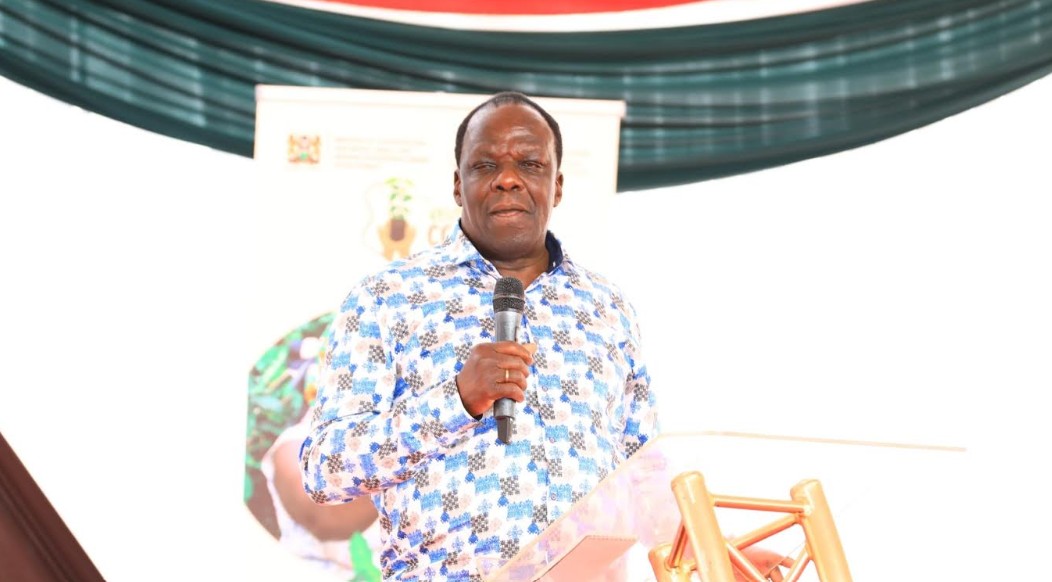
The Cabinet Secretary for Cooperatives and Micro, Small and Medium Enterprises (MSMEs) Development, Wycliffe Oparanya, has said that the revival of the coffee sector in the country could be accelerated if more counties ventured into its farming.
Oparanya, who met with coffee farmers from Ndimaru Sub-County, Kuria, said that 34 counties have already ventured into coffee production, with the latest being Nyandarua.
“We want to introduce the cash crop to more counties with the potential of growing coffee to boost the coffee production in the country,” he said.
Currently, the production of coffee in Kenya stands at about 50,000 metric tonnes as compared to 200,000 metric tonnes before the 1980s, a huge drop that resulted in an urgent need to revive the sector, he noted.
The CS disclosed that the revival of the coffee sector would aim to ensure the country produces at least 150,000 metric tonnes of coffee before 2029.
Migori County is currently producing about 1.8 million kilogrammes of coffee annually, but with the revival of the coffee sector, the country could see its potential rise to five million kilogrammes.
He said that the New Kenya Planters Co-operative Union (NKPCU) was introducing some measures that include proper management of cooperatives, the Cherry Fund and the introduction of term limits for officials serving in cooperatives.
Coffee Cherry Advance Revolving Fund (CCARF) was established to provide affordable, sustainable and accessible cherry advances to smallholder coffee farmers whose land under coffee does not exceed 20 acres.
The government had set aside Sh9 billion for the Cherry Fund, with more than Sh6 billion already borrowed and utilised by coffee farmers, a significant milestone in addressing the exploitation of middlemen and coffee cartels.
Other proposals included a better organisation structure of the value chain, properly formulated market links, and employment of extension officers, as well as the formulation of policies and bills to guide the Coffee sector.
If passed in Parliament, the proposed Coffee and Cooperatives bills 2024 will help improve the sector.
Oparanya said that special focus should be placed on empowering cooperatives that have 80 per cent small-scale coffee farmers in the county, which contributes to more than half of the coffee production in the country.
He said the government, through the NKPCU, would soon employ 1,600 extension officers in 34 growing coffee counties to provide the necessary skills, knowledge and support to coffee farmers to boost the coffee production in the county.

Other proposals by NKPCU include sending money directly to farmers instead of the traditional channels of cooperatives to reduce mismanagement of the hard-earned cash of coffee farmers.
The CS disclosed that the revival aims to enable the country to regain the lost glory of the 1980s, when it used to be the largest exporter of coffee in Africa.
Currently, Uganda, a member of the East African Community (EAC), is the biggest exporter of coffee in Africa, generating 400,000 metric tonnes annually.
He, however, encouraged the county governments to continue partnering with the national government to realise a transformation in the revival of the coffee sector in the country.
“Agriculture is a fully devolved function of the county, and our work as the national government is to formulate policies that will assist in a faster revival of the sector to empower our farmers economically,” said Oparanya.
Oparanya also encouraged cooperatives in the country to embrace the idea of establishing a nursery to produce enough coffee seeds for distribution to new farmers.
Migori Governor Ochilo Ayacko said that they would continue to partner with parties like the Food and Agriculture Organisation (FAO) to generate funds to help streamline the coffee sector in the county.
He noted that the county, in partnership with the national government, would help to address some of the challenges affecting the productivity of the 11 coffee cooperatives in the county.
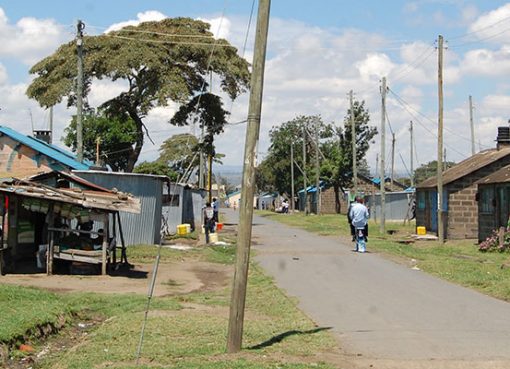
The Kuria region is the biggest coffee-producing area, boasting eight cooperatives and contributing to three-quarters of all the coffee production that currently stands at 1.8 million kilogrammes annually.
He disclosed that in the coming supplementary budget, Sh5 million would be set aside for the revival of the coffee sector to increase the county’s productivity from 1.8 to 5 million kilogrammes annually.
Ochilo, however, urged the national government to address the insecurity issue along the borders of Ndimaru and Transmara in Narok County to boost the morale of residents to venture more into agriculture.
“The land clashes along the Kuria-Transmara borders, if they remain unresolved, will not have any agricultural productivity because residents will fear losing their property and lives,” said Ochilo.
By Makokha Khaoya